
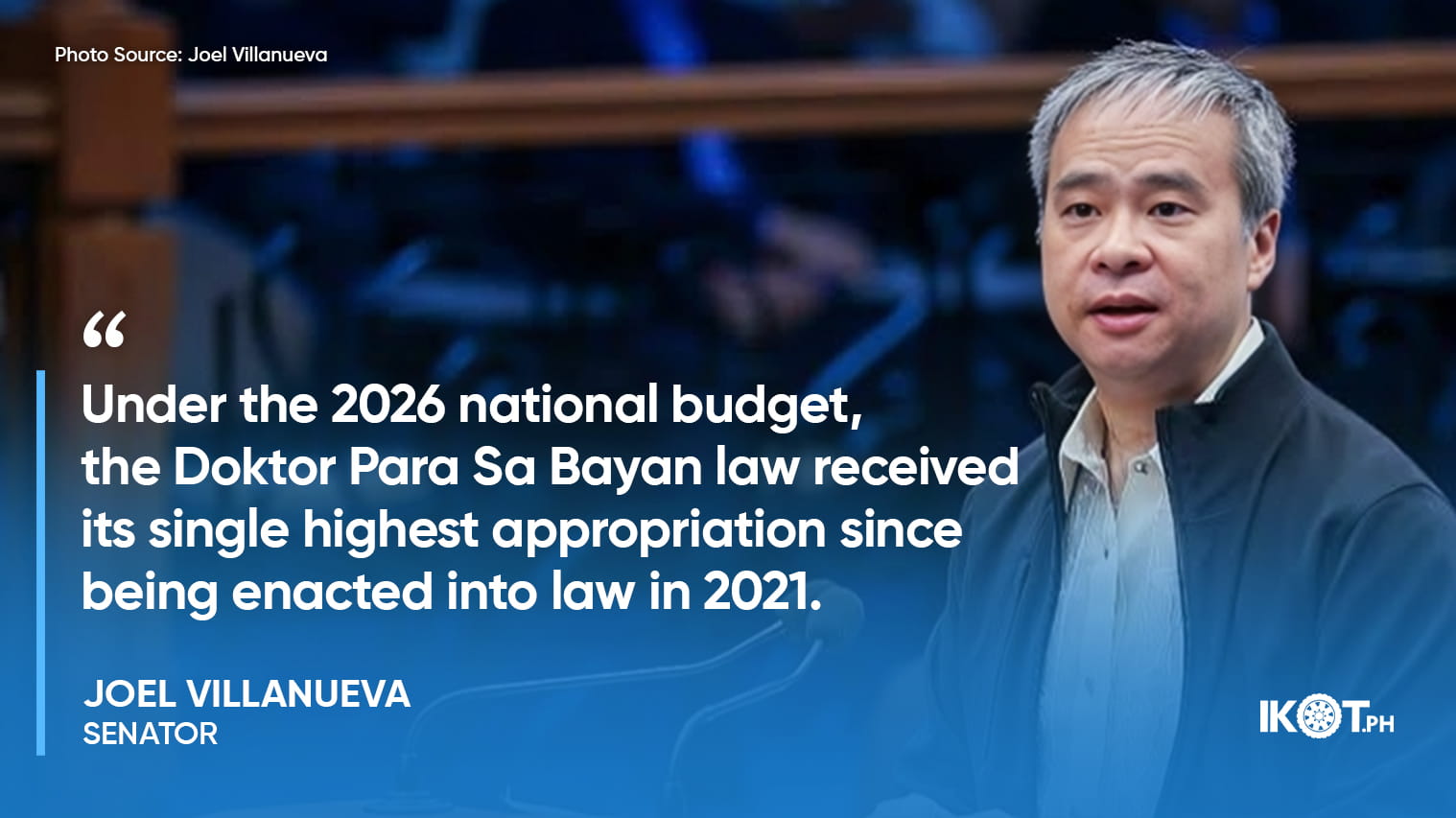
Senator Joel Villanueva said he looks forward to the implementation of the Doktor Para Sa Bayan law after the program received P1.095 billion in funding under the 2026 General Appropriations Act.
“We’re very grateful to President Bongbong Marcos for supporting our Doktor Para Sa Bayan law by ensuring there is sufficient funding to support the program,” said Villanueva, principal sponsor and author of Republic Act No. 11509.
“The 2026 budget of the Doktor Para Sa Bayan law matched the total appropriations for the program in the past five years.”
“Under the 2026 national budget, the Doktor Para Sa Bayan law received its single highest appropriation since being enacted into law in 2021,” the veteran legislator noted. “In fact, the 2026 budget of the Doktor Para Sa Bayan law matched the total appropriations for the program in the past five years.”
From 2021 to 2025, the Doktor Para Sa Bayan law received P1.075 billion, which the Commission on Higher Education (CHED) used to finance the medical scholarships and return service program (MSRSP) and establish medical schools at state universities and colleges across the country, the seasoned lawmaker explained.
The senator appealed to the CHED leadership to facilitate and expedite the establishment of more medical schools in state universities and colleges to encourage more students to pursue a career in medicine.
“We are prepared to extend any assistance that the CHED may need. We look forward to receiving periodic updates from the commission regarding the implementation of the program this year especially in light of the huge funding,” he said. “We want to ensure that the CHED will make good on their commitments so that the funds are spent appropriately and the goals of the program are achieved.”
“The Doktor Para sa Bayan law sought to have at least one public school within a region offering a medicine course where scholars can study to become doctors.”
The Doktor Para sa Bayan law sought to have at least one public school within a region offering a medicine course where scholars can study to become doctors, Villanueva said. After passing the boards, MSRSP scholars are expected to do their return service within the public health system equivalent to how long they were scholars under the program.
The Doktor Para sa Bayan Act aims to produce more physicians by offering free tuition, book, living and other allowances to qualified beneficiaries.
The law requires scholars to serve in public health facilities for at least one year for every scholarship year enjoyed.