
As consumers brace for water rate hikes this 2026, House Deputy Majority Leader Luigi Villafuerte and Camarines Sur Rep. Migz Villafuerte are calling on senators to clear a House-passed approach to integrated resource management to ensure easy, universal access to safe and affordable water for Filipinos in the long haul.
House Bill (HB) No. 6789, or the proposed National Water Resources Management Act, is anchored on the establishment of a Department of Water Resources (DWR), and seeks to future-proof water systems in our climate-vulnerable country against the increasingly disastrous impact of planet heating.
One of the 44 Common Legislative Agenda (CLA) bills that President Marcos and leaders of the 20th Congress identified for priority action in 2025, this bill creating the DWR was approved by a 264-7 vote during the last session week before lawmakers from both chambers took their yearend break from Dec. 30, 2025 to Jan. 25, 2026.
HB 6789 is one of the 12 LEDAC bills, which, according to Majority Leader Ferdinand Alexander Marcos, had been cleared thus far under the 20th Congress.
The Villafuertes plus Camarines Sur Rep. Tsuyoshi Anthony Horibata and Bicol Saro Rep. Terry Ridon, had authored HB 1557, which was one of several measures consolidated into the House-approved HB 6789.
“Water is a limited yet essential resource that not only sustains life but also drives economic development and helps maintain ecological balance.”
Luigi Villafuerte and Migz Villafuerte, along with Horibata and Ridon, had also co-authored another seven (7) of the 12 LEDAC priority bills already passed by the House on third and final reading since last year.
Alongside establishing a DWR to take charge of comprehensive resource management, the bill believes the government can best oversee the sustainable development, responsible use, conservation and protection of our water resources by also creating the Water Regulatory Commission (WRC) as an independent, quasi-judicial body to license and regulate all water service providers, including sewerage and septage services, said Luigi and Migz Villafuerte.
Moreover, said the Villafuertes, the bill establishes a Water Trust Fund (WTF) under the Bureau of the Treasury (BTr) to finance water development, sanitation, wastewater management and sustainability programs.
“We are appealing to our senators to consider passing this 2026 their version of an integrated legal framework for the sustainable development, responsible use, conservation, and protection of our country’s water resources,” Luigi Villafuerte said.
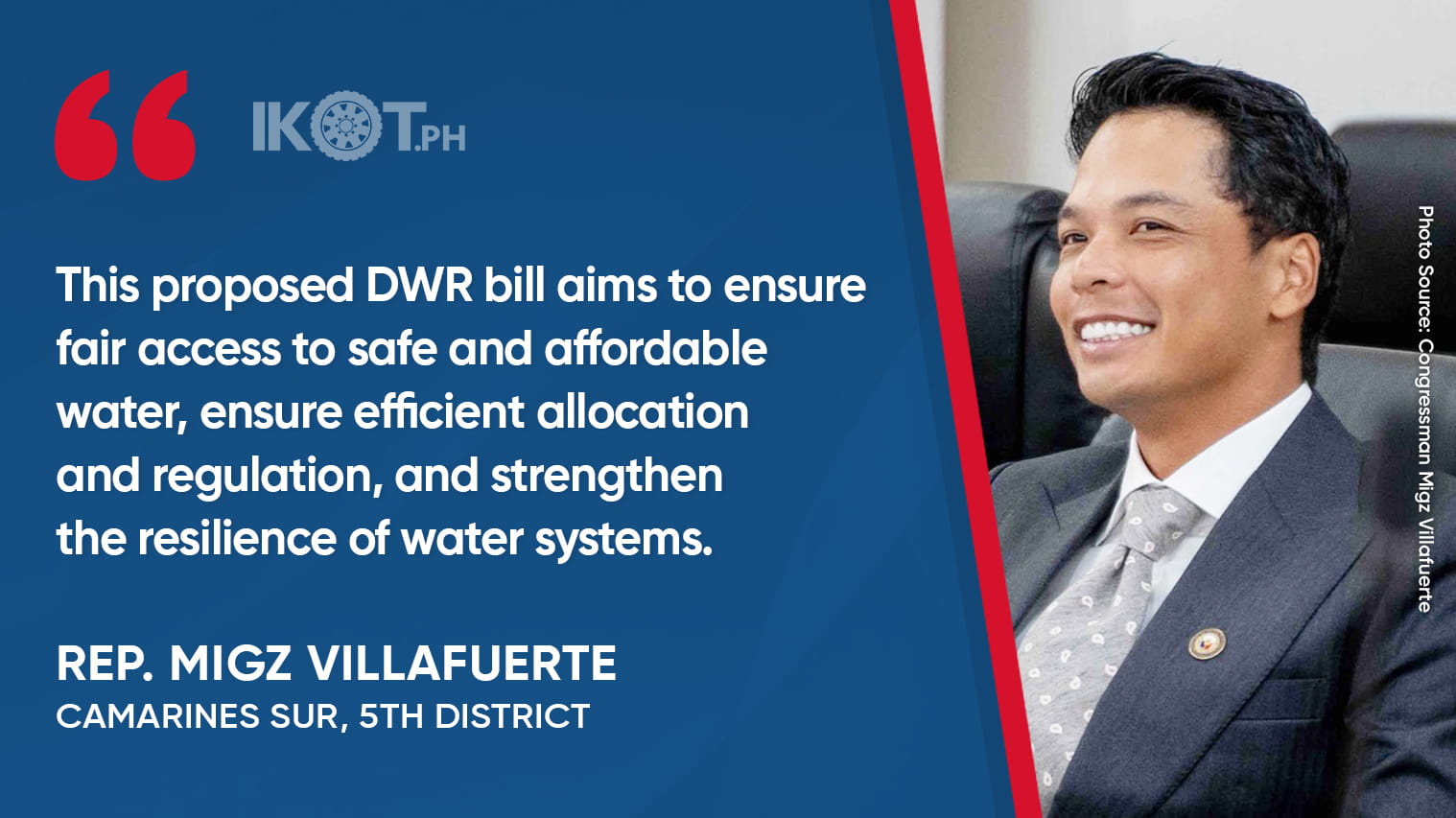
“This proposed DWR bill aims to ensure fair access to safe and affordable water, ensure efficient allocation and regulation, and strengthen the resilience of water systems against climate risks and natural disasters,” said Migz Villafuerte, who chairs the House committee on information and communications technology (ICT).
The Villafuertes said that enactment of the DWR bill into law will promote genuine and transparent involvement from the private sector, while focusing on infrastructure and public works that embrace climate-resilient and innovative designs and technologies, and globally recognized best practices.
A similar bill creating the DWR was filed in the House of Representatives by lawmakers that included Migz Villafuerte and then-Rep. and now Camarines Sur Gov. LRay Villafuerte, and a consolidated measure on this topic was approved on third and final reading by the House of Representatives in the 19th Congress.
However, this House-passed bill failed to become a law because the Senate was not able to pass a counterpart measure.
Migz said that, “Water is a limited yet essential resource that not only sustains life but also drives economic development and helps maintain ecological balance. Unfortunately, water is often taken for granted, and the Philippines is facing significant challenges in managing, distributing and safeguarding its water resources. “
Luigi Villafuerte traced these challenges to “rapid population growth, uncontrolled urbanization, environmental degradation, and the worsening effects of climate change.”
The deputy majority leader noted that the ASEAN Integrated Water Resource Management (IWRM) has identified fragmentation of institutional responsibilities, lack of science-based data and information for effective planning and decision-making, and inadequate water infrastructure facilities as key challenges exacerbating water management issues in the Philippines.
“Ultimately, many of the country’s current water-related laws and frameworks are outdated and fail to address today’s current realities,” he said. “Rural and low-income communities often bear the brunt. With over 113 million people, a large number of Filipinos still struggle to access safe and dependable water.”
Under the bill, key agencies shall be attached to the DWR, including the Metropolitan Waterworks and Sewerage System (MWSS), National Irrigation Administration (NIA), Laguna Lake Development Authority (LLDA), National Water Resources Board (NWRB) and Local Water Utilities Administration (LWUA), plus several water-related units now under the Departments of Environment and Natural Resources (DENR) and of the Interior and Local Government (DILG).
The enactment of the DWR bill into law will promote genuine and transparent involvement from the private sector, while focusing on infrastructure and public works that embrace climate-resilient and innovative designs and technologies, and globally recognized best practices.
The Villafuertes said that the establishment of a DWR and WTF are essential at this time as water consumers, including those in Metro Manila, are facing higher water bills this 2026 following last months move by the MWSS Regulatory Office (MWSS-RO) to authorize rate adjustments by the Maynilad Water Services Inc. (MWSI) and Manila Water Co. Inc. (MWC).
Such rate adjustments took effect last Jan. 1, 2026, and will apply to water bills this first quarter.
The rate hikes approved by the MWSS-RO will raise monthly bills by P5.06 for MWSI customers consuming up to 10 cubic meters (cu. m.), and by a higher P29.86 for MWC customers consuming the same monthly water volume.
For customers with higher consumption levels, the adjustments will amount to a P19.06 increase for MWSI customers using 20 cu. m., and a higher P66.25 for MWC customers consuming the same water volume per month.
Citing data from the United Nations Children’ Fund (UNICEF,) the Villafuertes said that over half of all households (approximately 53%) do not have access to a safely managed water supply, while 39% lack basic sanitation services.
The situation is even more alarming, they said, in schools, where 55% have no access to safely managed water and 26% operate without safe sanitation facilities.
“These numbers highlight just how crucial it is to implement thorough and well-coordinated reforms in the water sector, and to adopt innovative solutions and international best practices to address the challenges of climate change,” said the Villafuertes, both of whom had served as Camarines Sur governor prior to their election to the House.
The proposed DWR shall be the primary national agency to enforce Presidential Decree (PD) No. 1067, which revised and consolidated the laws covering the ownership, appropriation, utilization, development, conservation and protection of our country’s water resources.
PD 1067 is “The Water Code of the Philippines” that was issued by then-President Ferdinand Marcos Sr. in 1976.
This would-be DWR shall serve as the national policy coordination office for local government units (LGUs) and non-governmental organizations (NGOs) in the development and sustainability of all river and catchment basins, for which the Department shall recommend the approval and funding of national government agency and corporations’ support for such local and non-government river and catchment basin initiatives.
The WRC shall be an independent, quasi-judicial regulatory body tasked with issuing and promulgating rules, regulations and guidelines covering water service providers and sanitation service providers, including the grant and revocation of licenses to these firms.
It shall establish tariffs, rates and other charges that are fair and reasonable, and ensures the economic viability and a fair return on investments of service providers.
This bill further creates the WTF, to be sourced from raw water pricing, permit fees, registration fees, supervision and regulation enforcement fees, filing fees, testing fees, payments for ecosystem services, and other service income from the use of water resources.
The annual levies and reasonable fees and surcharges as may be necessary for achieving the purposes, powers and function of the WRC shall also be remitted to the Trust Fund.
Proceeds from this Trust Fund shall be utilized for water development, water sanitation and waste water treatment and management, and water sustainability programs and projects authorized under this Act.