
The House Committee on Legislative Franchises is set to conduct a motu proprio inquiry in aid of legislation into issues surrounding the legislative franchise of Solar Para sa Bayan Corporation, following concerns raised over compliance and the protection of the consuming public.
Earlier during the Committee on Legislative Franchises proceedings, Cong. Presley C. De Jesus, Representative of PhilRECA Party-List, moved for this investigation, citing recent reports involving the legislative franchise grantee, including the alleged sale or transfer of a controlling interest without prior congressional approval, questions on compliance with franchise conditions, and public disclosures that the company allegedly has been non-operational since 2022 due to regulatory delays.
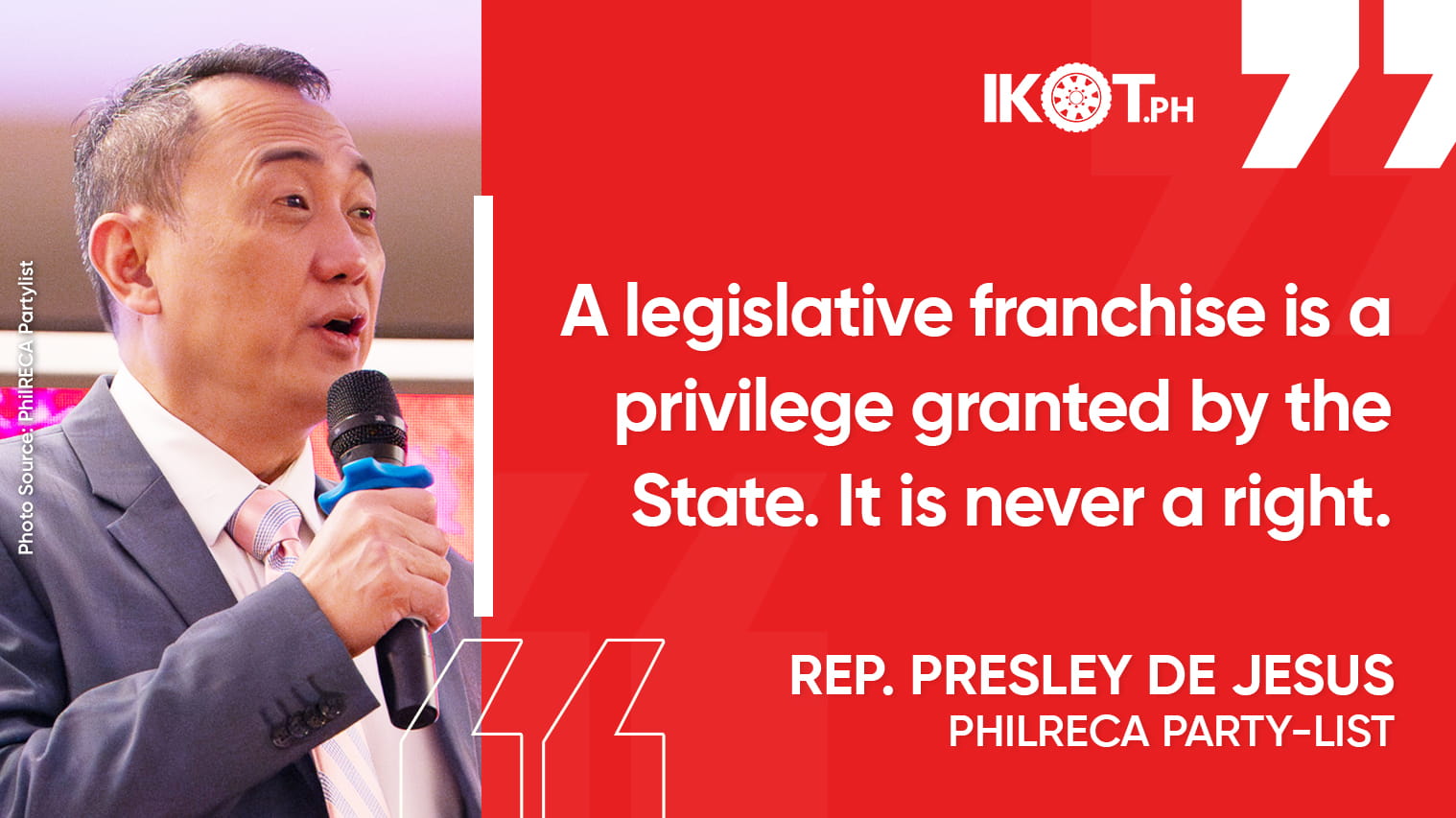
“A legislative franchise is a privilege granted by the State. It is never a right. Congress has the obligation to continuously examine whether that privilege is being exercised in a manner consistent with law and with the welfare of the people,” Cong. De Jesus said.
The two representatives stressed that a nationwide franchise covering virtually the entire archipelago is overly broad, difficult to regulate, and fundamentally inconsistent with the localized nature of electric distribution.
He added that the proceedings would allow the Committee to assess whether existing franchise provisions remain adequate and to identify possible policy reforms necessary to ensure that franchise holders fulfill their obligations to consumers and the public.
Cong. De Jesus also moved for the conduct of the referendum among the members of the Committee to secure the majority vote necessary for the motu proprio inquiry. He expressed confidence that the members are one with the Committee’s duty to uphold transparency and the primacy of public interest in the grant and regulation of legislative franchises.
Following the approval of this motion, Cong. Sergio C. Dagooc, Representative of APEC Party-List, formally requested the Energy Regulatory Commission (ERC) to look into previous issues involving Solar Para sa Bayan in areas where it reportedly operated.
“There are unresolved issues that raise fundamental questions on regulatory compliance, consumer protection, and respect for the franchise rights and property of electric cooperatives.
These matters warrant closer scrutiny by both regulators and Congress,” Cong. Dagooc said.
“Electric distribution is not a one-size-fits-all undertaking.”
Cong. Dagooc’s request sought regulatory clarification and enforcement on serious concerns raised by affected stakeholders, including the operation of renewable energy facilities without permits, absence of an approved tariff from the ERC, issuance of official receipts allegedly not registered with the BIR, and the use of distribution assets owned by the Occidental Mindoro Electric Cooperative (OMECO) without permission, notification, or approval.
Since deliberations on the Solar Para sa Bayan franchise began in 2018, the Power Bloc has consistently raised legal, economic, and sectoral objections to granting broad nationwide authority to a single private entity, warning that such an approach poses serious risks to the structure and stability of the electric power industry.
The two representatives stressed that a nationwide franchise covering virtually the entire archipelago is overly broad, difficult to regulate, and fundamentally inconsistent with the localized nature of electric distribution.
“Electric distribution is not a one-size-fits-all undertaking. Oversight, accountability, and consumer protection are strongest when service providers are locally anchored and directly answerable to the communities they serve,” the group said.
The representatives also clarified that the inquiry does not prejudge the outcome of the committee deliberations.
“We reserve any final position until the Committee has completed its hearings. This inquiry is precisely intended to surface the facts and allow all stakeholders to be heard before Congress reaches any determination,” the Power Bloc stressed.
The Power Bloc reiterated that the award of legislative franchises must be based strictly on an applicant’s qualifications, compliance record, and proven capacity to serve the public, and not on market influence or speculative promises.
Ultimately, the Power Bloc stands by their position that genuine electrification and affordable power, particularly in rural and missionary areas, can only be achieved by strengthening electric cooperatives, enforcing fair competition, and maintaining robust regulatory oversight.