
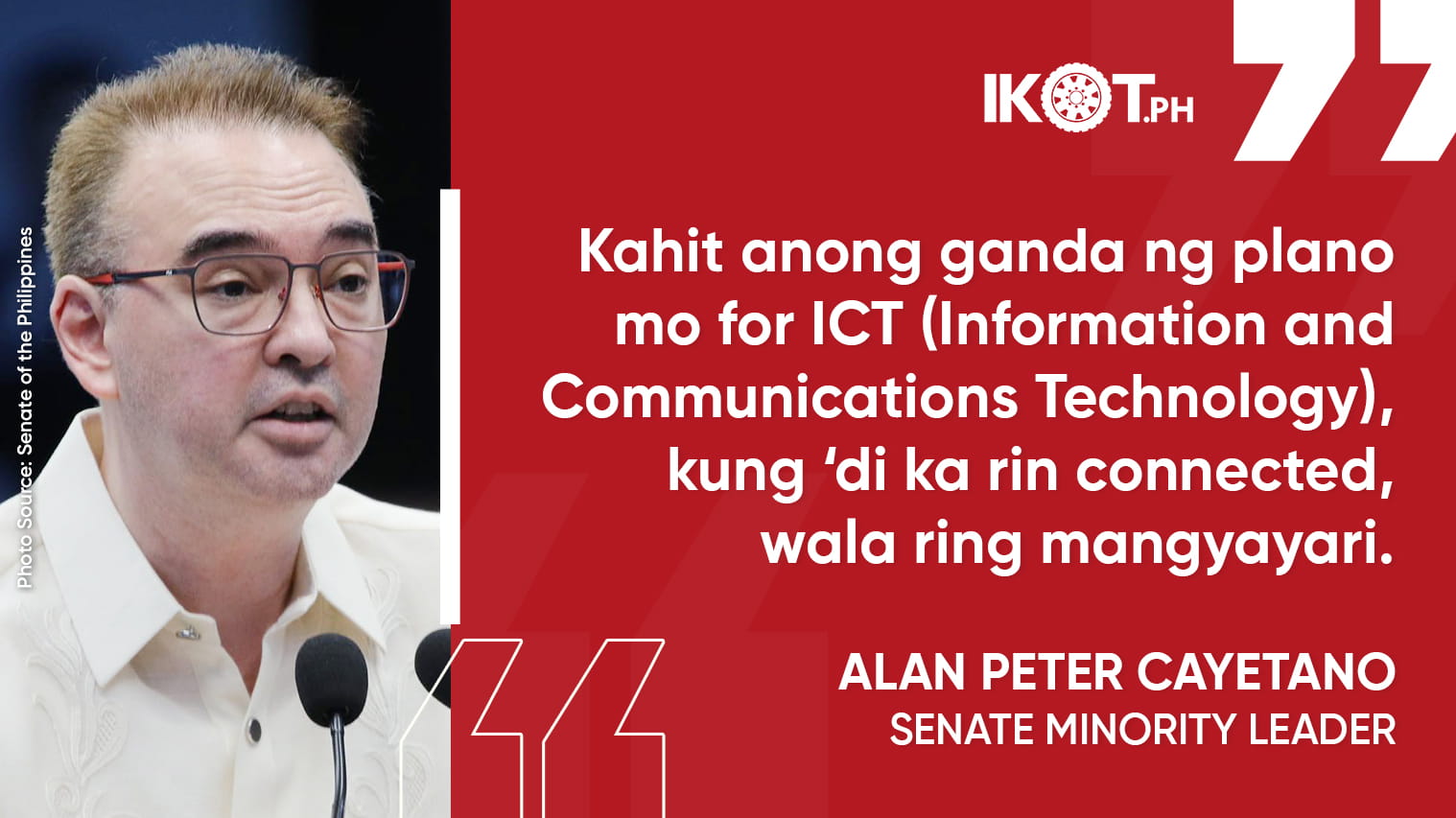
Senate Minority Leader Alan Peter Cayetano welcomed the approval of the country’s first nationwide digital connectivity master plan, saying it gives clearer direction to reforms under the Konektadong Pinoy Act which he authored.
President Ferdinand Marcos Jr. had approved the nationwide digital connectivity master plan recently, which lays out the government’s long-term strategy to expand reliable and secure internet access across the country, particularly in unserved and underserved areas.
This came five months after Cayetano’s Konektadong Pinoy Act lapsed into law in August 2025, which primarily aims to make it easier for service providers to enter the market, foster competition, and offer consumers more affordable and varied internet service options.
The veteran legislator had earlier said the Konektadong Pinoy Act was intended to modernize the country’s digital framework and expand access to internet services nationwide, noting that its full impact depends on the existence of a long-term connectivity plan.
“(This law) modernizes our digital infrastructure, ensuring that all Filipinos have access to, and the use of, affordable, quality, and up-to-date information and communication technologies.”
“(This law) modernizes our digital infrastructure, ensuring that all Filipinos have access to, and the use of, affordable, quality, and up-to-date information and communication technologies,” the seasoned lawmaker said.
“[Pero] kahit anong ganda ng plano mo for ICT (Information and Communications Technology), kung ‘di ka rin connected, wala ring mangyayari,” the senator added.
He said the country needs to develop modern technology to streamline government services, promote transparency, and improve service delivery.
“If all of these different laws work, we also hope to have free WiFi in the schools to help the students.”
“If all of these different laws work, we also hope to have free WiFi in the schools to help the students,” Cayetano added.
He said with the nationwide digital connectivity master plan now approved by the President, implementation would determine whether existing laws translate into improved internet access for public services and education.