The Union of Local Authorities of the Philippines (ULAP), in partnership with global biopharmaceutical company Takeda, strengthened local and community-level action against dengue through its one-year implementation of the Project E-CODE (Empowering Community Objectives for Dengue Education)—a collaborative initiative designed to build awareness, promote prevention, and reinforce the shared responsibility of government and communities in addressing vector-borne diseases.
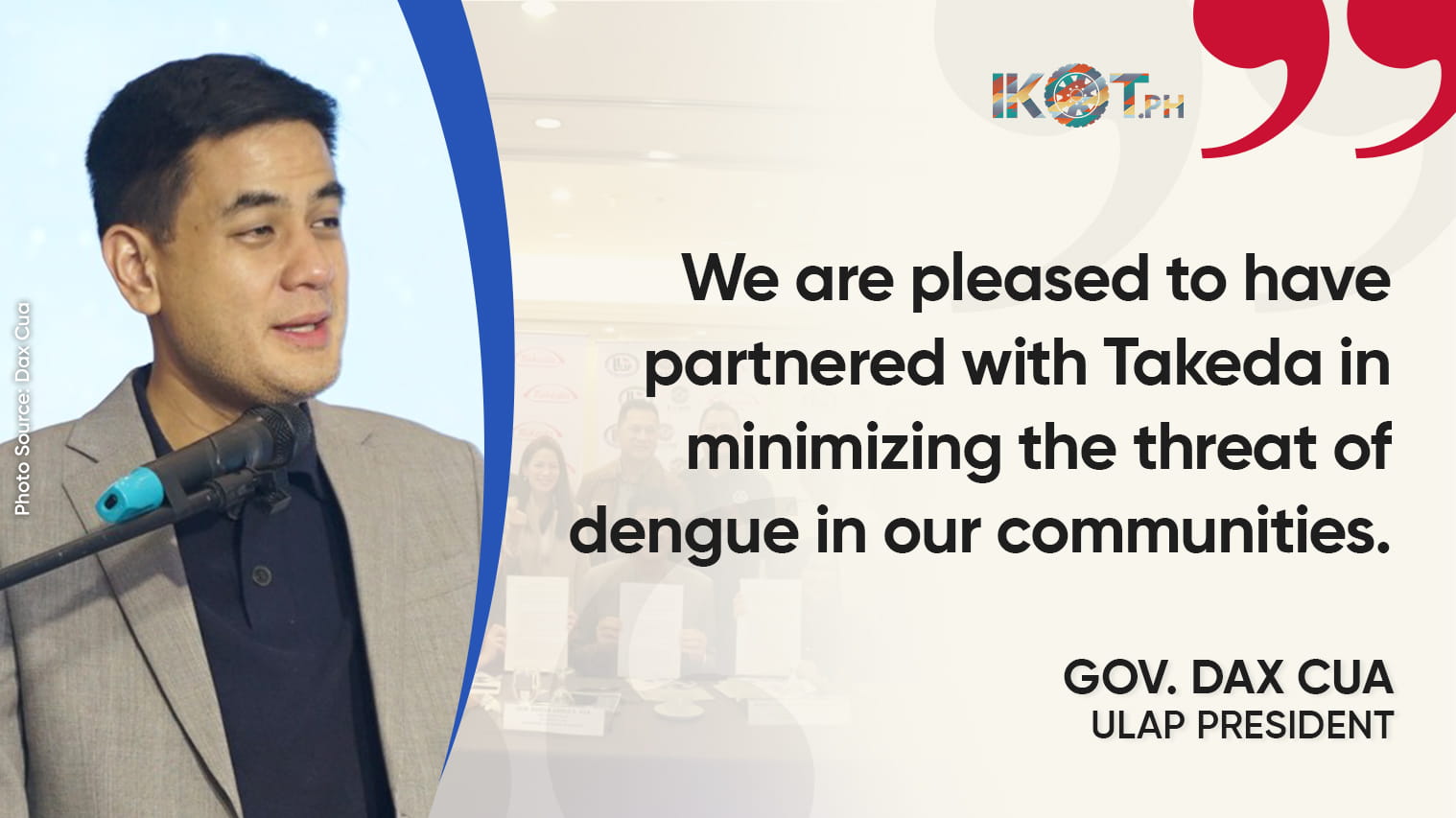
“We are pleased to have partnered with Takeda in minimizing the threat of dengue in our communities,” ULAP president and Quirino governor Dax Cua said.
Project E-CODE, which was implemented across various local government units (LGUs), has supported a range of activities aimed at translating policy commitments into concrete community action.
“Dengue prevention does not only rest upon the LGU. It requires the active engagement of the community in vector control, health promotion, and disease surveillance to ensure that preventive efforts are effective and sustained.”
Cua said that these include dengue awareness sessions in schools and barangays, capacity-building activities for barangay health workers and local officials, community clean-up and “search-and-destroy” operations to eliminate mosquito breeding sites, and the distribution of locally tailored information, education, and communication materials.
“Collectively, these efforts have reached thousands of residents and contributed to stronger local preparedness and vigilance against dengue,” said the governor.

He added that as a result of these interventions, participating LGUs have reported improved community participation in vector control activities, heightened public awareness on early detection and prevention, and more responsive local disease surveillance systems.
Cua also said that Project E-CODE has reinforced the role of barangays and households as frontline partners in dengue prevention, complementing LGU-led public health programs.
The governor also emphasized that sustained dengue prevention requires collective action.
“Our strong commitment—shared by ULAP and our member LGUs—is to prevent vector-borne diseases such as dengue by strengthening community engagement and participation,” he said.
“Dengue prevention does not only rest upon the LGU. It requires the active engagement of the community in vector control, health promotion, and disease surveillance to ensure that preventive efforts are effective and sustained,” he added.
Cua also reiterated the call of ULAP and its partners to the Philippine Food and Drug Administration to fast-track the review and approval of dengue vaccines currently in the pipeline to ensure that Filipinos have access to safe and effective, life-saving dengue vaccines as soon as possible.
“Expanding access to vaccination, alongside sustained vector control and community engagement, will significantly strengthen the country’s ability to protect children and vulnerable populations from dengue,” the governor said.