
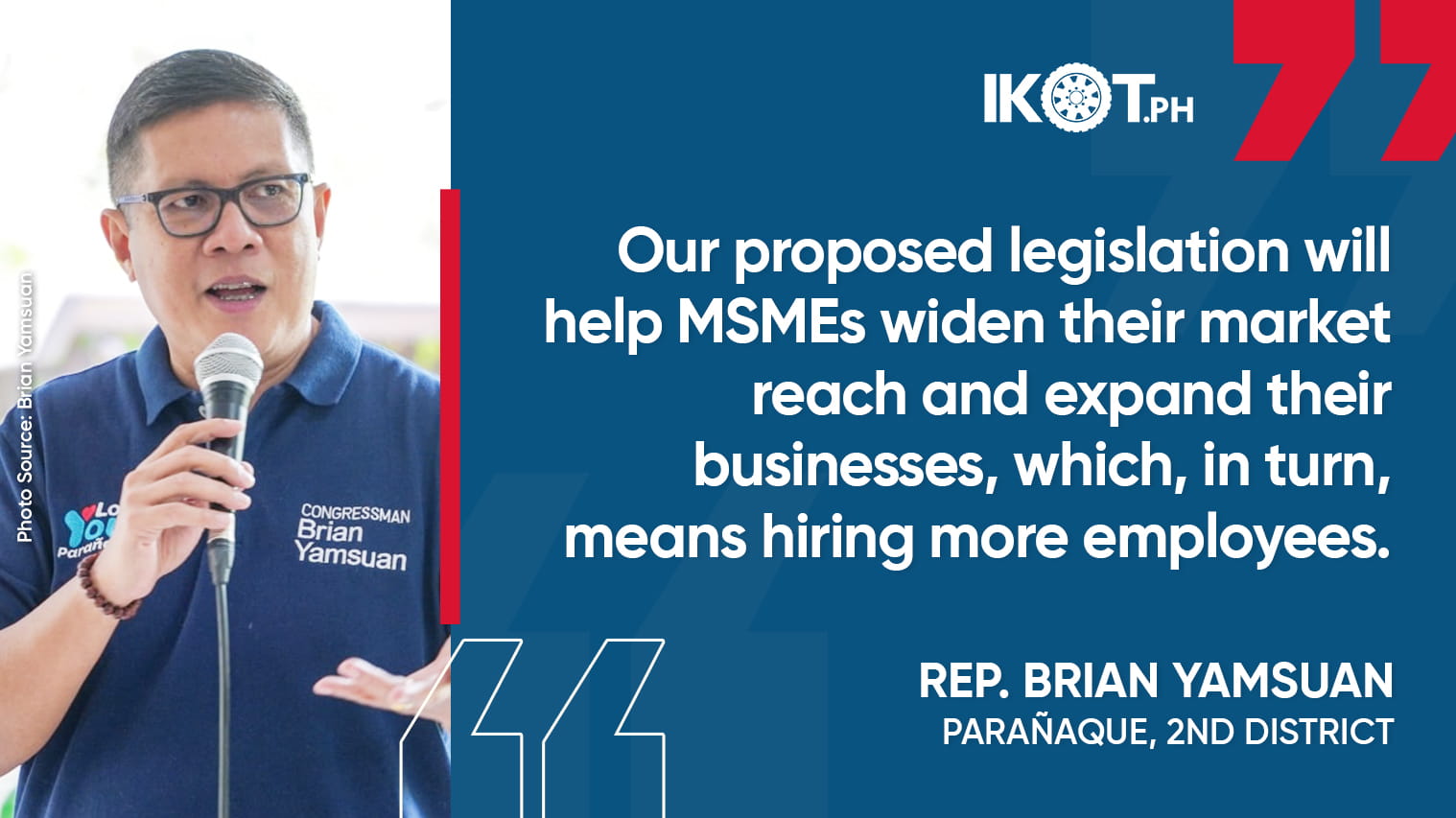
Parañaque 2nd District Representative Brian Raymund Yamsuan has urged Congress to swiftly pass a measure which aims to create more jobs and accelerate the growth of micro, small and medium enterprises (MSMEs) by expanding their access to domestic and global supply chains.
Yamsuan said that with MSMEs comprising 99.6 percent of business establishments and employing 67 percent of the country’s workforce, empowering them is the key to lowering the unemployment rate.
Through House Bill (HB) 6599, Yamsuan has proposed the establishment of a National Supplier Development Program to provide funding and technical support to MSMEs in serving as suppliers of goods and services to large domestic and global corporations.
“Our proposed legislation will help MSMEs widen their market reach and expand their businesses, which, in turn, means hiring more employees,” Yamsuan said.
Under HB 6599, a National Supplier Development Fund will also be created to enable MSMEs to acquire new machinery and technology, secure the necessary certifications and train their personnel in specialized skills.
The unemployment rate stood at 4.4 percent or equivalent to about 2.26 million jobless Filipinos in December 2025, according to last week’s report by the Philippine Statistics Authority (PSA).
The December results placed the Philippines’ average unemployment rate for 2025 at 4.2 percent, higher than the 3.8 percent average jobless rate in 2024.
“Maraming negosyo nagsisimula ng maliit. May mga nagsisimula sa pagbebenta ng home-cooked meals, nagtatayo ng maliit na panaderya o nagpo-provide ng iba’t ibang services. (Many businesses start small. Some start by selling home-cooked meals, setting up a small bakery or providing various kinds of services) Many of them have the potential to become big, but they remain confined within their communities and low-value segments of the economy. This is what we want to change,” Yamsuan said.
He pointed out that in his congressional district in Parañaque, the entrepreneurship programs he has been carrying out in coordination with the Departments of Social Welfare and Development (DSWD) and of Labor and Employment (DOLE) have seen the rise of individuals starting their own businesses, but who still face challenges in expanding their ventures.
Yamsuan has also filed bills seeking to institutionalize these livelihood initiatives, particularly the DSWD’s Sustainable Livelihood Program and the DOLE’s Integrated Livelihood (Kabuhayan) Program.
“It is unfortunate that the beneficiaries of these programs and other small business operators find themselves with limited market access. Given the proper skills, training, and technology, large firms can hire our MSMEs, instead of procuring imported inputs and relying on foreign suppliers,” Yamsuan said.
Under HB 6599, a National Supplier Development Fund will also be created to enable MSMEs to acquire new machinery and technology, secure the necessary certifications and train their personnel in specialized skills.
The bill provides for an initial P1 billion allocation for the Fund, which will be administered by the Department of Trade and Industry (DTI).
Operating on a co-financing basis, the Fund can be accessed by MSMEs endorsed by a corporation or “anchor firm” that has identified the former as a potential supplier. The Fund will help cover costs in modernizing the operations of MSMEs through new equipment and technology, training, quality control, production management; and securing quality, environmental and process certifications.
Yamsuan said that with MSMEs comprising 99.6 percent of business establishments and employing 67 percent of the country’s workforce, empowering them is the key to lowering the unemployment rate.
The bill provides for tax breaks equivalent to 150 percent of training and technology transfer costs to encourage large corporations to integrate MSMEs into their supply chain.
“A large anchor firm that successfully integrates a new local MSME into its direct supply chain for at least two consecutive years with verifiable evidence of technology or skills development, shall be entitled to an additional tax deduction equivalent to 150 percent of the total cost of training and technology transfer expenses provided to that MSME,” the bill states.
The DTI is tasked under the bill to develop, operate and maintain a national “Tatak Pinoy Suppliers” Digital Matchmaking Platform, which is a searchable database of pre-screened and pre-qualified MSMEs that corporations can tap as suppliers based on their specific needs and standards.
In 2023, there were more than one million MSME establishments in the country which contributed around 25 percent of total export revenue and 40 percent of the country’s Gross Domestic Product (GDP).
A survey by the Bangko Sentral ng Pilipinas (BSP) found that key challenges faced by MSMEs include access to finance, securing permits and licenses, cost of utilities and labor, talent retention, and market access.