
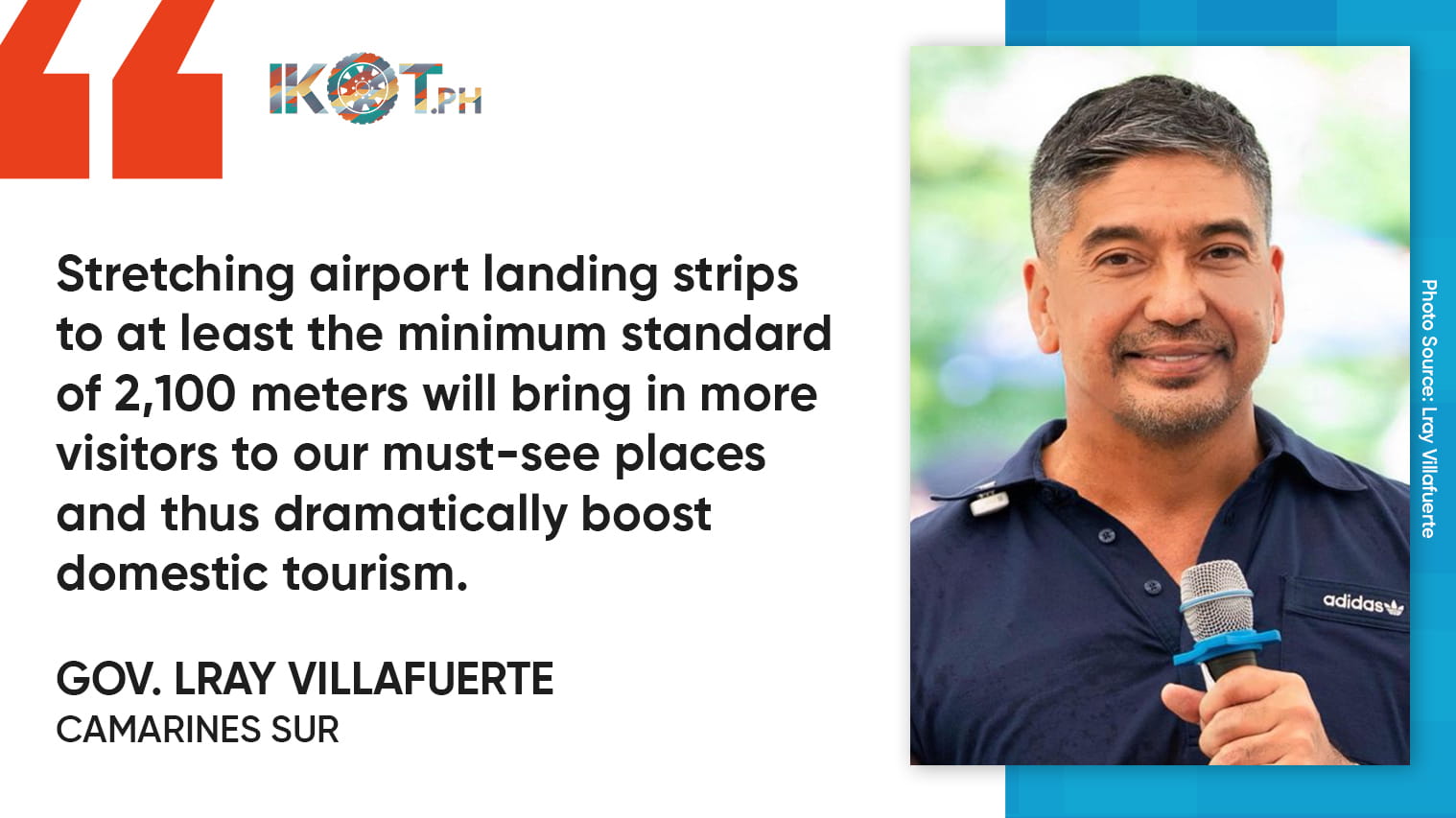
Camarines Sur Governor and National Unity Party (NUP) president LRay Villafuerte has hailed the fresh commitment of the Department of Transportation (DOTr) for longer runways at regional or alternative airports, so these landing strips can accommodate bigger aircraft, as part of long-term reforms to drastically slash airfare and entice a lot more tourists to see the Philippines.
“Stretching airport landing strips to at least the minimum standard of 2,100 meters will bring in more visitors to our must-see places and thus dramatically boost domestic tourism,” Villafuerte said.
“This is because longer regional airfields will let these runways take in bigger passenger aircraft like the Airbus jets that can seat almost 500 passengers, as against the turboprop planes now operating in most alternative airports that each carry fewer than a hundred passengers per flight,” Villafuerte, who is senior vice chairman (for South Luzon) of the League of Provinces of the Philippines (LPP), added.
Following a presidential directive, DOTr Acting Secretary Giovanni Lopez announced last week that the DOTr will stretch runways at new regional airports to at least 2,100 meters or 2.1 kms, which is the minimum standard requirement for landing strips to take in single-aisle or narrow-body jet aircraft like the Airbus A320 or the Boeing 737; and install equipment for night flights in these airfields.
Domestic airlines have been calling, too, for bigger investments in regional airports to cut their operating costs and enable them to make travel more affordable for air travelers.
“Ang polisiya po natin sa DOTr, pagdating sa mga bagong airports na itatayo, lahat dapat ng runway must be 2,100 meters minimum para ready sila for bigger aircraft pagdating ng araw,” Lopez said.
With this government plan for longer runways in regional airports, as ordered by President Marcos no less, Villafuerte said, “There is greater reason now for the DOTr to consider our proposal for a three-year P6 billion plan to accelerate the long-overdue modernization of the Naga Airport by lengthening its landing strip to 2 km, as a way to attract more visitors and thereby sustain—and even boost—the momentum of CamSur as one of the country’s economic, investment and tourism frontrunners.”
Amid the latest Department of Tourism (DOT) data proclaiming CamSur as the No. 1 tourist destination in Bicol, Villafuerte said: “Our province could cement its status as one of the country’s must-see places if the long-planned upgrade or expansion of the Naga Airport were to proceed at full speed in order to dramatically boost passenger capacity and tourist arrivals in, say, three years’ time.”
“For this to happen,” said Villafuerte, “the government needs to considerably augment the 2026 budget for airport improvements for the Naga airstrip to raise it about five times to P2 billion, and then set aside in the next NEPs (National Expenditure Programs or national budget plans) another P2 billion in 2027 and P2 billion more in 2028—or a total of P6 billion in three years to double the length of the runway to 2 km so it could start taking in the bigger passenger jets.”
He said that, “Our three-year P6-billion airport upgrade proposal now jibes with the directive of the President for longer runways in regional airports, which, according to DOTr Sec Banoy (Lopez), translates into elongating landing strips to the minimum of 2.1 kms.”
Presently, with the limited plane capacity at smaller airports, commercial airlines use only turboprop airplanes in their flights to these places that carry fewer passengers and result to higher per-seat costs.
Domestic airlines have been calling, too, for bigger investments in regional airports to cut their operating costs and enable them to make travel more affordable for air travelers.
In a statement, the Air Carriers Association of the Philippines (ACAP) said it welcomed the government’s push to reduce domestic ticket prices, in light of criticism that flying overseas is cheaper than traveling to popular local destinations.
ACAP said that cost pressures such as airport infrastructure constraints keep the airlines’ operating costs high, which are passed on to passengers in the form of costlier plane tickets.
“On some airports with short runways, airlines operate smaller turboprop aircraft with fewer seats, resulting in higher costs per seat, making it challenging to sustainably and affordably serve some domestic markets,” said ACAP, which comprises flag carrier Philippine Airlines (PAL) and its lower-cost regional brand PAL Express, budget carrier Cebu Pacific and its regional brand Cebgo, and AirAsia Philippines.
“Unless the Naga Airport becomes modern and large enough to fly in and fly out passenger jets with 300 or more seats per plane and that are used for international flights, there is simply no way for our province to charm and accommodate a far, far bigger number of both foreign and domestic tourists to go to our must-see places like the CWC (CamSur Watersports Complex) and Caramoan Islands,” Villafuerte said.
In the meantime, Villafuerte appealed to the DOTr and Cebgo to put off anew the plan to stop all the remaining turboprop flights at the Ninoy Aquino International Airport (NAIA) and transfer them to the Clark International Airport in Pampanga beginning March 29.
This March 29 deadline, which will be the last leg of the two-year phaseout of turboprop operations to decongest NAIA, will mean that all turboprop flights of Cebgo in Coron (Palawan) and in Naga City and those of Cebgo-subsidiary Airswift in El Nido (Palawan) will, starting end-March, be taking off from or landing at the Clark airport.
With the current runway only 1.2 km long, Cebgo only uses in its Manila-Naga-Manila flights the turboprop Bombardier Q400 planes that each seat 50 to 90 passengers.
“Longer regional airfields will let these runways take in bigger passenger aircraft like the Airbus jets that can seat almost 500 passengers, as against the turboprop planes now operating in most alternative airports.”
In contrast, jets like that the Airbus planes that are used in international flights and need longer runways to land or take off, can each accommodate 180 to 360 passengers per flight.
“CamSur might no longer be on the radar for many foreign or domestic tourists once the turboprop phaseout happens in end-March because the options—both exhausting—that will be left for visitors after March 29 are: [1] a two-hour land trip from Metro Manila to Clark in Pampanga and then a flight from Clark to Legazpi City in Albay and then a two-hour land trip from Albay to Naga City, or [2] a 10-hour land trip from Metro Manila to Naga City,” he said.
So, even if the government were to clear the accelerated expansion plan of P6 billion over three years, Villafuerte appealed to the DOTr and Cebgo to put the March 29 deadline on hold and let Naga Airport-NAIA turboflights continue after that—at least even if until the end of summer only.
Villafuerte said that prospective investors might even decide to reconsider plans to invest in CamSur once they can no longer fly directly from Metro Manila to Naga City because of the turboprop phaseout.
“This will just be too bad, considering that CamSur has emerged as one of the country’s formidable investment hubs,” Villafuerte said, “partly on the strength of its marvelous growth narrative as a province that has pole-vaulted from being among the country’s poorest over two decades ago to the current third richest and No. 2 revenue earner among all LGUs (local government units).”
Villafuerte said that more investors are likely to set up shop in CamSur soon as the Philippine Economic Zone Authority (PEZA) just recently approved the proposal of the CamSur provincial government for its own special economic zone (SEZ) at the CamSur Uptown.