
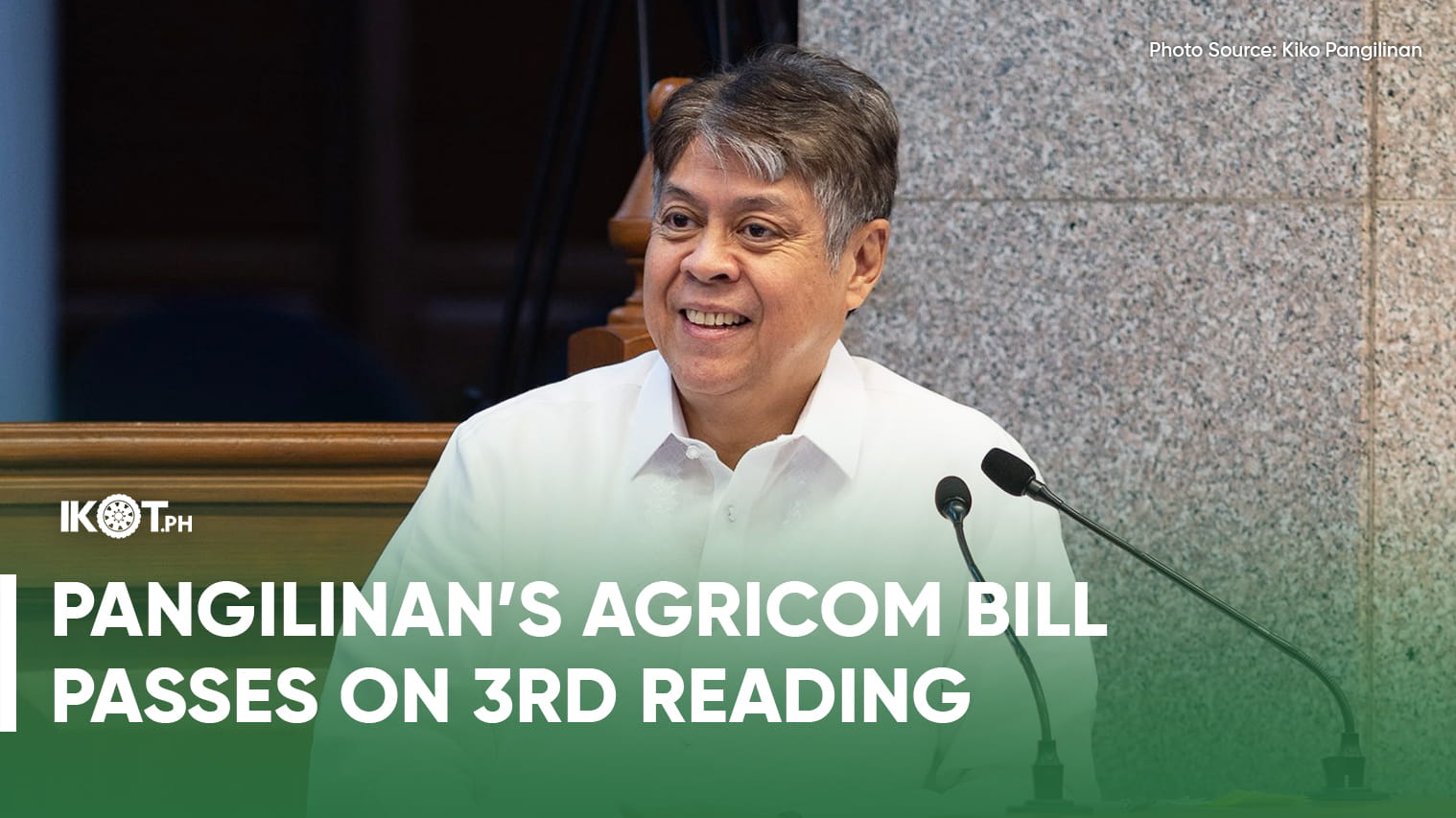
Senator Kiko Pangilinan’s proposed Senate Bill No. 1624, which will create the Congressional Commission on Agriculture, Fisheries, and Food Security (AGRICOM), was passed on third reading during the Senate’s plenary session recently.
The AGRICOM, a three-year intervention designed to seek concrete and targeted reforms in the country’s agriculture and fisheries sector, aims to address the pervasive threats to the country’s national food security.
“The commission intends to engage experts both international and local experts in the field of agriculture and fisheries for us to be able to come up with recommendations, identify challenges and problems.”
During a hearing of the Senate Committee on Agriculture, Food, and Agrarian Reform, chaired by Pangilinan, the veteran legislator explained that the commission “intends to engage experts both international and local experts in the field of agriculture and fisheries for us to be able to come up with recommendations, identify challenges and problems”.
In passing the legislation, one of the seasoned lawmaker’s key agendas after taking on the helm of the committee, the senator expressed hope that the House of Representatives would likewise pass a counterpart bill.
“It is a timely intervention that the congressional commission will look into the state of Philippine agriculture and fisheries and come up with recommendations.”
“It is a timely intervention that the congressional commission will look into the state of Philippine agriculture and fisheries and come up with recommendations that will finally put in place reforms and structural regulatory reforms that will address the challenges of the sector,” he added after taking note that the Agriculture and Fisheries Modernization Act (AFMA) of 1997, which defined measures how to modernize the sector, will turn 30 years old next year.
SB No. 1624 will harmonize the policies and programs of the Department of Agriculture (DA), Department of Agrarian Reform (DAR), Department of Environment and Natural Resources (DENR), Cooperatives Development Authority (CDA), and other government agencies in charge of matters relating to agriculture as it seeks to marry the overlapping mandates of these agencies.
The commission will also, among other things, “restructure and streamline agriculture and fisheries-related bureaucracies to address their institutional weaknesses and shortcomings, including the relationship between and among national, provincial, and local stakeholders in order to effectively implement agriculture and fisheries policies and programs, including the transfer of information and technology, particularly at the grassroots level.”
Previously, Pangilinan said the AGRICOM seeks to identify the challenges in the entire food system—supply chain, laws, mandates, formation, climate risks, and the experiences of farmers, fishers, traders, middlemen, consumers, wholesalers, and retailers.
A long-time champion of farmers’ and fisherfolk’s empowerment, rural development, and food security, he stressed that the AGRICOM will put farmers, fisherfolk, consumers, indigenous communities, agribusiness practitioners, and other beneficiaries at the center of agricultural reforms.