
The House Committee on Revision of Laws, chaired by Rizal Representative Emigdio Tanjuatco III, approved the subcommittee report on the proposed New Espionage Act during a joint meeting with the House Committee on National Defense and Security.
The approval covered the substitute bill consolidating House Bills (HBs) 812, 1457, 1844, 2793, 3023, 4202, 4886, 6177, 6183, and 7201, all of which seek to modernize the country’s antiquated espionage law.
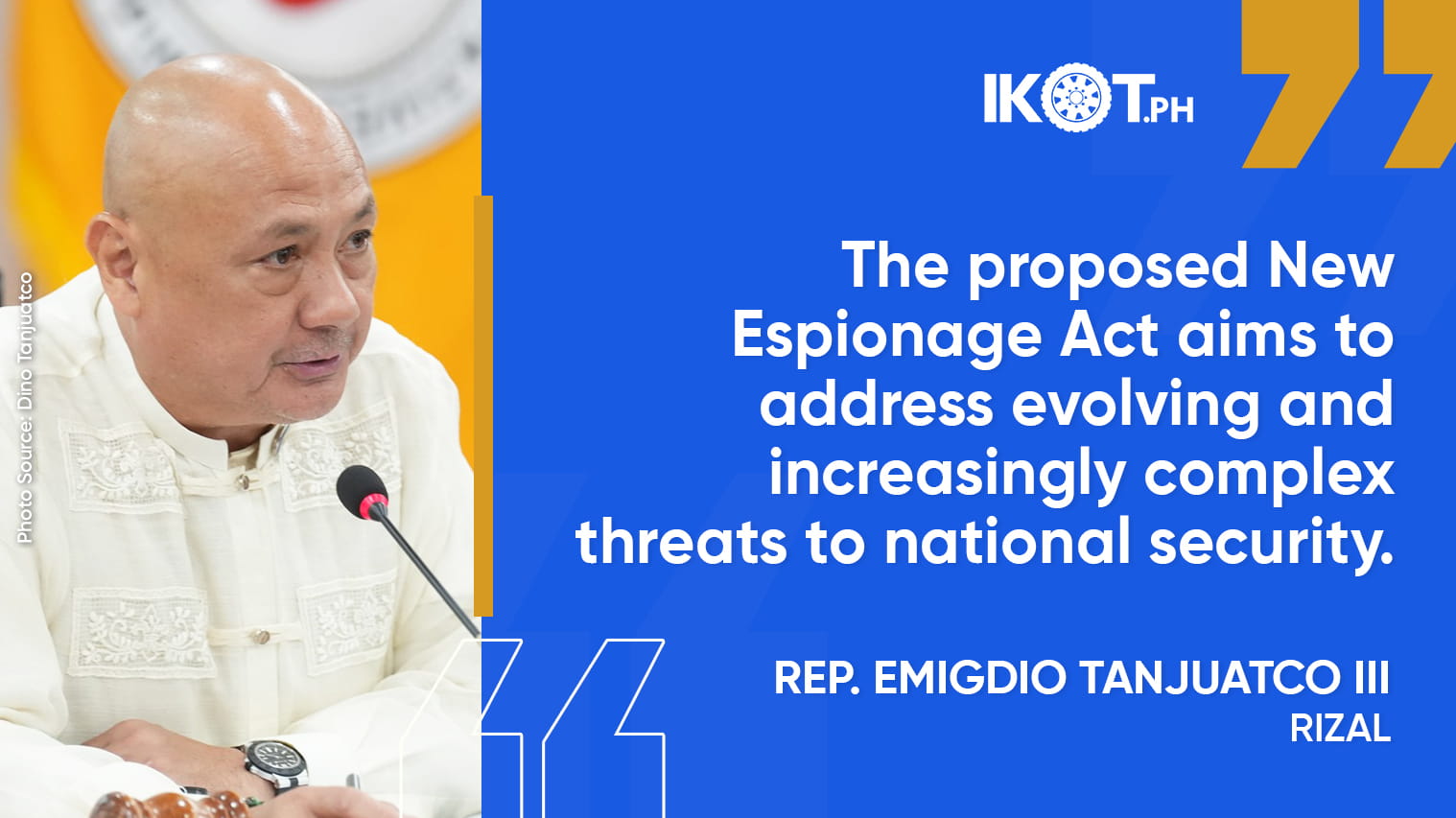
Tanjuatco said the proposed New Espionage Act aims to address evolving and increasingly complex threats to national security, noting that the measure is the product of rigorous deliberations and close inter-committee coordination.
“The bill seeks to modernize the legal framework while ensuring safeguards to constitutional rights and democratic freedoms.”
The legislator stressed that the bill seeks to modernize the legal framework while ensuring safeguards to constitutional rights and democratic freedoms.
“It reflects our collective effort to protect the state, its institutions, and its people, without undermining the democratic freedoms we are sworn to uphold,” the lawmaker said.
1TAHANAN Party-list Representative Nathaniel Oducado, vice chairperson of the national defense panel, said the measure reflects a unified effort to strengthen the country’s ability to protect national security while remaining faithful to the Constitution and democratic principles.
Among the salient features of the proposed law are the expanded definition and scope of espionage, strengthened protection of classified information and critical infrastructure, recognition of cyber and other technological threats, extra-territorial application, and the imposition of deterrent penalties.
These penalties include life imprisonment without parole or good conduct time allowance, as well as fines ranging from P10 million to P20 million.
Negros Occidental Representative Javi Benitez, in his explanatory note for House Bill 2793, underscored the need for a new espionage law, pointing out that existing statutes punishing espionage are outdated.
“Currently, Philippine law remains limited in scope and outdated.”
“Currently, Philippine law remains limited in scope and outdated… they do not adequately address cyber-enabled surveillance, interference in democratic processes, or the use of proxy actors and technology-based tools for strategic infiltration,” Benitez pointed out.
Presenting the subcommittee report, San Juan City Representative Ysabel Maria Zamora, who heads the technical working group, said the substitute bill was approved after two subcommittee meetings attended by representatives from various agencies, including the Department of Justice, Department of National Defense, Armed Forces of the Philippines, National Security Council, National Intelligence Coordinating Agency, UP Law Center, National Bureau of Investigation, Philippine National Police, and the Criminal Investigation and Detection Group.
Following the joint meeting, the panel also approved the substitute bill consolidating House Bills 1748 and 4373, which seek to create the Code Commission of the Philippines mandated to review and codify Philippine laws.