
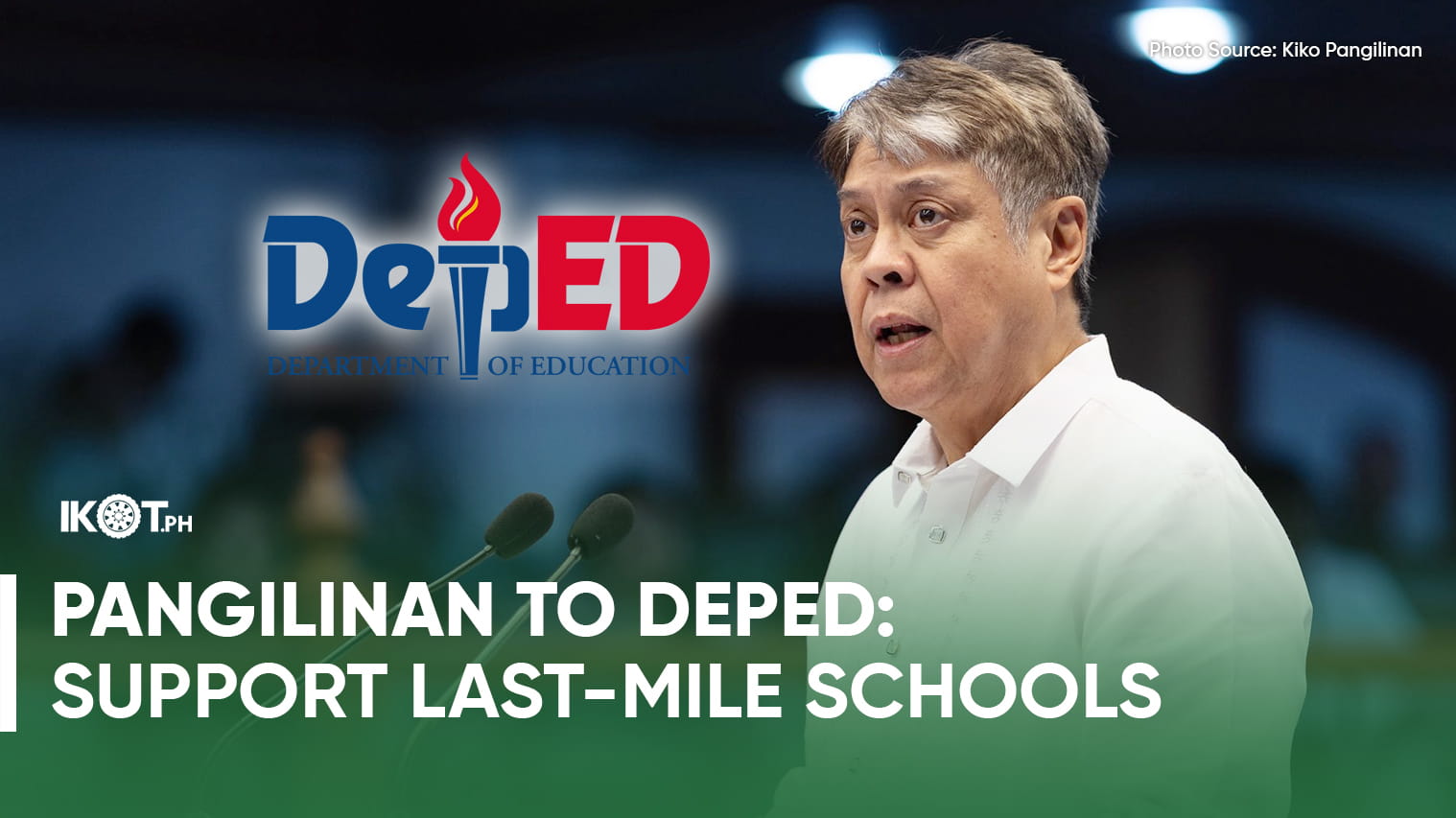
Senator Kiko Pangilinan filed Senate Bill No. 1842, or the Last Mile Schools Act, which will institutionalize last-mile schools in the public basic education system by mandating the Department of Education (DepEd) to adopt policies responsive to schools’ unique operational realities.
“It directs the development of tailored approaches to learning delivery, teacher deployment, infrastructure standards, learner support services, and performance monitoring,” the bill’s explanatory note read.
“The Last Mile Schools Act directs the development of tailored approaches to learning delivery, teacher deployment, infrastructure standards, learner support services, and performance monitoring.”
The measure will also push the DepEd to provide the necessary support, including infrastructure, to ensure that education remains accessible to learners in far-flung areas.
Pangilinan proposed that the Department of Public Works and Highways (DPWH) construct and improve access roads leading to last-mile schools across the country, ensuring safer, faster, and more reliable access to education for students and teachers in geographically isolated and disadvantaged areas.
The measure also promotes the Department of Energy and the National Electrification Administration to install electricity, and the Department of Information and Communications Technology to implement communications and IT systems, among other initiatives.
Under the veteran legislator’s bill, a last-mile school shall be considered as such if it has fewer than 4 classrooms, has makeshift or non-standard rooms, lacks or has irregular electricity, and has not received funds for new construction projects in the last 4 years.
It must also be at least 1 hour from the center of a city or municipality, or be in difficult terrain, to be accessible to learners.
Also significant in the bill is the creation of tailored programs for their learners. This would include learning delivery and intervention mechanisms, school staffing standards, learning tools and equipment, learner support services, and relevant pre-service teacher education curriculum and in-service training.
“It is our responsibility to ensure that there are learning opportunities and established education systems for every Filipino learner, regardless of where they live.”
“Education should be within reach,” the seasoned lawmaker said. “It is our responsibility, our obligation as lawmakers, to ensure that there are learning opportunities and established education systems for every Filipino learner, regardless of where they live.”
“By doing so, we are investing not only in infrastructure but in the future of our children,” the senator concluded.