
Camarines Sur Governor LRay Villafuerte has welcomed a congressional investigation into the “chronic deterioration, alleged defective structural design, repeated ‘piecemeal’ rehabilitation and possible irregularities” in the funding and maintenance of the Andaya Highway, which is the portion of the over 3,000-kilometer (km) Maharlika Highway that passes through the province.
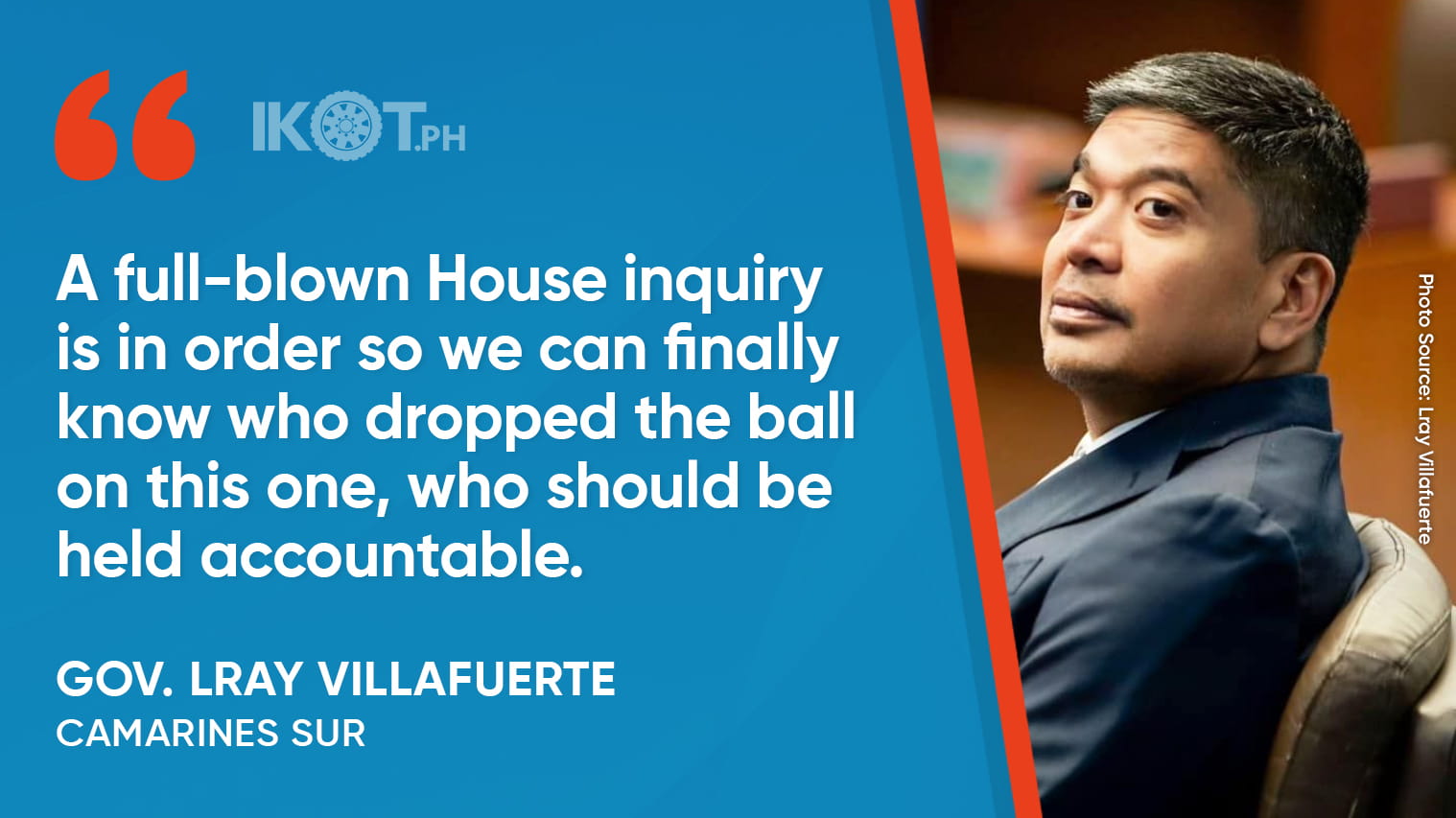
Villafuerte said, “A full-blown House inquiry is in order so we can finally know who had dropped the ball on this one, who should be held accountable, and how do we make sure that this rehab screw up never happens again in the Andaya highway or in any other road or bridge infra projects of the DPWH (Department of Public Works and Highways).”
“With its defective structural design exacerbated by the piecemeal rehabilitation work made on this major road through the decades, the Andaya Highway has sadly fallen to its current infuriating state of severe disrepair, and it’s about time that our lawmakers investigate why the DPWH, for all the resources and expertise at its disposal, has allowed this to happen,” he added.
The Andaya Highway cuts through the municipality of Santa Elena in Camarines Norte; the municipalities of Sipocot, Lupi, Ragay and Del Gallego in CamSur; and the municipalities of Tagkawayan, Guinayangan, and Calauag in Quezon.
“This seemingly benign neglect of the Andaya Highway in the past is another indictment of the level of massive fraud and inefficiency at the DPWH,” Villafuerte said.
“In fairness to President Marcos, he has taken initial steps to correct this Andaya Highway problem ever since he assumed office in 2022,” he added. “We are hopeful that with action man Sec. Vince (Secretary Vivencio Dizon of the DPWH) now at the helm of the DPWH, the comprehensive rehabilitation of the Andaya Highway, as envisioned by the President, will now proceed at a fast pace.”
In a resolution, Bicol Saro Rep. Terry Ridon wants the House committee on public accounts along with the other pertinent committees to likewise examine relevant findings of the Commission on Audit (COA) on the road and bridge infrastructure projects of the DPWH for the purpose of “determining accountability, preventing wastage of public funds and improving project quality, oversight and transparency.”
The formal probe of the mostly dilapidated, nearly 93-km stretch in CamSur of the Maharlika Highway or Pan Philippine Highway is being sought by Ridon, who chairs the public accounts panel, in House Resolution No. 740.
In his resolution, Ridon said that, “Concerns have been raised over why the DPWH allowed such long-standing and pervasive damage to persist, and whether there were lapses in planning, design, supervision, and monitoring in the project’s implementation.”
“Allegations were raised that repeated reblocking projects and fragmented budgeting over many years may have enabled waste, inefficiency, or corruption, underscoring the need to examine whether funds were programmed and released consistent with sound planning and whether projects delivered durable outputs consistent with contract specifications,” he said in HR 740.
Ridon noted that in its recent report on the DPWH, the COA has “publicly flagged recurring issues relevant to road infrastructure implementation—such as inadequate planning, detailed engineering, supervision, and monitoring that contributed to delayed and inefficient project implementation—demonstrating a broader oversight concern that warrants legislative inquiry, particularly where communities suffer from repeatedly failing roads and bridges.”
Ridon pointed out in his resolution that during an inspection by Dizon, “the DPWH had attributed the highway’s recurring failures to a design issue that allows water to seep underneath the road structure, indicating potential deficiencies in design standards, drainage engineering, materials specifications, or quality assurance/quality control.”
He said that COA’s 2024 Annual Audit Report noted that hundreds of DPWH projects were “found to be unusable, idle, or technically deficient, resulting in significant losses to the government and pointing to gaps in project supervision and compliance with standards.”
“This seemingly benign neglect of the Andaya Highway in the past is another indictment of the level of massive fraud and inefficiency at the DPWH.”
Such audit findings “underscore the need for heightened legislative scrutiny of road infrastructure planning and implementation to protect public funds and ensure that infrastructure serves its intended purpose,” Ridon said.
Ridon said that a joint inquiry by the public accounts panel with other appropriate committees in the House will enable the Congress to find out, among others, the following:
· Whether the Andaya Highway’s recurring failures are attributable to defective or substandard design (including drainage and subgrade/structural design), and whether DPWH design review, geotechnical assessment, hydrologic/ hydraulic analysis, and materials specifications were adequate and properly applied;
· Whether the historical pattern of “piecemeal” rehabilitation and repeated reblocking along the Andaya Highway reflected sound engineering planning and life-cycle costing, or instead resulted in wasteful or duplicative expenditures inconsistent with economy, efficiency, and effectiveness;
· Whether appropriations, allotments, releases, and disbursements for Andaya Highway works (including reblocking, overlays, drainage works, slope protection, and related items) were supported by complete and consistent plans, program-of-works, detailed engineering documents, and justified scope, and whether project segmentation was used to evade proper scrutiny or competitive safeguards;
· Whether there are relevant COA observations and audit results that indicate systemic weaknesses affecting roads and bridges, and what reforms are needed to prevent “unusable/idle” outputs, delays, and losses; and
· Whether officials, contractors, or other accountable persons may be held administratively, civilly, or criminally liable where evidence shows negligence, gross inefficiency, misrepresentation of completion/quality, or misuse of public funds.
A national primary highway spanning 92.65 km connecting Santa Elena in the first district of Camarines Norte through Quezon province to Sipocot in the first district of CamSur, this major road was named Quirino Highway—as National Route N68 in the country’s highway network—when it was first built in the 1950s during the Elpidio Quirino presidency as an alternative route to the Pan-Philippine Highway that connects the islands of Luzon, Eastern Visayas and Mindanao.
The Andaya Highway cuts through the municipality of Santa Elena in Camarines Norte; the municipalities of Sipocot, Lupi, Ragay and Del Gallego in CamSur; and the municipalities of Tagkawayan, Guinayangan, and Calauag in Quezon.
The Quirino Highway was expanded in the 1970s and again in the 1990s, and in 2004, its CamSur portion was renamed Rolando Andaya Highway by virtue of Republic Act (RA) No. 9234, in honor of the late congressman Rolando Andaya Sr.