
In many Filipino families, there is always “the responsible one.”
The one who pays on time.
The one who adjusts first.
The one who figures things out before anyone else has to.
Sometimes, this person carries the finances.
Sometimes, they carry decisions.
Sometimes, they carry emotional stability.
Often, the role isn’t chosen.
It’s inherited.
It begins early—being careful with money, not asking for too much, understanding the situation without it being explained. You learn to read the room. You learn when to adjust. You learn that reliability keeps things steady.
Over time, responsibility stops being something you do.
It becomes who you are.
Ikaw ’yung maaasahan.

At first, that feels like strength. And it is. Reliability is strength. Responsibility builds stability. It keeps things from falling apart.
But there’s a side of responsibility we rarely name.
The part where it becomes heavy.

When you are always the one who adjusts, your own needs slowly move to the background. You become skilled at carrying weight—but less practiced at putting it down. Saying yes becomes automatic. Saying no feels wrong, even when you are already stretched.
And this pattern doesn’t only happen inside families.
It shows up at work—the employee who never misses a deadline and absorbs extra tasks.
It shows up in relationships—the partner who manages everything, quietly.
It shows up in friendships—the one who always organizes, pays first, fixes logistics.
It even shows up internally—the person who sets a silent rule: I should be able to handle this.
Eventually, responsibility turns into quiet fatigue.
Not the loud kind that demands attention, but the steady tiredness that builds when you are always the one holding things together.
The hardest part?
Responsible people are rarely asked how they are doing.

Because they look fine.
They are functioning, producing, paying bills, and showing up. On the surface, everything appears under control. Inside, though, there is often a growing pressure—an unspoken fear of what would happen if they stopped being “the strong one.”
This is where resentment can begin to form, quietly and unintentionally.
Not toward the people you love.
Not toward your job.
But toward the role itself.
Toward the belief that rest must be earned.
That support must be given before it is received.
That your limits are optional.
Over time, responsibility fuses with worth.
If I don’t carry this, who will?
If I slow down, am I still dependable?
If I say no, what does that make me?
These questions rarely get voiced. But they shape many financial and personal decisions.
Money, in this context, stops being just a resource. It becomes proof.
Proof that you can handle things.
Proof that you are reliable.
Proof that you are still the one others can count on.
And when money becomes proof, it becomes heavier than it needs to be.
The truth is this: being responsible does not mean being endlessly available.
It does not mean carrying everything alone.
It does not mean ignoring your capacity until exhaustion forces you to stop.
Healthy responsibility has boundaries.
It recognizes that sustainability matters—that you cannot keep giving from a state of depletion and expect stability to last. Responsibility without limits does not collapse because of weakness. It collapses because of exhaustion.
Learning to set boundaries around responsibility is not a rejection of care.
It is a way of protecting it.
Sometimes that boundary looks like pausing before saying yes.
Sometimes it looks like clarifying what you can realistically support.
Sometimes it looks like admitting, even to yourself, that you need help too.
These shifts are rarely dramatic. They are quiet. And they often come with guilt.
But guilt is not always a signal that you are doing something wrong. Sometimes it is simply a sign that you are stepping out of a role that once kept things safe—but now keeps you small.
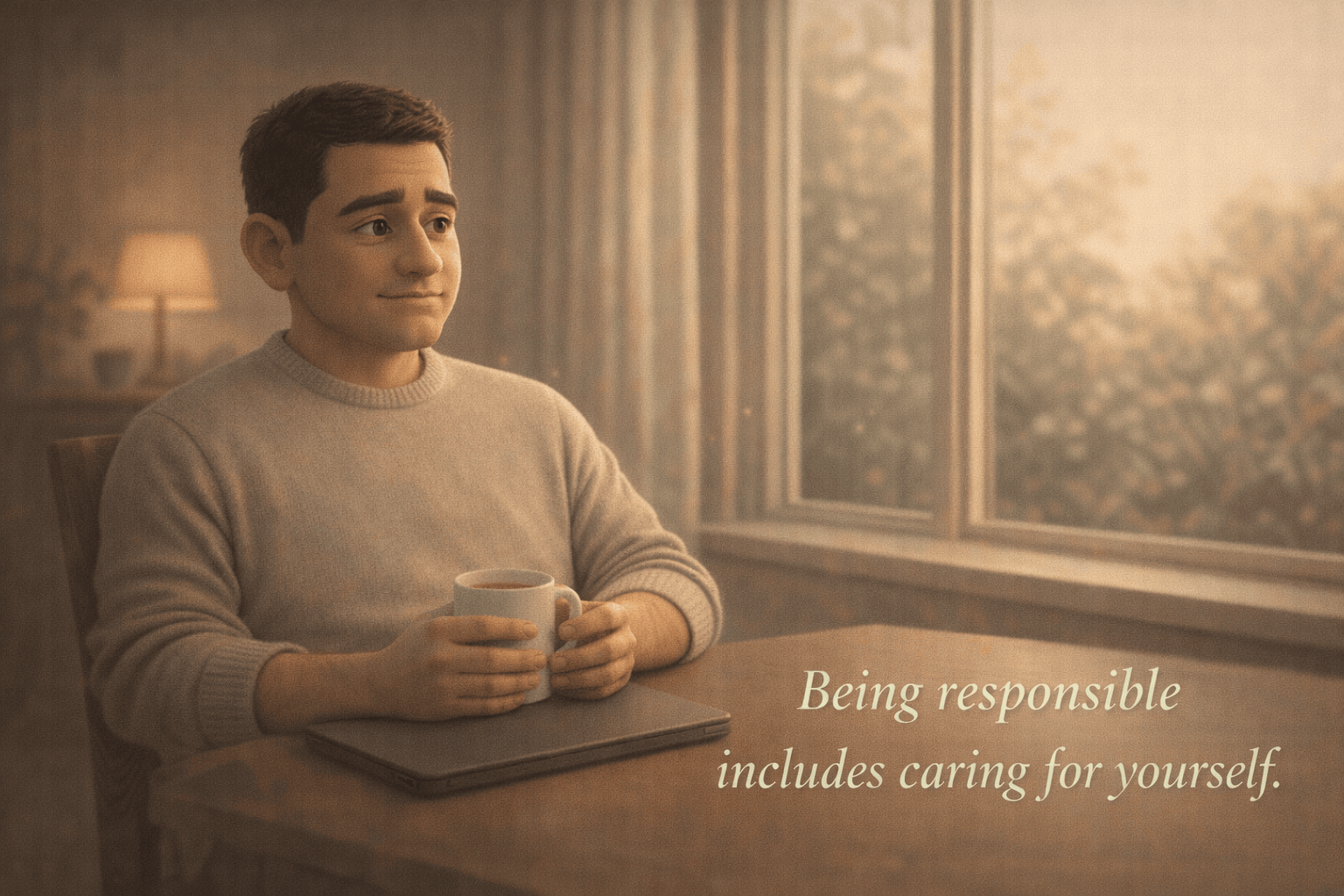
Being responsible does not require self-erasure.
It can include rest.
It can include support.
It can include choosing yourself without abandoning others.
Because responsibility that is sustainable does not just hold things together.
It allows the one holding everything to remain whole.
Responsibility becomes healthier when it includes care for the one who has been carrying it all along.
Catch Thanjo’s personal finance column every Tuesday at 7 p.m. on IKOT.PH and across Facebook, X (Twitter), and Instagram.
DISCLAIMER:
The views and opinions of our partners and contributors expressed in this article are exclusively their own and are made in their personal capacities. They do not reflect the views, policies, or official stance of IKOT.PH, its editors, officers, or affiliates. As such, nothing contained herein shall be construed as professional advice or as an official declaration, endorsement, or position of IKOT.PH.