
Parañaque 2nd District Representative Brian Raymund Yamsuan has proposed a measure that aims to institute a scholarship and return service program for aspiring pharmacists and other allied medical professionals to help stave off a manpower crisis in the country’s public health system.
Yamsuan said his proposed legislation under House Bill (HB) 7355 will allow deserving students to pursue degrees in priority allied health programs through fully funded government scholarships, on the condition that they serve in their respective localities within the public health system after passing their respective licensure examinations.
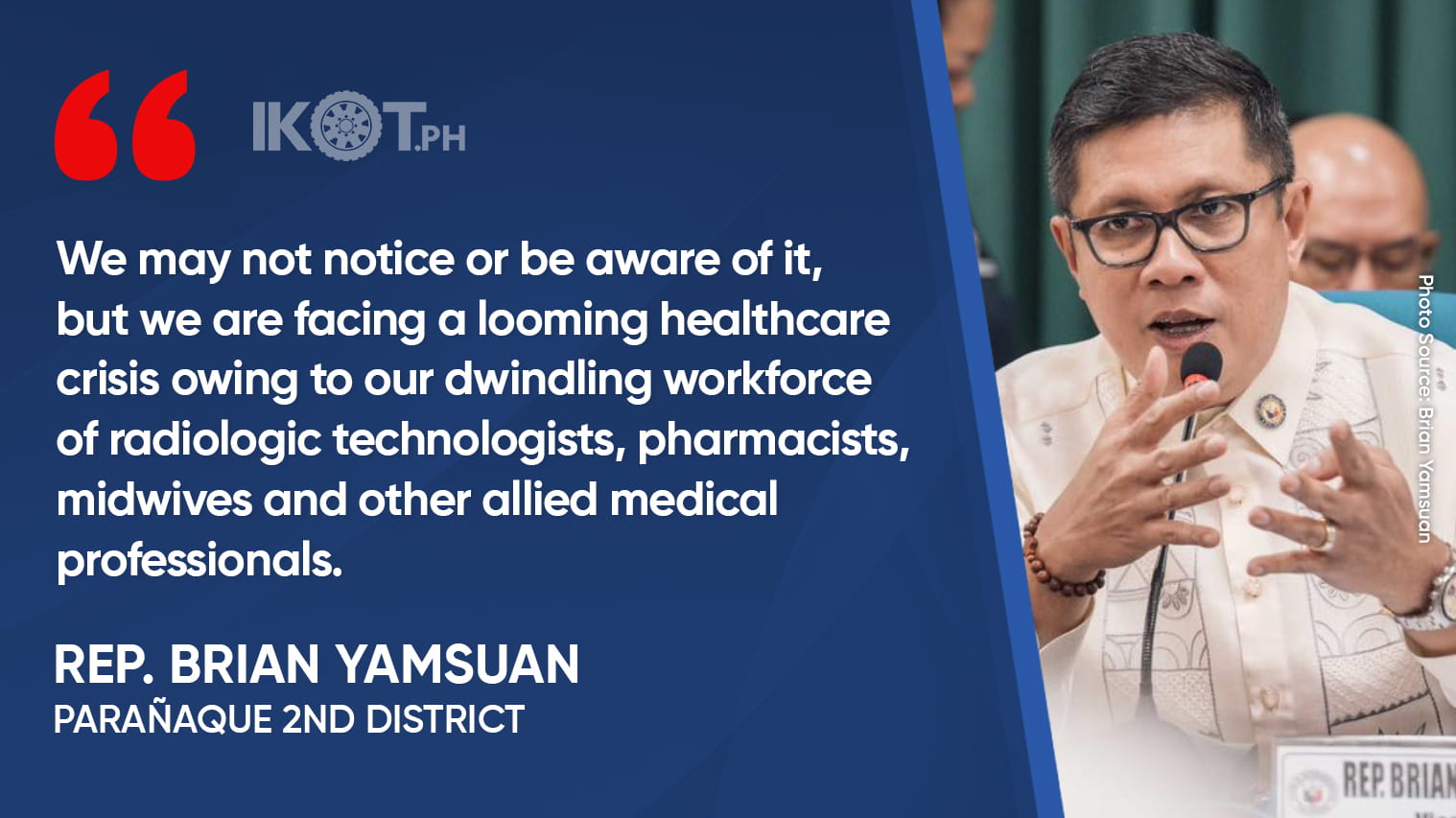
“We may not notice or be aware of it, but we are facing a looming healthcare crisis owing to our dwindling workforce of radiologic technologists, pharmacists, midwives and other allied medical professionals. The support they deliver in terms of diagnostic, rehabilitation and technical services are indispensable to our healthcare system, especially in rural communities and other underserved areas,” Yamsuan said in filing the bill in line with his H.O.P.E. (Health, Opportunities and jobs, Peace and order and Education) legislative agenda.
The Private Sector Advisory Council (PSAC), said the Philippines needs approximately 57,000 pharmacists, yet only 30,000 are currently in practice, leaving a gap of 27,500.
“We should act now to ensure that every Filipino has access to adequate, modern healthcare in the future. Hindi maipapatupad nang maayos ang ating Universal Health Care Program kung kulang ang mga doktor, nars at mga katuwang nila sa paghahatid ng serbisyong pangkalusugan (We cannot properly implement our Universal Health Care Program if we lack doctors, nurses, and their partners in delivering healthcare services),” he added.
Yamsuan said that while Congress has passed into law the Doktor Para Sa Bayan Medical Scholarship Act and the Commission on Higher Education (CHED) has been implementing short- and medium-term measures to deal with the shortage of nurses, preemptive steps have yet to be taken to address the fast-declining manpower in the allied health professions.
According to CHED, the number of radiologic technologists who are qualified to operate x-ray equipment, MRIs and other diagnostic imaging devices, has been dropping at an alarming rate, with the shortage now classified as “an ongoing crisis.”
The country is also already facing a massive shortage of pharmacists. The Private Sector Advisory Council (PSAC), said the Philippines needs approximately 57,000 pharmacists, yet only 30,000 are currently in practice, leaving a gap of 27,500. With just about 4,000 board certified pharmacists produced each year, and assuming the demand remains constant, it would take seven years to fill the deficit, the PSAC warned.
“These challenges are further exacerbated by the inequitable geographic distribution of allied-health professionals, as the workforce remains heavily concentrated in urban centers, leaving rural communities understaffed and existing workers overworked,” said Yamsuan in his explanatory note on the bill.
To address these urgent concerns, HB 7355 provides for the creation of the Philippine Allied Health Council (PAHC), which shall be responsible for identifying, reviewing and updating at least once every five years the list of priority allied health programs that should be covered by state-funded scholarships.
The PAHC shall also be responsible for determining the scope, amount, and prioritization of financial aid and benefits under the bill’s Allied Health Professionals Subsidy and Return Service Program.
Financial assistance covered under the measure may include, but shall not be limited to the following: tuition and other school fees; allowances for books, supplies and equipment, clothing or uniform, housing, and transportation; internship or practicum fees; annual medical and health insurance coverage; licensure exam subsidies; and other necessary supplemental aid.
In its final report, the Second Congressional Commission on Education (Edcom II) also warned about the worsening shortage of allied health workers in the country due to migration, high dropout rates, and limited access to public medical education.
Eligible applicants include Filipino citizens who are graduating senior high school students, current or incoming college students, or bachelor degree holders who wish to pursue a second degree in the allied health professions covered by the program.
Under the bill, scholars shall render the mandatory return service and be integrated into the public health system within six years from passing the board exams. They should serve in a government health facility in their respective localities or in any underserved community closest to their hometown and shall receive the appropriate civil service rank, salary and related benefits.
“In doing so, the measure aims to address both the scarcity and maldistribution of the allied-health workforce, guaranteeing that the program will ultimately strengthen our health systems, beginning with the country’s unserved and underserved areas, where the gaps are most critical,” Yamsuan said.
The bill also allows the Department of Health (DOH to tap scholars still pursuing their degrees to serve in public health offices or government hospitals in times of pandemic or any public health emergency.
In its final report, the Second Congressional Commission on Education (Edcom II) also warned about the worsening shortage of allied health workers in the country due to migration, high dropout rates, and limited access to public medical education.
The Edcom II recommended expanding scholarships for medical and allied health students, improving training facilities and program quality, revising licensure policies to help more graduates qualify, and strengthening return service requirements for government scholars.