
The House Committee on Tourism, chaired by Romblon Representative Eleandro Jesus Madrona approved the measure consolidating 18 bills to seek to abolish the travel tax, subject to the crafting of a clear and sustainable alternative funding mechanism for important programs supported by the tax collections.
The panel consolidated House Bills 7367, 7443, 7612, 7703, 7757, 150, 3529, 3890, 4793, 7155, 7631, 5821, 6228, 6979, 7307, 7695, 7758, 7845, including the privilege speech of Cagayan de Oro Representative Rufus Rodriguez.
The abolition of the travel tax was added to the Legislative Executive Development Advisory Council (LEDAC) priority list as of February 10, 2026, with a target of passing the measure by June 2026. The proposal seeks to eliminate the current P1,620 to P2,700 tax imposed on departing passengers.
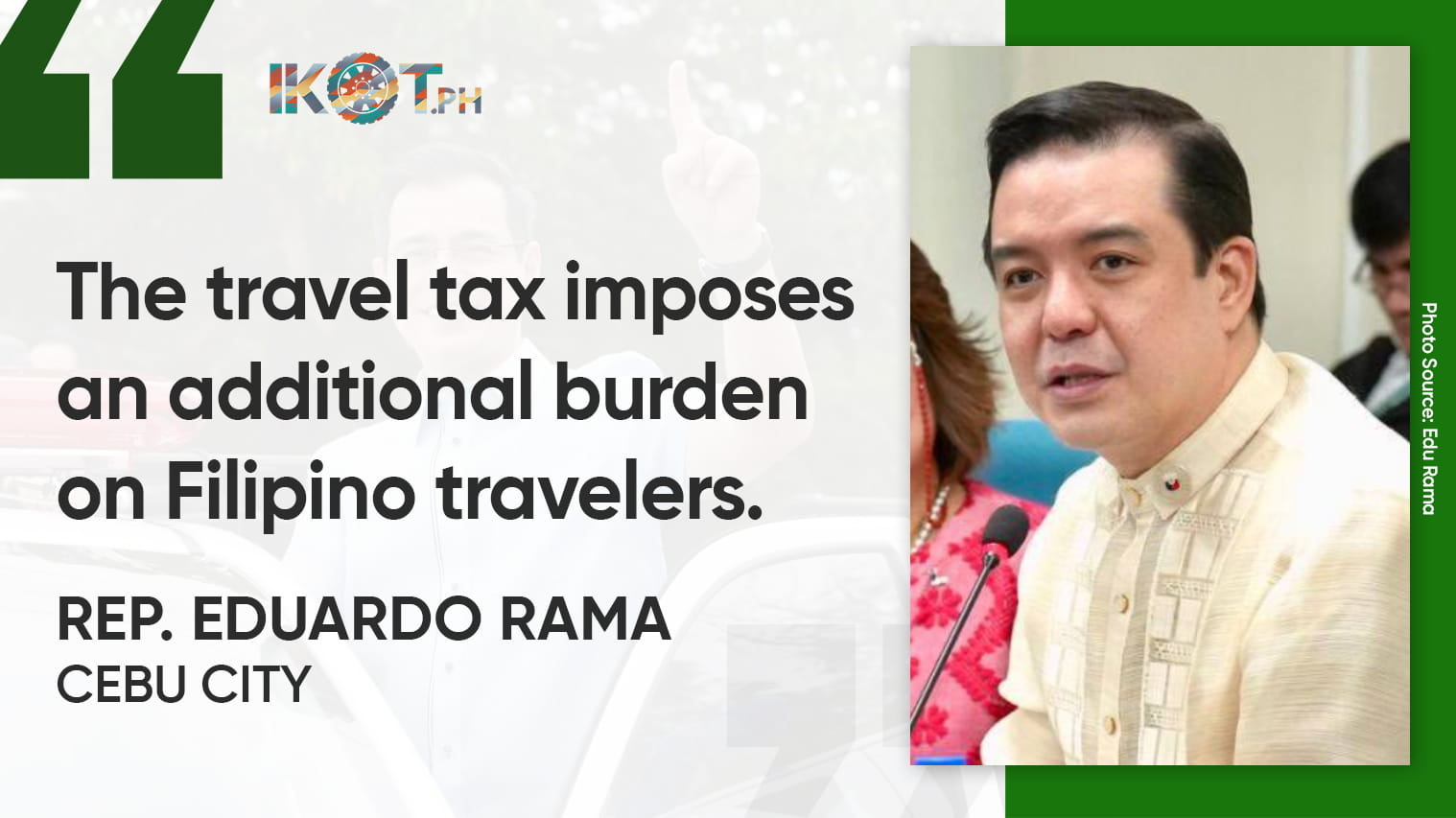
“The travel tax is at odds with the government’s policy of easing travel for its citizens.”
Cebu City Representative Eduardo Rama, author of House Bill 7367, emphasized that the travel tax imposes an additional burden on Filipino travelers and is at odds with the government’s policy of easing travel for its citizens.
However, the panel members sought to ensure that programs and projects funded by proceeds from the travel tax, such as tourism, cultural development, and scholarships, will continue to have funding support.
Republic Act 9593, or the “Tourism Act of 2009,” directs travel tax revenues to agencies such as Tourism Infrastructure and Enterprise Zone Authority (TIEZA), Commission on Higher Education (CHED), and the National Commission for Culture and the Arts (NCCA).
Committee on Appropriations Chairperson and Nueva Ecija Representative Mikaela Angela Suansing said funding continuity for the programs of these agencies will be addressed as the measure moves forward in the legislative mill.
“Mag-uusap po kami, of course ng mga authors ng measures and the three chairpersons, Chair Madrona, Chair Quimbo (Ways and Means) and myself kasi tatlong committees po ang dadaanan nito. Rest assured po, given the criticality of the funds, we will work together to ensure that those funds will remain available for the departments of the different government institutions involved,” Suansing explained.
“Travel tax collections reached P8.7 billion in 2025 and were used for tourism development, cultural programs, and improvement of public tourist sites, as well as cultural heritage and ecotourism destinations.”
TIEZA Chief Operating Officer Mark Lapid informed the committee that travel tax collections reached P8.7 billion in 2025 and were used for tourism development, cultural programs, and improvement of public tourist sites, as well as cultural heritage and ecotourism destinations.
Part of the fund is also devoted to programs to attract private sector investments in tourism enterprise zones under TIEZA.
The CHED and the NCCA allocate their share of the tax for programs pursuant to their respective mandate.
CHED Commissioner Dr. Shirley Agrupis expressed concern that repealing the travel tax without identifying an alternative funding source would significantly reduce the Higher Education Development Fund (HEDF), as 40% of travel tax collections account for 85.6% of its resources.
Agrupis said the HEDF supports scholarships, research, institutional development, and tourism education programs, benefiting 5.4 million students in 1,906 higher education institutions, including 1.6 million scholars.
For her part, NCCA Deputy Executive Director Marichu Tellano sought safeguards to ensure continued funding for culture and the arts, particularly those that would guarantee a replacement appropriation for the National Endowment Fund for Culture and the Arts (NEFCA), at an amount not lower than the average share from the travel tax to ensure NCCA programs remain supported.