
Camarines Sur (CamSur) representatives led by Luigi Villafuerte and Migz Villafuerte have backed the push by the Commission on Human Rights (CHR) for stronger and sustained measures to protect media workers, as a means to guarantee a free and independent press, which is one hallmark of a vibrant democracy.
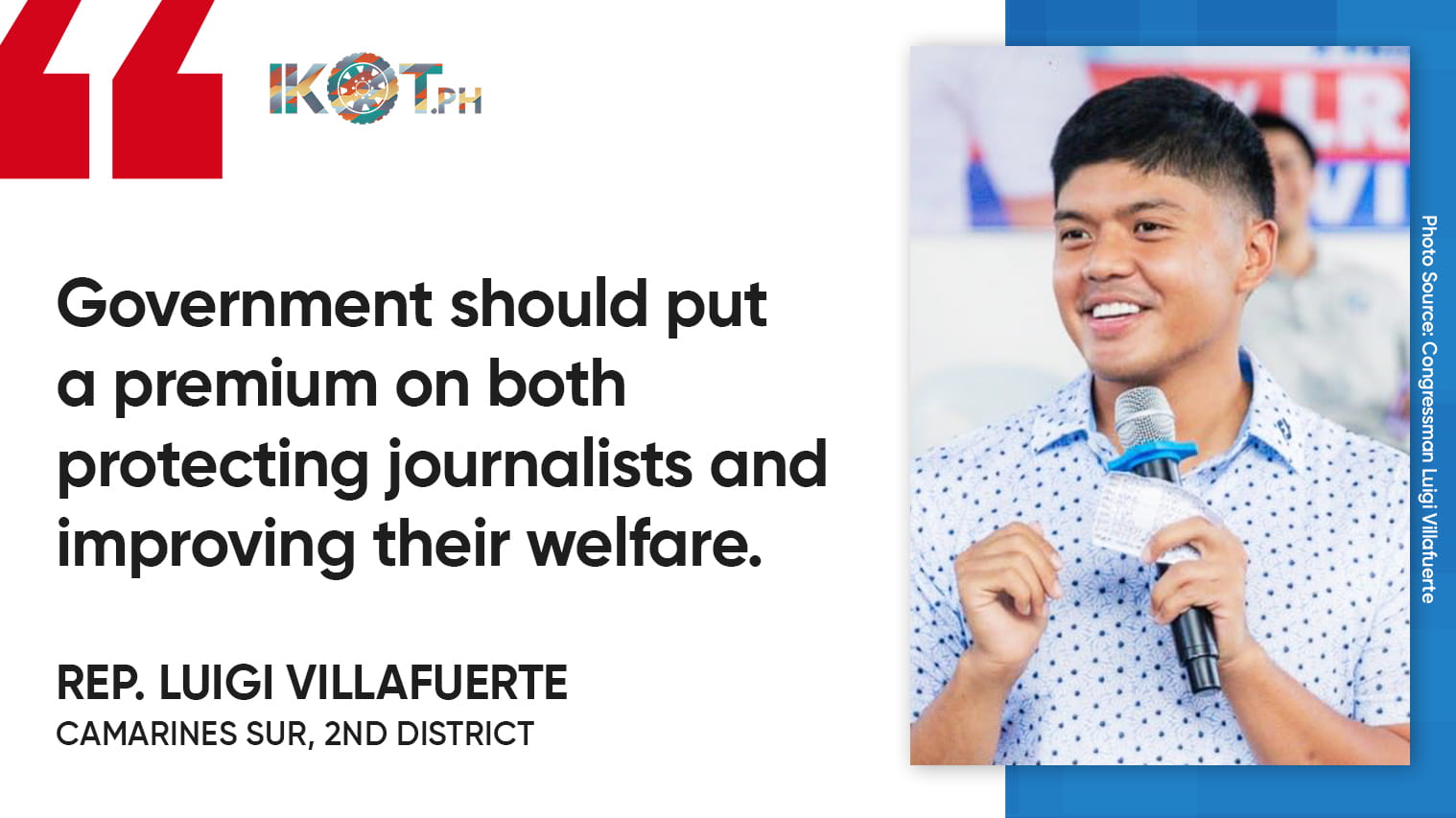
“Government should put a premium on both protecting journalists and improving their welfare,” said Luigi and Migz Villafuerte, as they concurred with the CHR’s position that media safety goes beyond physical safety alone but also includes the needed legal, digital, structural and even professional protections to ensure independent and ethical reporting.
The Villafuertes said the 20th Congress can support this CHR view on best upholding press freedom by passing this time around “the proposed legislation according media people the same rights enjoyed by their fellow workers in the government and private sector, such as security of tenure, hazard and overtime pay, mandatory additional insurance coverage and other job-related benefits.”
They recalled that this pro-media proposal was passed by the House of Representatives in the 19th Congress, but it was not enacted into law as the Senate had failed to pass its counterpart measure.
HB 304, which was authored by then-Rep. and now CamSur Gov. LRay Villafuerte along with Migz and Horibata plus the Bicol Saro partylist, was passed by the House in November 2022.
Authored with fellow CamSur Rep. Tsuyoshi Anthony Horibata and Bicol Saro Rep. Terry Ridon at last year’s onset of the 20th Congress, HB 1985 aims to: [1] guarantee the rights of media workers to self-organization; [2] entitle them to additional economic benefits enjoyed by their fellow workers in the public and private sectors; and [3] establish a safe, protected atmosphere conducive to their productive, free and fruitful work a journalists.
“That this proposed measure was approved on third and final reading by the House of Representatives in the 19th Congress, underscored the overwhelming support in the chamber at that time for improving the welfare of Filipino media workers,” Luigi said.
On the recent occasion of National Press Week this February, the CHR called for stronger and sustained measures to protect journalists and media workers, stressing that the public’s right to truth cannot be upheld while journalists continue to face threats, harassment, violence and legal intimidation in the course of their work.
As the CHR committed to addressing gaps in the protection of media workers by way of its Philippine Plan of Action for the Safety of Journalists (PPASJ), it said that strengthening journalists’ safety “goes beyond physical security and includes legal, digital, professional and structural protections necessary for independent and ethical reporting.”
Luigi, who is a deputy majority leader, and Migz, the chairman of the House committee on information and communications technology (ICT), said that lawmakers can work in parallel with the CHR on upholding and advancing media welfare by passing House Bill (HB) No. 1985, or the “Media Workers’ Welfare Act.”
Authored with fellow CamSur Rep. Tsuyoshi Anthony Horibata and Bicol Saro Rep. Terry Ridon at last year’s onset of the 20th Congress, HB 1985 aims to: [1] guarantee the rights of media workers to self-organization; [2] entitle them to additional economic benefits enjoyed by their fellow workers in the public and private sectors; and [3] establish a safe, protected atmosphere conducive to their productive, free and fruitful work a journalists.
In HB 1985, its authors said that: “Media workers serve as frontliners in ensuring public information, promoting freedom of the press and expression, and upholding democracy, hence contributing to shaping public discourse and act as watchdogs in government accountability issues that, at times, jeopardize their safety and security.”
“But despite the nature of their work and their significant role in our society as truth seekers and purveyors of vital information, journalists and other media workers face a wide array of labor standards and protection issues in the country,” Luigi said.
Luigi said that such challengers to their profession include contractualization, lack of security of tenure, and dangerous working conditions.
In line with the government’s responsibility to protect Filipino media workers and its effort towards the realization of these constitutional mandates, Migz said that HB 1985 aim to guarantee media workers the following:
· A minimum wage, at the least; plus overtime pay, night shift premiums, hazard pay and other forms of compensation provided in the Labor Code of the Philippines and other related laws and issuances;
· Social security and welfare benefits, as well as mandatory additional insurance benefits such as death benefit, disability benefit, and medical insurance benefit; and
· Their classification as regular employees after six months from the start of employment.
Migz said that HB 1985 also tasks the Department of Labor and Employment (DOLE) to create a News Media Tripartite Council (NMTC), which will serve as a platform for media workers and their employers to craft mutually beneficial policies and settle conflicts.
HB 1985 states that media workers shall not receive less than the applicable minimum wage rate prescribed by the Regional Tripartite Wages and Productivity Board RTWPB, and shall be entitled to overtime pay and night shift premiums, as well as other forms of compensation provided by Presidential Decree No. 442, as amended, otherwise known as the “Labor Code of the Philippines,” and other related laws and issuances.
It also mandates coverage of media workers under the Social Security System (SSS), Home Development Mutual Fund (Pag-IBIG) and the Philippine Health Insurance Corp. (PhilHealth) upon their employment.
The payment of monthly contributions shall be jointly shared by the media workers and their employers, when applicable, in accordance with existing rules and regulations.
Media workers shall also be entitled to retirement benefits as provided under Republic Act (RA) No. 11199, otherwise known as the “Social Security Act of 2018.”
Media workers shall also be entitled to retirement benefits as provided under Republic Act (RA) No. 11199, otherwise known as the “Social Security Act of 2018.”
The bill provides that media workers who are required to physically report for work in dangerous areas such as strife-torn or embattled areas, distressed or isolated stations, disease-infested areas or in areas declared under a state of calamity or emergency for the duration thereof which expose them to great danger, contagion, radiation, volcanic activity or eruption, occupational risks or perils to life as determined by the DOLE, shall be compensated with a hazard pay in the minimum amount of P500 per day, with no diminution.
The hazard pay shall be computed at P500 times the number of days that the media workers are physically reporting for work in dangerous areas.
The would-be NMTC shall be empowered to increase the amount of the hazard pay of media workers.
Under the bill, employers shall provide their media workers covering events in dangerous areas with basic safety gear and equipment such as bulletproof vests and helmets, first-aid kits, fire protection jackets, face shields, medical grade protective equipment, harnesses, safety shoes, and life vests.
Employers shall provide, too, mandatory additional insurance coverage to their media workers as follows:
· Death benefit of P200,000 for each media worker who shall perish in the line of duty;
· Disability benefit of up to P200,000 for each media worker who shall suffer total or partial disability, whether permanent to temporary, arising from any injury sustained in the line of duty; and
· Medical insurance benefit of up to P100,000 for each media worker.
To guarantee security of tenure, the bill states that media workers shall be classified as regular employees after six (6) months from the start of employment, regardless of the nature of employment.
However, the said six (6) months period shall be computed cumulatively if a media worker is repeatedly engaged for shorter periods.
Employers are prohibited from terminating the services of their media workers except for just or authorized causes, and with the observance of procedural due process.
Violations of the provisions of this Act shall be subject to applicable penalties provided in PD 442, or the Labor Code, as amended, and other related laws and issuances.