
Two committees of the House of Representatives are doubling down on their combined efforts to put together a substitute bill penalizing fake news at this time when the unbridled spread of bogus reports intended to disinform or deceive the public has become such “a grave threat to our democratic institutions, public health and social cohesion,” CamSur Rep. Migz Villafuerte has said.
Villafuerte said a technical working group (TWG) created by the House committee on information and communications technology (ICT), which he chairs, and by the committee on public information is “now hammering out a substitute bill in place of over 10 similar measures,” with the goal of striking a balance between outlawing fake news and upholding the democratic tenet of free speech.”
Majority Floor Leader Sandro Marcos III is among the authors of the other anti-fake news bills.
Villafuerte said in a recent joint hearing that a TWG created by the House committees on ICT and on public information is “working on a substitute bill geared to address the proliferation of false information and ensuring accountability for those who deliberately mislead the public.”
“Alongside imposing punitive action against peddlers of disinformation or misinformation, this proposed ‘Fake News and Digital Disinformation Act,’ is also about fostering an environment where truth prevails, and trust in our sources of legitimate information is enhanced or restored,” Villafuerte said.
In a 2025 survey by the Social Weather Stations (SWS), Villafuerte said 65% of Filipinos admitted they found it difficult to distinguish fake from real news, while 59% saw disinformation on the internet as a “serious” issue.
“I am sure that everybody agrees with me, that we now stand at a critical juncture in our society where the rapid spread of misinformation and fake news poses a significant threat to our democratic institutions, public health, and social cohesion,” said Villafuerte at the recent joint hearing that he presided over as ICT panel chairman and with Parañaque City Rep. Brian Raymund Yamsuan as vice chairman of the House public information committee.
The House public information committee is chaired by Cagayan de Oro City Rep. Lordan Suan, while the TWG formed by the two panels to work on a substitute bill is headed by Bulacan Rep. Agatha Paula Cruz.
Villafuerte issued this statement as President Marcos drew up with Congress leaders in the third Legislative-Executive Development Advisory Council (LEDAC) meeting of the 20th Congress a new batch of 12 priority bills, including the “Anti-Fake News and Digital Disinformation Act.”
Villafuerte and Yamsuan said the TWG has been tasked to finetune the provisions of the would-be substitute bill with the participation of various stakeholders from the government, media, cybersecurity and technology groups, civil society and social media (socmed) platforms.
A former CamSur governor, Villafuerte said that, “As we delve into the specifics of this proposal, let us keep in mind the urgent need to balance the principles of free speech with the responsibility we must protect our citizens from harm caused by disinformation, misinformation, and malinformation.”
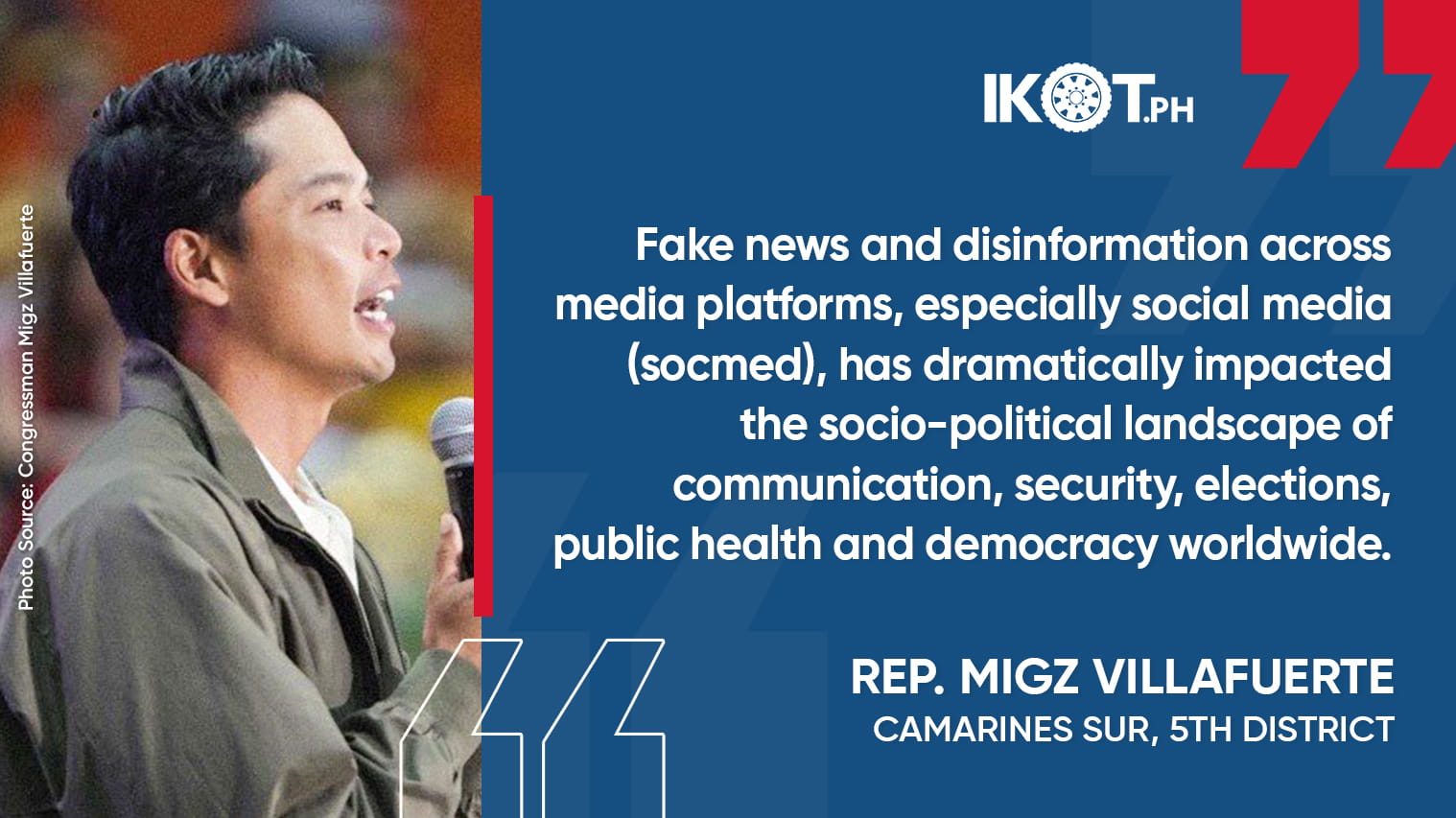
In House Bill (HB) No. 6314, or his version of the anti-fake news measure, Villafuerte said that, “The proliferation of fake news and disinformation across media platforms, especially social media (socmed), has dramatically impacted the socio-political landscape of communication, security, elections, public health and democracy worldwide.”
In a 2025 survey by the Social Weather Stations (SWS), he said 65% of Filipinos admitted they found it difficult to distinguish fake from real news, while 59% saw disinformation on the internet as a “serious” issue.
Further, the prevalence of fake news and disinformation has also significantly affected public trust in mainstream media, said Villafuerte, as 68% of respondents of a separate 2025 survey by Publicus Asia said they used internet search engines as their main source of political and current affairs information, followed by 66% and 65% who used Facebook and television (TV), respectively.
Established news outlets garnered significantly lower percentage scores, he said.
“As communication channels evolve at an unimaginable pace, it is imperative to institutionalize responsive safeguard measures aimed at protecting the public while maintaining to uphold the fundamental freedoms stipulated in our Constitution,” Villafuerte said in HB 6314, which he introduced with Deputy Majority Leader Luigi Villafuerte and fellow CamSur Rep. Tsuyoshi Anthony Horibata plus Bicol Saro Rep. Terry Ridon.
Yamsuan, who authored HB 5241 or his version of the anti-false information bill, said after the joint hearing that the proposed harsh punishment against peddlers of false information that threatens public order and national security is necessary because “fake news can be weaponized to manipulate public opinion, incite fear and panic, and endanger our democratic processes.”
Villafuerte said that the proposed substitute bill would do the following:
• Define fake news, disinformation, social media platforms, cyber-enabled dissemination and malicious intent;
• Identify prohibited acts including the malicious and knowing publication or dissemination of fake news or disinformation, especially those that incite violence, promotes hate speech, as well as acts related to the perpetuation of troll farms, bot networks, or coordinated campaigns aimed at spreading fake news;
• Impose penalties for violations including jail time or cash fines or both, within the jurisdiction of Regional Trial Courts (RTCs);
• Enumerate circumstances where maximum penalty shall be imposed, exceptions on the implementation of this measure, and guidelines for a judicial recourse;
Require socmed platforms operating in the Philippines or providing services to users in our country to assign their respective liaison officers to the Department of Information and Communications Technology (DICT).
These liaison officers shall act as pointpersons of socmed platforms Act on matters concerning compliance with this Act and and other cyber-related laws; and coordinate takedown or moderation requests involving malicious disinformation that threatens national security or public order; and
• Create a Joint Congressional Oversight Committee for the implementation of this measure once it is enacted into law.
Posting on Facebook after the joint hearing,Villafuerte said: “Ang fake news ay hindi simpleng usapin ng opinyon, lalo na kapag ginagamit ito upang maghasik ng takot at lituhin ang mamamayan.”
“Mas paiigtingin ang mga talakayan sa mga susunod na TWG meetings, kung saan kukunin ang pananaw ng mga stakeholder mula sa gobyerno at pribadong sektor upang makabuo ng isang batas na patas ngunit epektibo,” he said.