
With the non-stop oil price spikes likely to spiral up further in the weeks ahead following last weekend’s missile attacks in the Middle East, Deputy Majority Leader Luigi Villafuerte and Camarines Sur Rep. Migz Villafuerte want the government to fast-track contingency plans, including the grant of fuel subsidies to vulnerable sectors, to shield Filipinos from possibly galloping inflation in the event that the armed conflict in the region escalates.
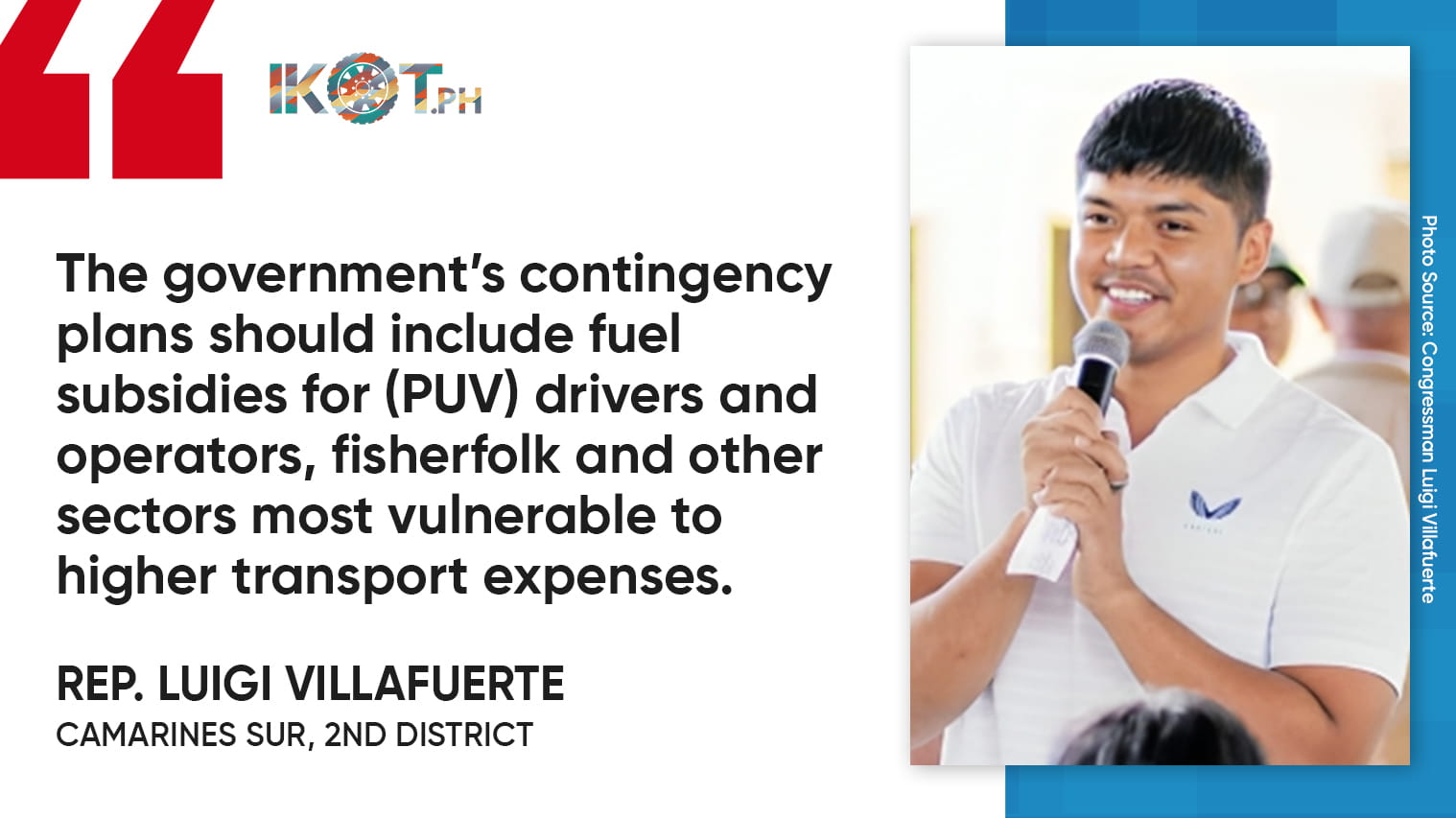
“The government’s contingency plans should include fuel subsidies for (PUV) drivers and operators, fisherfolk and other sectors most vulnerable to higher transport expenses in the event that the armed conflict in the Middle East gets worse better it gets any better, leading to ever spiraling retail costs of diesel, gasoline and other petroleum products,” Luigi and Migz Villafuerte said.
The Villafuertes said the Philippines’ extreme vulnerability to oil supply volatility, as shown in the current Middle East conflict, is one more reason for the government to accelerate its switch to renewables for power generation, as a way to reduce the country’s overdependence on fossil fuel.
Speculations are rife that unless the so-called joint “preemptive strikes” by the United States and Israel and the counterattacks by Iran end quickly, the strategically important chokepoint Strait of Hormuz, could remain closed and aggravate oil supply disruptions, possibly jacking up the cost of Brent crude—the international benchmark for crude oil—to $90 or higher, from $61 at the start of 2026.
Over the January-February months, non-stop price spikes have driven up the domestic pump prices of diesel by a total of P7.70 a liter and of gasoline by P6.70.
Alongside monthly fuel subsidies, Luigi Villafuerte said the proposed subsidy program, as contained in HB 3388, also seeks to automatically enroll fisher-beneficiaries in the NHIP of the Philippine Health Insurance Corp. (PhilHealth) to help defray their medical expenses in the face of their meager earnings from fishing.
With headline inflation already rising in February, the rate of price increases this March and onwards, the Villafuertes fret that “higher crude induced by the Middle East conflict, could lead to even faster inflation by way of higher prices of fish, meat and vegetables, and higher rates of electricity and other utilities and transportation, among others.”
Before the latest military attacks in the Middle East, the Villafuertes have led CamSur lawmakers in urging the Congress to legislate a program providing a monthly fuel subsidy of ₱1,000 to municipal fisherfolk plus their automatic enrollment in the National Health Insurance Program (NHIP).
Although belonging to a sector that is a major contributor to the domestic economy, our fisherfolk are, paradoxically, among the poorest Filipinos as they earn as low as ₱90 to ₱130 each at the end of a day’s fishing.
Hence, the Villafuertes’ proposal in House Bill (HB) No. 3388 on the establishment of a subsidy program dubbed “Pantawid Pambangka Program.”
“This bill-proposed Pantawid Pambangka Program is intended to help defray these fisherfolk’s fuel expenses, which eat up as much as 60% to 80% of the daily income they earn from their fish catch,” Luigi said of HB 3388, which he and Migz Villafuerte, the chairman of the House committee on information and communications technology (ICT) had authored with fellow CamSur Rep. Tsuyoshi Anthony Horibata and Bicol Saro Rep. Terry Ridon.
Alongside monthly fuel subsidies, Luigi said the proposed subsidy program, as contained in HB 3388, also seeks to automatically enroll fisher-beneficiaries in the NHIP of the Philippine Health Insurance Corp. (PhilHealth) to help defray their medical expenses in the face of their meager earnings from fishing.
The US and Israel launched what they called “preemptive” missile strikes against Iran last Feb. 28, resulting in the death of Iranian supreme leader Ayatollah Ali Khamenei.
In retaliation, Iran launched missile and drone attacks on Israel and on eight (8) oil-producing Middle Eastern states that house US bases in the region—Bahrain, Qatar, the United Arab Emirates (UAE), Oman, Kuwait, Iraq, Jordan and Saudi Arabia.
Iran’s Revolutionary Guards also banned navigation or marine transport in the Strait of Hormuz, the only sea passage for oil shipments from the Persian Gulf to the open sea.
With headline inflation already rising in February, the rate of price increases this March and onwards, the Villafuertes fret that higher crude induced by the Middle East conflict, would lead to faster inflation by way of higher prices of fish, meat and vegetables, and higher rates of electricity and other utilities and transportation.
The Villafuertes pointed out that with the constant rise in diesel prices, the fuel expenses of small Filipino fishers now account for as high as 80% of their total fishing expenses, forcing them to cut back on the time and days they spend at sea to save on their production costs, which, in turn, lead to their lower earnings.
With the high cost of fuel, small-scale fishers reportedly spend P800 to P1,000 on diesel per fishing trip, forcing them to earn as low as P300 to P500 when their fish catch is low.
To save on fuel costs, small fisherfolk either cut their fishing trips from 6-8 hours down to 4-5 hours, limit their trips from 5-6 days per week to only 3-4 days, or look for alternative livelihoods.
Citing Bureau of Fisheries and Aquatic Resources (BFAR) data, they said there were 2,302,648 registered fisherfolk in the Philippines as of 2022, and whose daily income per fishing boat was around P272, which is even divided among the two or three persons who man each boat.
Luigi said that, “With the increasing rate of fuel, our fisherfolk are considerably affected because they rely heavily on fuel to ensure they are able to fish even in faraway fishing grounds because of the depletion of nearby fishing grounds.”
Migz said that under the bill, the monthly subsidy of ₱1,000 shall be administered by the Department of Agriculture (DA), and that this amount shall be revised every year to account for inflation.