
The irksome sight of so-called “spaghetti” wires dangling from posts in urban centers might soon be gone, once senators clear their version of a newly-approved House Bill (HB) tasking electricity distribution, cable and telecommunications companies (telcos) to assume full responsibility for the safety, maintenance and orderly management of their overhead power and communications lines, according to Camarines Sur (CamSur) Rep. Migz Villafuerte.
Villafuerte, who chairs the House committee on information and communications technology (ICT), appealed to senators to act swiftly on their counterpart measure to HB 7565, or the “Safe Overhead Electric Distribution, Cable and Communication Lines Act,” which the bigger chamber passed unanimously on third and final reading recently by a 223-0 vote.
The plenary approval of HB 7565 was endorsed by the Villafuerte-headed ICT committee and the House committee on energy, chaired by Palawan Rep. Jose Alvarez, after both panels cleared this bill in a joint hearing.
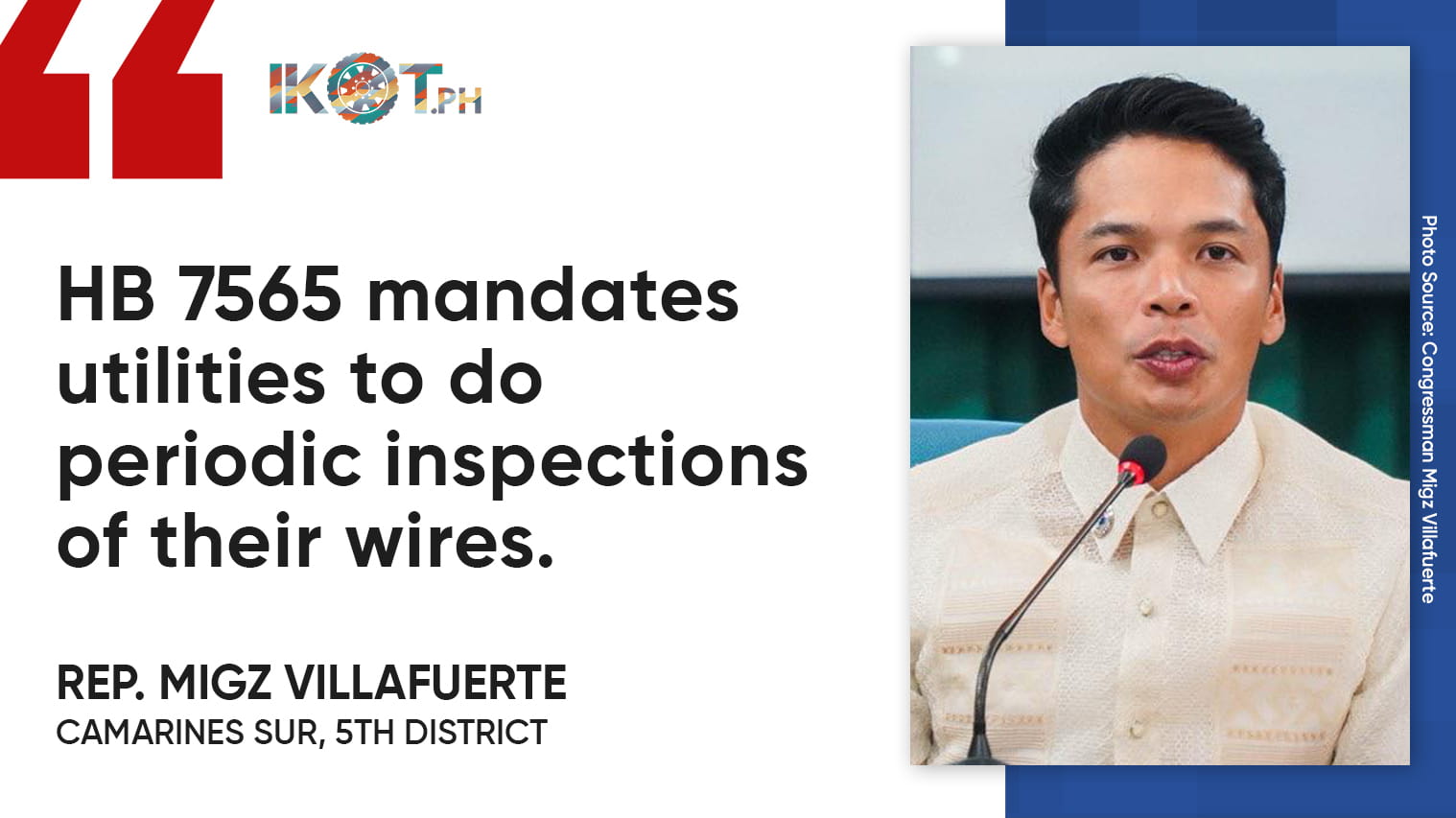
HB 7565 mandates utilities, said Villafuerte, to do periodic inspections of their wires; to remove dangling and unused wires; to bundle and secure active lines; to replace damaged or leaning poles; and to observe proper height clearances, in accordance with the Philippine Electrical Code.
Companies found violating this Act shall, under the bill, face escalating penalties, with fines ranging from P250,000 to P500,000 on the first offense; P500,000 to P1,000,000 on the second offense; and P1,000,000 to P2,000,000 on the third and succeeding offenses, he said.
HB 7565 also institutionalizes regular and systematic inspections by requiring electricity distribution, cable and telecommunications firms to undertake periodic audits of their overhead lines and to coordinate clean-up and rehabilitation activities within their service areas.
House Majority Floor Leader Rep. Ferdinand Alexander Marcos III, a principal author of HB 7565, said this bill squarely addresses long-standing public safety hazards by tasking utilities to be responsible for maintaining safe, orderly and compliant systems.
Marcos said the bill sets uniform standards and meaningful penalties “so that compliance becomes the norm, not the exception … We are setting uniform standards and meaningful penalties so that compliance becomes the norm, not the exception. This is about protecting lives, safeguarding property and ensuring that our infrastructure keeps pace with development.”
HB 7565 also institutionalizes regular and systematic inspections by requiring electricity distribution, cable and telecommunications firms to undertake periodic audits of their overhead lines and to coordinate clean-up and rehabilitation activities within their service areas.
This bill provides for the establishment of monitoring and service teams in every city and municipality that shall conduct semi-annual inspections, oversee removal of unused cables and monitor the replacement of defective poles and unsafe installations.
Local government units (LGUs) are tasked by the bill to have a key role in ensuring compliance by clothing them with the authority to pass implementing ordinances within 60 days from the effectivity of the implementing rules and regulations (IRR) of this Act, and to withhold or deny the renewal of business permits of non-compliant utilities operating within their respective localities.
The measure also seeks the creation of an inter-agency committee to jointly prescribe the standards in the overhead installation of the lines, cables, utility poles and equipment of the concerned service providers.
This proposed inter-agency committee shall comprise representatives from the Energy Regulatory Commission (ERC), National Telecommunications Commission (NTC), Departments of the Interior and Local Government (DILG) and of Information and Communications Technology (DICT), National Transmission Corp. (Transco) and the other appropriate agencies.
Prior to its plenary approval, HB 7565 was passed in the joint committee hearing in place of several similar bills, including HB 64 authored by Reps. Jurdin Jesus Romualdo (Camiguin), HB 584 by Rep. Jaime Fresnedi (Muntinlupa City), HB 617 by Rep. Antonino Roman III (Bataan), HB 5238 by Rep. Agatha Paula Cruz (Bulacan) and HB 6872 by Rep. Christopherson Yap (Southern Leyte).
A similar bill co-authored by Romualdo was passed by the House two years ago in the 19th Congress, but a counterpart measure remained at the committee level in the Senate.
The other authors of the similar bills consolidated into HB 7565 pointed to the importance of requiring service providers to observe good housekeeping practices in putting up all types of utility lines, cables, poles and accessories for them to deliver their services to their respective customers.
“Let us make our communities and streets safe from overhead hazards which has caused injuries and deaths aside from damages to properties,” said Romualdo in HB 64. “Let us encourage these service utility providers to be responsible of their overhead installations.”
Fresnedi said in HB 584 that the measure aims to address the problem of “spaghetti” wires, or the “obstructive, entangled and low-hanging wires which are an eyesore and safety concern to the public.”
“These disorganized and neglected utility lines not only contribute to visual blight but also pose serious risks to public safety,” he said. “The lack of coordinated maintenance among electric distribution, cable, and telecommunications companies has worsened this issue over the years.”
The plenary approval of HB 7565 was endorsed by the Villafuerte-headed ICT committee and the House committee on energy, chaired by Palawan Rep. Jose Alvarez, after both panels cleared this bill in a joint hearing.
In HB 617, Roman noted that the measure aims to “mandate all electric, cable and telecommunications companies to conduct periodic inspections of their respective utility line installations to ensure strict compliance with the standards and regulations provided under the Philippine Electrical Code.”
The Philippine Electrical Code was approved and adopted by the Board of Electrical Engineering of the Professional Regulation Commission (PRC), by virtue of Republic Act (RA) No. 7920, or the “New Electrical Engineering Law.”
Fresnedi said that under this Code, overhead power lines have strict guidelines for height clearances over streets, sidewalks, alleys, roads and driveways for the safety of the public. “However, through the passage of time, in the absence of regular inspection and monitoring, the sagging of these wires and cables may happen which endangers the lives of people.”
Cruz noted in HB 5238 that overhead lines, poles and cables “stretch across our skylines and roadsides like veins carrying the lifeblood of electricity, information and communication. If left untended, these veins can also clog, fray, and collapse. Dangling wires, leaning poles, tangled and unused cables, and even collapsed utility structures have become not only an eyesore but a daily peril. What should serve as lifelines of progress turn into traps of neglect.”
“In a country often battered by natural calamities, we cannot allow man-made hazards to dangle above our heads,” Cruz added. “This measure) ensures that what brings light, power, and connection no longer casts a shadow of danger.”
Yap pointed out in HB 6872 that “when poles are overloaded, wires are left hanging or abandoned, and facilities are poorly maintained, our streets become dangerous. Lives are put at risk, properties are damaged, and public spaces meant for everyone turn into symbols of neglect and disorder.”
He said that the Supreme Court has repeatedly affirmed that as public utilities that rely on lines or cables to serve their customers, “these companies are presumed to have the expertise and resources to install and maintain their posts and wires safely, and are liable when their negligence causes fire, injury, or loss. Government regulators have likewise adopted technical standards to protect the public from electrical hazards.”