
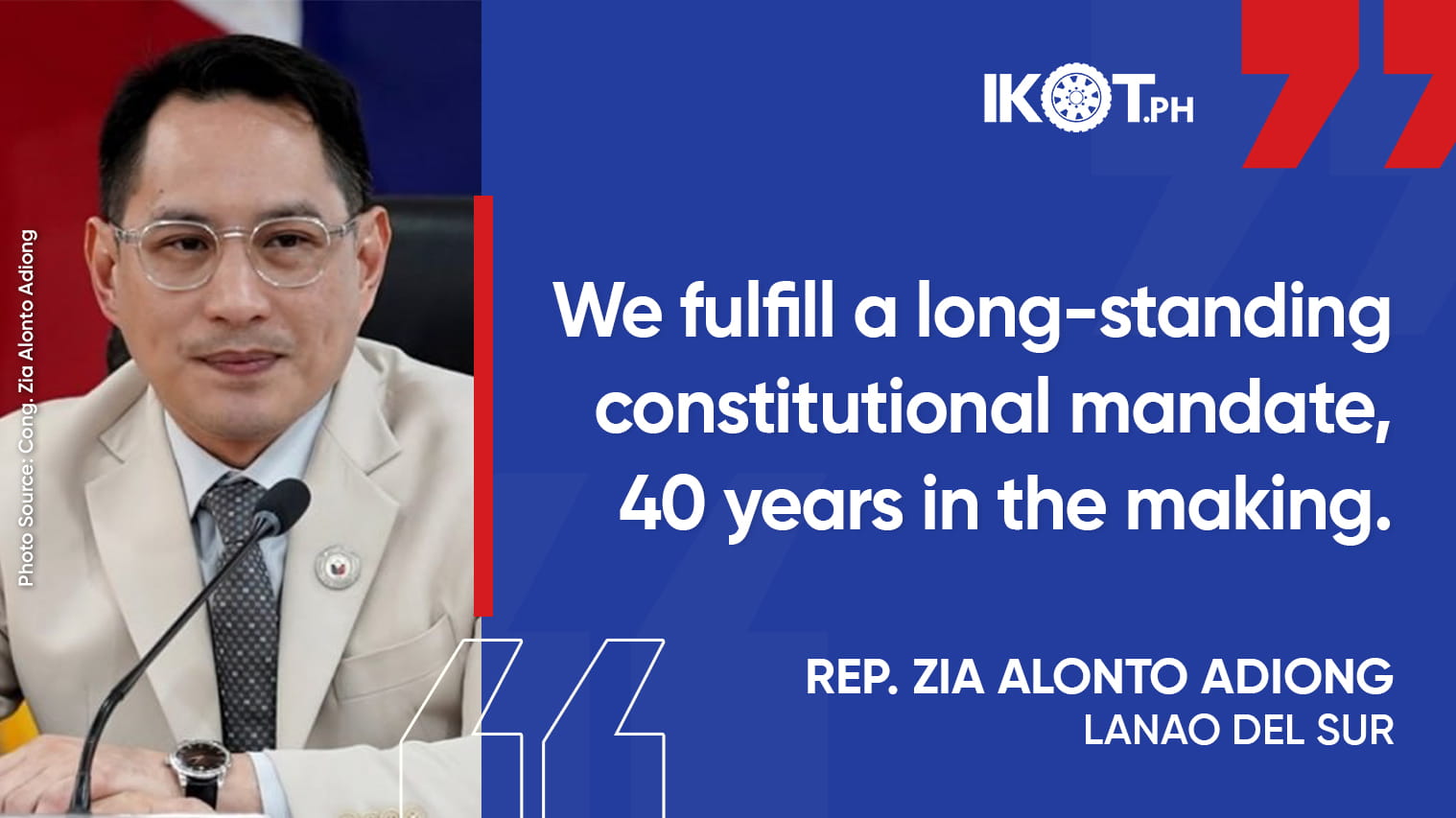
Calling it the electoral reform “40 years in the making,” Lanao del Sur Representative Zia Alonto Adiong pushed for the passage of a bill banning political dynasties, saying Congress can no longer afford to ignore a clear constitutional directive.
“Today, we have the opportunity to make history. Today, we fulfill a long-standing constitutional mandate, 40 years in the making,” Adiong, chair of the House Committee on Suffrage and Electoral Reforms, said in sponsoring House Bill No. 8389.
The measure—principally authored by Speaker Faustino “Bojie” Dy III and Majority Leader Sandro Marcos, with 173 other lawmakers as co-authors—seeks to implement a provision of the 1987 Constitution that has remained unenforced for four decades.
Adiong stressed that the Constitution clearly directs the State to ensure equal access to public office and prohibit political dynasties.
“Our Constitution is unequivocal in its guidance. Under the 1987 Philippine Constitution, Article II, Section 26 states that the State shall guarantee equal access to opportunities for public service and prohibit political dynasties as may be defined by law,” the veteran legislator said.
The seasoned lawmaker explained that while Congress is tasked to define political dynasties, this authority must be exercised within the bounds of other constitutional rights.
“Our responsibility is to craft a definition that is constitutional, workable, and capable of withstanding scrutiny here in plenary session and in the courts.”
“Our task is not simply to write the most restrictive definition possible. Our responsibility is to craft a definition that is constitutional, workable, and capable of withstanding scrutiny here in plenary session and in the courts,” he said.
Adiong underscored that the bill strikes a careful balance between reform and democratic principles.
“This bill is designed with precisely that objective. It uses the limited authority granted to Congress by the Constitution to define political dynasties in a manner that enables their prohibition, while remaining fully consistent with the other rights and principles enshrined in our fundamental law,” he said.
Adiong also highlighted the extensive groundwork behind the measure, including multiple committee hearings and nationwide consultations in Cavite, Cebu, and Cagayan de Oro, where stakeholders aired both support and concerns.
“These discussions reaffirmed an important reality. The challenge before Congress is constitutional, legal, and deeply practical,” he said.
“This measure is grounded and pragmatic.”
“That is why this measure is grounded and pragmatic. It seeks to advance the constitutional directive to prohibit political dynasties while preserving the democratic foundations upon which our Republic stands,” Adiong added.
The measure is among the priority reforms of the House leadership and is also included in the Legislative-Executive Development Advisory Council agenda of President Ferdinand Marcos Jr.
“This bill represents a careful and deliberate step toward fulfilling that mandate,” Adiong said, as he urged his colleagues to support the measure.