As chair of this year’s Association of Southeast Asian Nations (ASEAN), the Philippines is in a pivotal position to advance regional solidarity amid global energy uncertainty.
Senator Chiz Escudero said Manila must exert efforts to push forward the ASEAN Petroleum Security Agreement (APSA) and ensure member states can support one another during petroleum supply disruptions.
The APSA is ASEAN’s proposed framework for emergency fuel-sharing, designed to allow member states to supply petroleum to neighbors facing shortages of at least 10 percent of their domestic needs. Its objectives are to stabilize energy supply, prevent economic shocks, and reinforce ASEAN’s collective resilience in times of crisis.
Escudero noted that the APSA scheme is modeled after the International Energy Agency (IEA), which pioneered coordinated fuel-sharing among its members.
“ASEAN can establish its own mechanism for emergency fuel supply.”
“By accelerating APSA’s completion, ASEAN can establish its own mechanism for emergency fuel supply, triggered when a member state experiences a shortfall of at least 10 percent,” the veteran legislator said.
The seasoned lawmaker added that this arrangement supports ASEAN’s three priority pillars—Peace and Security Anchors, Prosperity Corridors, and People Empowerment—reflecting the region’s collective focus on resilience, economic integration, and community solidarity.
“The current volatility in the Middle East highlights the urgency of a regional action, with oil prices rising and supply chains vulnerable. We have to act as one ASEAN,” the senator said.
He underscored that ASEAN’s fuel-sharing framework will be most effective if backed by member states with oil reserves and production capacity, such as Brunei Darussalam, Indonesia, and Malaysia.
“By pooling resources, ASEAN can ensure that emergency supplies are not only pledged but delivered when needed.”
“Their role is crucial in anchoring the agreement. By pooling resources, ASEAN can ensure that emergency supplies are not only pledged but delivered when needed,” Escudero said.
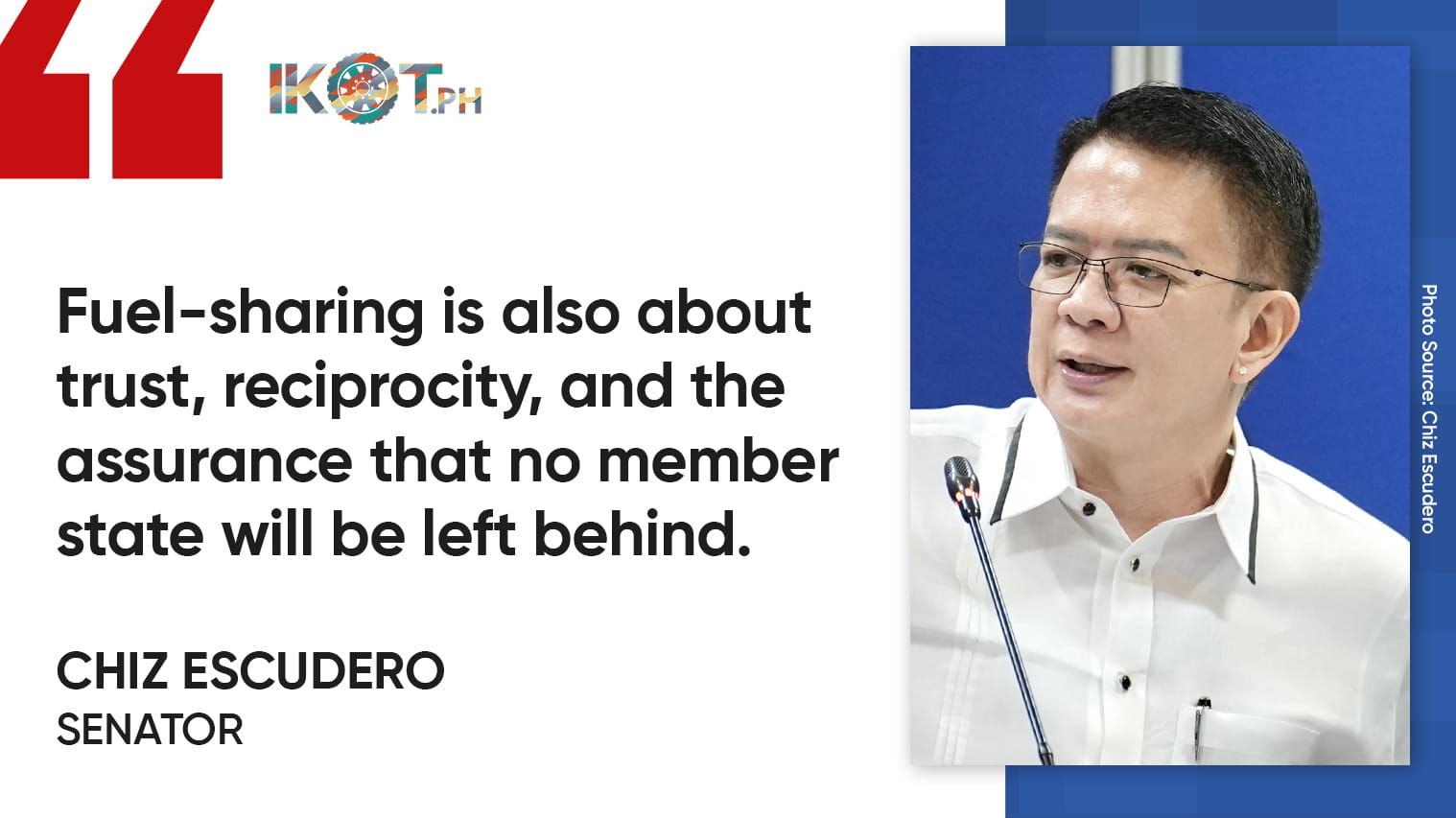
“Fuel-sharing is not only about barrels of oil. It is also about trust, reciprocity, and the assurance that no member state will be left behind,” he added.
Escudero said that the Philippine chairmanship is both a responsibility and an opportunity.
“This is our chance to lead ASEAN toward energy resilience. By working together, we can shield our region from external shocks and truly embody the theme of this year’s summit, ‘Navigating Our Future, Together,’ with solidarity and shared purpose,” he concluded.