
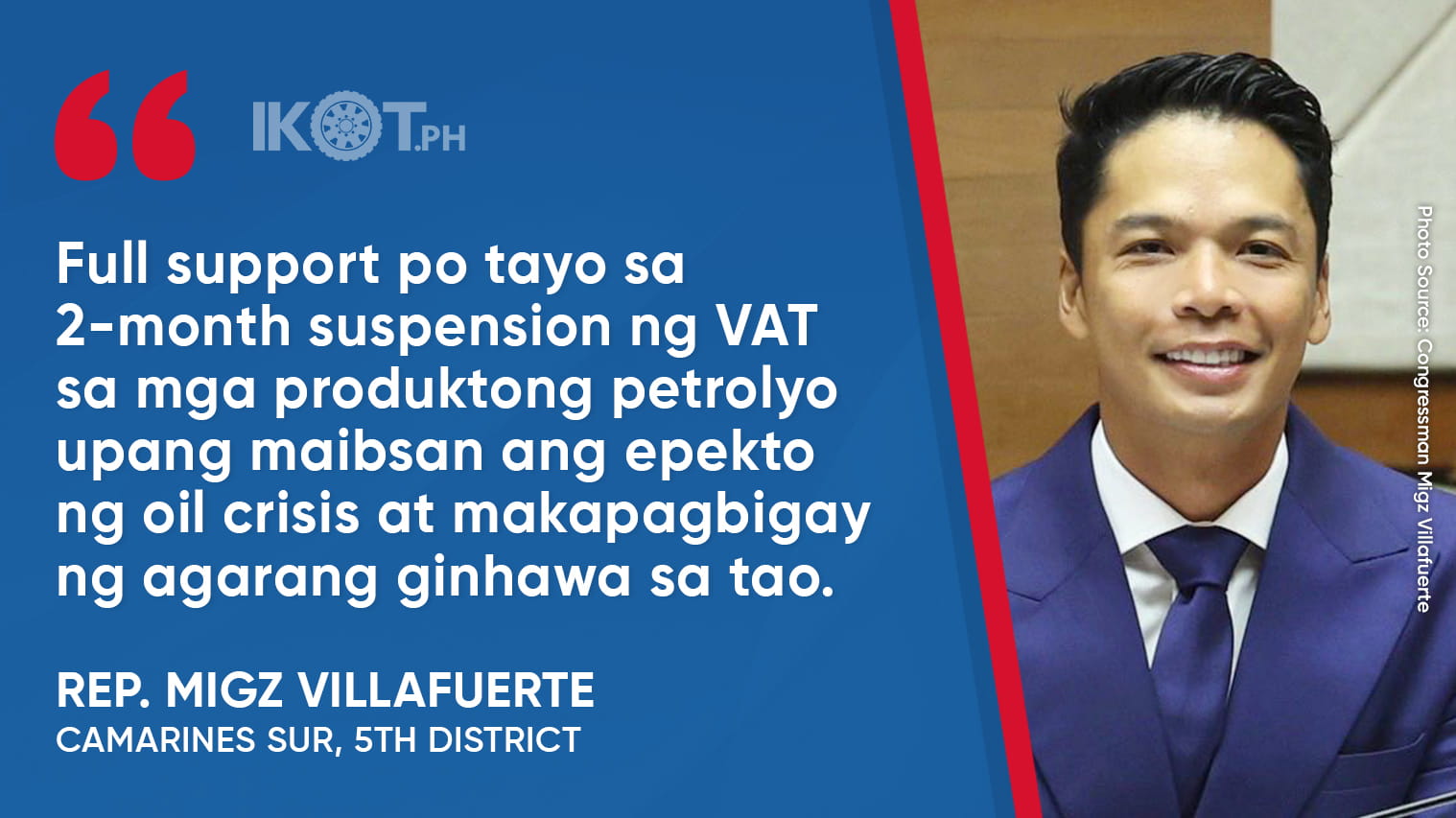
Camarines Sur (CamSur) Rep. Migz Villafuerte is backing a proposal in the 13-committee House mega panel tackling the global oil shock to suspend for two months the collection of the Value Added Tax (VAT) on petroleum products, “to relieve the burden of the now outrageous fuel prices, which, unless eased, could possibly shove as many 1.34 million to 3.5 million near-poor Filipinos into poverty.”
Villafuerte said he supports the proposal of Marikina City Rep. Miro Quimbo, who heads the multi-panel oversight and policy review Legislative Energy Action and Development (LEAD) Council, “to put off for two months the collection of VAT on petroleum products, to give Filipinos a badly-needed respite from the rocketing pump prices of diesel and gasoline brought about by the Middle East war that broke out in end-February.”
Quimbo, who chairs the House committee on ways and means, is the overall chairman of the LEAD Council, which Speaker Faustino “Bojie” Dy III created earlier this April to tackle the economic fallout from the war-driven global oil shock and to craft legislative proposals to cushion its pernicious impact on Filipinos and businesses.
“I agree with Rep. Miro that a two-month VAT suspension is feasible, in light of the projected P20 billion windfall profits that the government has thus far collected from the outrageously high diesel and gasoline prices at the pump after the US-Israel joint attack on Iran began nearly two months ago,” said Villafuerte, who is on the LEAD Council as chairman of the House committee on information and communications technology (ICT).
Villafuerte said the cost of fuel is a major driver of inflation, and the Philippines is highly vulnerable to volatile oil prices because it imports 98% of its fossil fuel needs.
Villafuerte explained that a substantial and quick reduction of fuel prices is necessary to prevent a spike in the country’s poverty rate, given that the government think tank Philippine Institute for Development Studies (PIDS) projects as many as 1.34 million to 3.5 million more Filipinos could become poor owing to the economic shocks arising from the sky-high oil prices amid the Mideast war.
He noted that based on its policy note on “a simulation of current oil price conditions,” the PIDS said the national poverty rate could rise from 13.2% in 2025 in 14.4% this year—translating into another 1.34 million Filipinos becoming poor—should the cost of crude oil be at $105 per barrel and a pass-through rate of 35% to domestic prices.
Moreover, the PIDS study said that 2.35 million more Filipinos could become poor if oil prices rise to $125 a barrel, and a bigger number of 3.5 million Filipinos could fall into poverty, if crude goes even higher at $145 a barrel.
This will “(reverse) recent gains” in the government’s poverty reduction efforts, said the PDIS study, because the most vulnerable to becoming poor are those coming “largely from households just above the poverty line—the so-called near-poor—who are most at risk of slipping into poverty as daily expenses rise.”
Poor families are the hardest hit by faster inflation resulting from the higher costs of fuel and other expenses because, as per the PIDS study, they are the ones who spend most of their income on essentials and have little to no savings at all, Villafuerte said.
From a per-barrel average of $60 to $70 for crude oil at the onset of 2026, global prices soared to $110 to $120, and even peaking briefly at $128, after the US-Israel joint air strikes on Iran started on Feb. 28.
From a pre-war average of P48 to P65 per liter of diesel and P49 to P63 for gasoline, such rates went up in Metro Manila to P110 to P150 for diesel and P82 to P105 for gasoline before the start of the Pakistan-brokered ceasefire between the US and Iran on April 8.
Crude oil prices eased to $80 to $86 a barrel this week because of the two-week ceasefire, leading to price cuts in diesel and gasoline.
However, Villafuerte recalled that no less than Energy Secretary Sharon Garin conceded that the government couldn’t predict how the ceasefire would affect global and domestic oil prices, as this problem “will stay longer than the war itself,” and that, “if it (local prices) ever goes down to P100 or below, it will take some time.”
“We don’t have visibility where this will go,” Garin said, as she did not rule out speculations that fuel prices could possibly rise to as high as P200 per liter.
In a weekend post on Facebook, Villafuerte said: “Full support po tayo sa 2-month suspension ng VAT sa mga produktong petrolyo upang maibsan ang epekto ng oil crisis at makapagbigay ng agarang ginhawa sa tao.”
“Naniniwala po tayo na mas mahalagang maibsan ang hirap ng mamamayan kahit pansamantalang mabawasan ang koleksyon ng buwis,” he said. “Kinakailangan ng batas upang maisakatuparan ito bilang tugon sa pagtaas ng presyo ng langis at iba pang bilihin.”
Villafuerte said there are also pending proposals in the Senate on suspending, reducing or removing altogether the VAT on oil products.
Without VAT, Villafuerte said importers of petroleum products can immediately reduce the prices of their imports at the point of entry as they wouldn’t have to pay
He said that Republic Act (RA) No. 12316 has empowered President Marcos to suspend or reduce excise taxes on oil products, which are equivalent to P6 per liter of diesel and P10 per liter of gasoline under the Tax Reform for Acceleration and Inclusion (TRAIN) Law.
The excise tax is computed on the volume and not on the price of a product.
“Suspending the collection of, or reducing, the 12% VAT on oil products will result in a more immediate and substantial cut in diesel and gasoline prices at the pump for the benefit of consumers because the VAT is computed based on the actual amount of these petroleum products,” he said.
“This means that the government collects more and more VAT taxes as diesel and gasoline prices go up higher and higher,” he added.
In case both chambers of the bicameral Congress agree to suspend or reduce the VAT on oil products, a law on this pro-consumer measure can be passed within weeks from the reopening of the Legislature on May 4, he said, judging from how fast the House, the Senate and Malacañan Palace had acted to bring about RA 12316.
He noted that RA 12316 was signed into law by the President on March 25, or barely a week after the House and the Senate had ratified the enrolled bill and then submitted it to the Palace for the President’s approval.
Without decisive action to substantially lower fuel prices in the local market, Villafuerte said that economic experts project headline inflation, which already rose to 4.1% in March 2026 from February’s 2.4%, to go up further in the months ahead.
The March inflation rate of 4.1% also breached the inflation target of 2% to 4% of the Bangko Sentral ng Pilipinas (BSP).
“Above-target inflation induces elevated second-round effects on the domestic economy—including higher transport fares, electricity and water bills, and commodity prices—that will hit the hardest ordinary Filipinos who are already reeling from the ever-spiraling cost of living,” Villafuerte said.
He said that the cost of fuel is a major driver of inflation, and the Philippines is highly vulnerable to volatile oil prices because it imports 98% of its fossil fuel needs.
The BSP said earlier it could raise interest rates should oil prices stay at $100 a barrel and inflation continues to breach 4%.
Villafuerte said the country’s oil players support the proposal to remove or suspend the VAT on oil products, on their same belief that such would lead to an immediate and hefty decline in petroleum prices for Filipino consumers.
Without the VAT, he said that importers of petroleum products can immediately reduce the prices of their imports at the point of entry as they wouldn’t have to pay the 12% tax when their fuel cargoes arrive in the country.
Even before the US-Israel war on Iran began last February, Migz Villafuerte and Deputy Majority Leader Luigi Villafuerte already expressed concern about the steady pre-war spike in fuel prices, and pushed the congressional approval of a measure—House Bill (HB) No. 3388—on a monthly fuel subsidy of ₱1,000 to municipal fisherfolk plus their automatic enrollment in the National Health Insurance Program (NHIP).
Later on, the Villafuertes appealed to the Department of Agriculture (DA) and the Bureau of Fisheries and Aquatic Resources (BFAR) to make good on their plan to ask for an additional budget from the P10-billion Presidential Assistance to Farmers and Fisherfolk (PAFF) to increase the amount for the fuel subsidy program for qualified farmers and fishermen, or to tap the unused fuel subsidy funds deposited in the Development Bank of the Philippines (DBP).
In HB 3388, the Villafuertes proposed the establishment of a subsidy program dubbed “Pantawid Pambangka Program,” to help defray our fisherfolk’s fuel expenses, which eat up as much as 60% to 80% of the daily income they earn from their fish catch.
With the high cost of fuel, small-scale fishers reportedly spend P800 to P1,000 on diesel per fishing trip, forcing them to earn as low as P300 to P500 when their fish catch is low.
To save on fuel costs, small fishers either cut their fishing trips from 6-8 hours down to 4-5 hours, limit their trips from 5-6 days per week to only 3-4 days, or look for alternative livelihoods.