
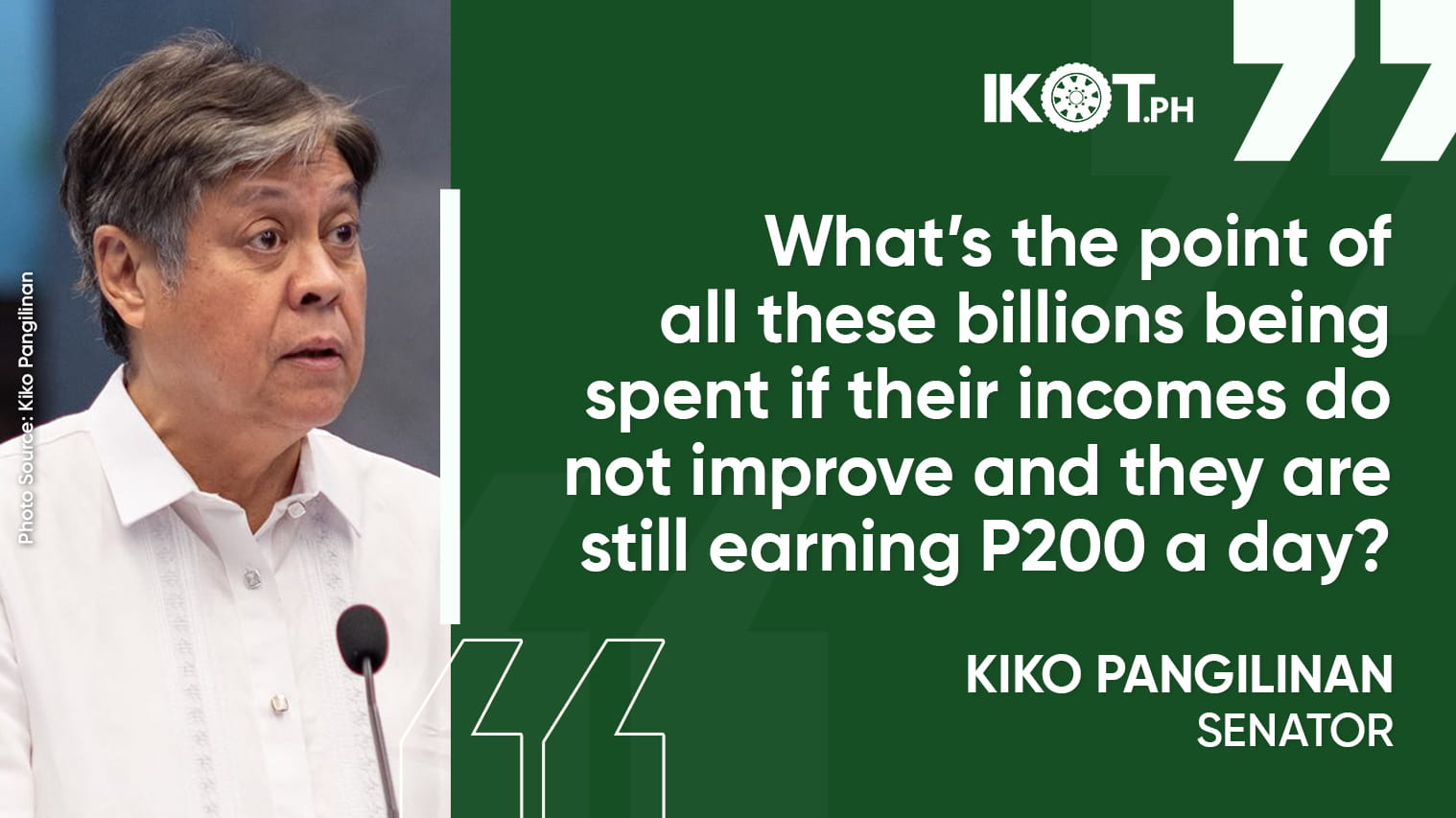
Senator Kiko Pangilinan raised concern over the continued underutilization of the Coconut Farmers and Industry Trust Fund, saying billions of pesos meant to help coconut farmers remain unused while many continue to earn only around P200 a day.
During the hearing of the Senate Committee on Agriculture, Food, and Agrarian Reform hearing on the coco levy fund, Pangilinan raised concern over the continued underutilization of the fund, saying billions of pesos meant to help coconut farmers remain unused while many of them continue to earn only around P200 a day.
Several government agencies and instrumentalities, including the LandBank, Agricultural Training Institute, Philippine Center for Postharvest Development and Mechanization, Bureau of Animal Industry, Department of Science and Technology, and the DA’s High Value Crops Development Program, reported utilization rates of below 50%.
The LandBank has a utilization rate of only 1%, which means it has lent to only 38,000 out of 2.5 million registered coconut farmers.
The LandBank, in particular, has a utilization rate of only 1%, which means it has lent to only 38,000 out of 2.5 million registered coconut farmers.
“What’s the point of all these billions being spent if their incomes do not improve and they are still earning P200 a day? Kalokohan, ‘di ba?” the veteran legislator said.
The seasoned lawmaker chairs the agriculture panel, led the hearing to discuss Senate Bill No. 1457, or the Act Strengthening Coconut Farmers Participation in the Utilization of the Coconut Farmers and Industry Trust Fund (CFITF), and Senate Resolution No. 23 on the Coconut Farmers and Industry Trust Fund Act.
Republic Act No. 11524 created the trust fund to finance programs under the Coconut Farmers and Industry Development Plan. These include hybrid coconut planting, technical training, intercropping, medical assistance, and support for coconut farmer cooperatives.
But the senator said the government should not merely track the number of trees planted, programs implemented, or funds released. He said the more important question is whether these interventions are actually improving the lives and incomes of coconut farmers.
“All these interventions are necessary so that you will not just increase productivity, but you will increase income.”
“All these interventions are necessary so that you will not just increase productivity, but you will increase income. So, from a benchmark of P200 a day when these interventions are undertaken, let’s not talk about 100 million trees over a period of x years without pegging an income benchmark,” Pangilinan said.
The Philippine Coconut Authority (PCA) disclosed during the hearing that coconut farmers earn only about P200 a day, their incomes largely depending on the size of the farms.
He directed the PCA to submit a paper showing how current interventions under the law can translate into higher income for coconut farmers.
Pangilinan said the committee would review the implementation of RA 11524 and determine whether amendments are needed to ensure that the coco levy fund more directly benefits coconut farmers. He also noted that he had expressed reservations on some provisions of the measure during its passage in the 18th Congress.
Pangilinan, who previously chaired the boards of the PCA and the National Irrigation Administration during the Aquino administration, also recalled a model where government support for production, processing, and clustering could allow coconut farmers to earn as much as P120,000 a month.
“That’s what you want to happen. That is the vision or the mission that with these interventions, a coconut farmer clustered with economies of scale will now earn this much,” he concluded.