
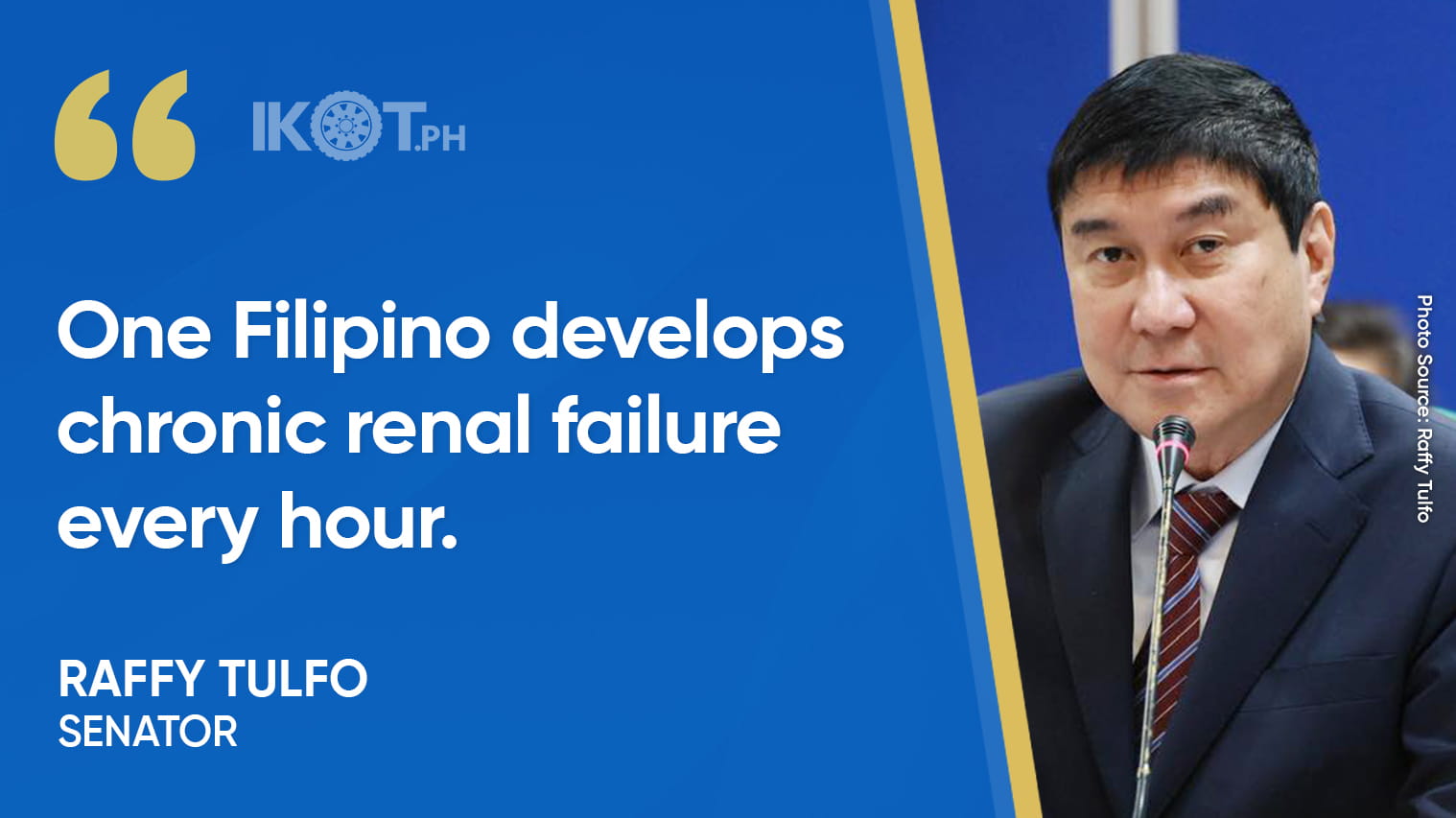
Senator Raffy Tulfo raised alarm over the rising number of Filipinos suffering from Chronic Kidney Disease (CKD), describing the illness as a “silent killer” that requires urgent government intervention.
In his privilege speech delivered at the Senate recently, Tulfo stressed that CKD has become a major public health concern in the Philippines, with an estimated 13 million Filipinos currently affected across different stages of the disease.
“Today, I wish to address an urgent public health issue that is silently but steadily affecting the Filipino people: ang pagtaas ng kaso ng Chronic Kidney Disease,” the legislator emphasized.
“The disease previously affected mostly senior citizens, around 57.44% of kidney disease patients are now between 20 and 59 years old.”
Citing data from the Philippine Society of Nephrology, the lawmaker said one Filipino develops chronic renal failure every hour. The senator also noted that while the disease previously affected mostly senior citizens, around 57.44% of kidney disease patients are now between 20 and 59 years old.
His expressed concern over the increasing number of younger patients diagnosed with CKD, including teenagers and even children as young as four years old. Hospitals nationwide, he said, continue to record new pediatric kidney failure cases.
He also shared the stories of several CKD patients who sought his assistance, including Mariano Trias, who was diagnosed at age 30; Ron Ryan Jacinto, who was diagnosed at 16 and has been undergoing dialysis for six years; and Argee Sibulan, who was diagnosed with Stage 5 CKD at four years old and has been on dialysis for nearly a decade.
According to Tulfo, one in every three CKD patients is already in Stages 3 to 5 of the disease. At these stages, treatment costs can reach as much as P116,000 for non-diabetic patients, while diabetic patients may spend between P46,000 and P120,000 to manage their condition.
“Uncontrolled diabetes and hypertension as the leading causes of CKD.”
He cited uncontrolled diabetes and hypertension as the leading causes of CKD, based on information from the Department of Health and the Philippine Renal Disease Registry. Diabetes can damage the kidneys over time through elevated blood sugar levels, while hypertension damages blood vessels and the kidneys’ filtering system.
Tulfo said the Philippines remains among the Southeast Asian countries with the highest CKD cases due to ineffective healthcare system, widespread risk factors, and limited public awareness.
To address the growing crisis, the senator proposed three key government measures: expanding early detection through routine blood pressure and blood sugar monitoring; increasing access to essential diagnostic procedures such as the Urine Albumin-to-Creatinine Ratio (uACR) test, which currently costs between P1,500 and P3,500 and is not covered by PhilHealth; and requiring warning labels on food products with high sugar and sodium content.
“Dapat may mga programa para sa early detection, essential diagnostic procedures such as the Urine Albumin-to-Creatinine Ratio (uACR) test at health label ratings sa mga produktong pagkain,” he pointed out.
Tulfo likewise urged fellow lawmakers to support his Senate Bill No. 2123, or the “Accessible Kidney Care Act,” which seeks to provide free kidney health screenings at Barangay Health Centers and Super Health Centers nationwide to make early detection more accessible to the public.