
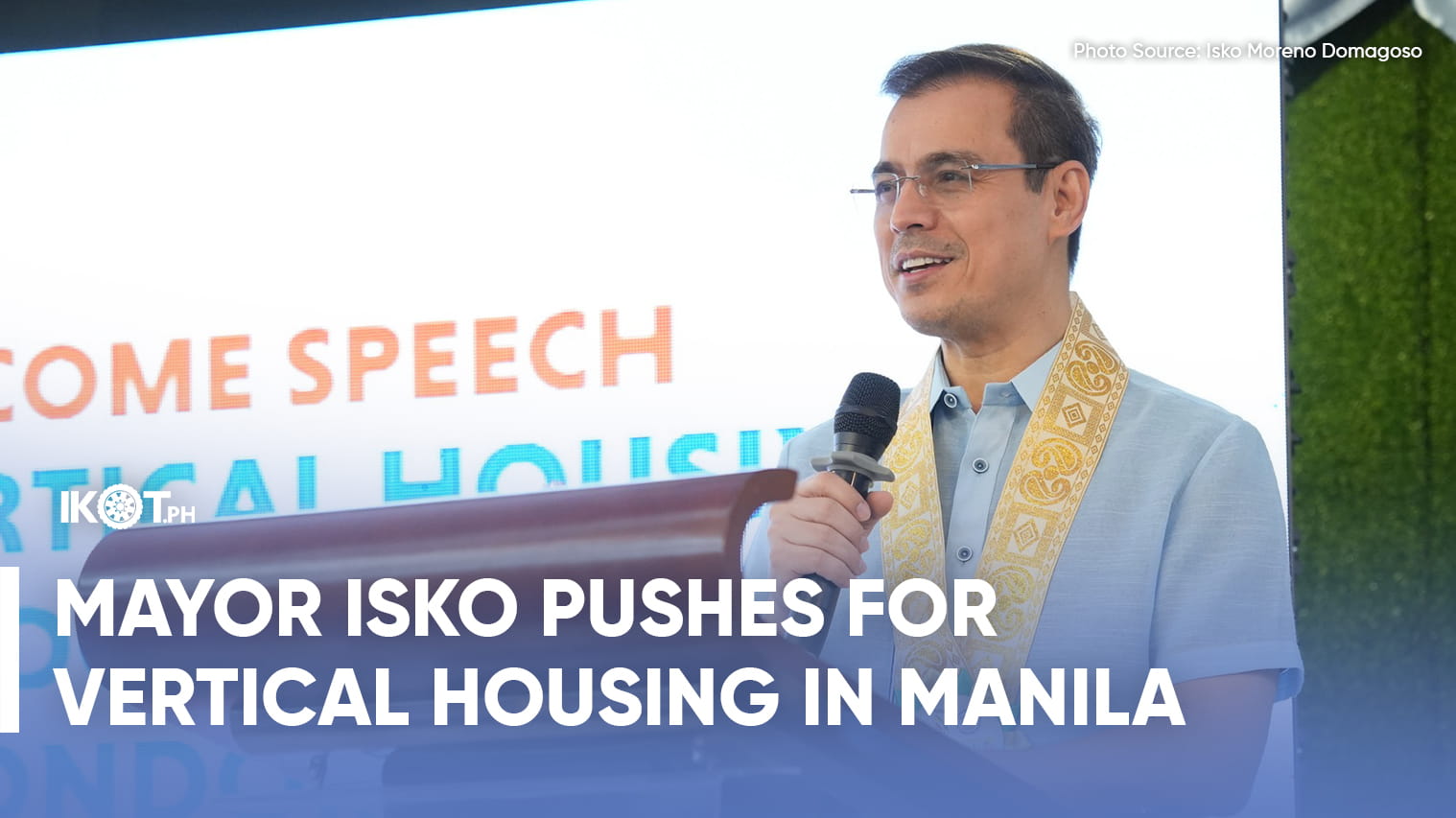
Manila City Mayor Francisco “Isko Moreno” Domagoso pitched his city government’s in-city vertical housing program before hundreds of real estate practitioners gathered for the National Real Estate Association’s 30th NREA-DHSUD National Convention, saying thousands of families had already benefited—and vowing to keep building.
Domagoso traced the roots of the program to his own experience growing up as a squatter in Manila, recalling how his mother migrated from Northern Samar, found work as a household helper in Tondo, and eventually put up a makeshift home on a lot along Road 10 at the end of Roxas Boulevard.
The mayor said his mother’s advice to him was simple: “Umulan, bumagyo, magkaroon ng delubyo, may masisilungan ka.”
“Nagtanim ng talbos ng kamote, bahay ang tumubo.”
“Nagtanim ng talbos ng kamote, bahay ang tumubo,” he said, describing the cycle of informal settlement as a “social perennial problem” driven not by laziness but by circumstance.
He said the program’s flagship projects—Binondominium 1, Binondominium 2, and BaseCommunity—were built during the height of the COVID-19 pandemic.
“We opted to take the risk of investing in our people at the height of the crisis,” Domagoso explained.
The units offer 42 square meters and two bedrooms, designed deliberately to give parents and children separate sleeping spaces—a conscious policy choice rooted in lived experience, he said, noting that cramped conditions in informal settlements contributed to domestic abuse and other household problems.
Beneficiaries pay a monthly fee of only ₱2,000, with no ownership transfer, Domagoso said, adding that all payments are returned to residents in full should they choose to leave and surrender the unit.
“Habang nabubuhay ka at tinutugunan mo ‘yung dalawang libo buwan-buwan sa gobyerno, walang makapagpapalayas sa ‘yo.”
“Habang nabubuhay ka at tinutugunan mo ‘yung dalawang libo buwan-buwan sa gobyerno, walang makapagpapalayas sa ‘yo,” he said.
“Government is not a savings bank,” Domagoso added. “Government is not to make money out of projects. Projects should be considered as public service. Who owns the property? Who owns the government? Who funded the government?”
He said the program is modeled closely after Singapore’s Housing Development Board system, with one key distinction: the City of Manila retains full ownership of all units.
Domagoso explained this was designed to prevent beneficiaries from selling their awarded housing and returning to the streets — a pattern he said had plagued relocation efforts going back to the 1980s.
He also announced that ground was broken for new projects before the end of 2025, including San Lazaro Residences and a planned expansion of the Binondominium series, with future developments rising to 20 stories and financed through loans from Landbank of the Philippines and the Development Bank of the Philippines.
Beyond housing, Domagoso cited parallel investments in health infrastructure, including the reactivation of a catheterization laboratory at a city-run hospital capable of performing angioplasty procedures at zero cost to patients, the construction of a 10-story fully air-conditioned city hospital, and the planned establishment of a Pamantasan ng Lungsod ng Maynila College of Medicine.
“‘Yung ligaya ng tao na siya’y may masisilungan,” he said of the program’s impact on families.
Domagoso closed by urging local government leaders nationwide to spend public funds aggressively rather than accumulate savings, arguing that delayed spending diminishes the real value of public investment: “A peso spent today is better spent today than to spend the same peso tomorrow.”