
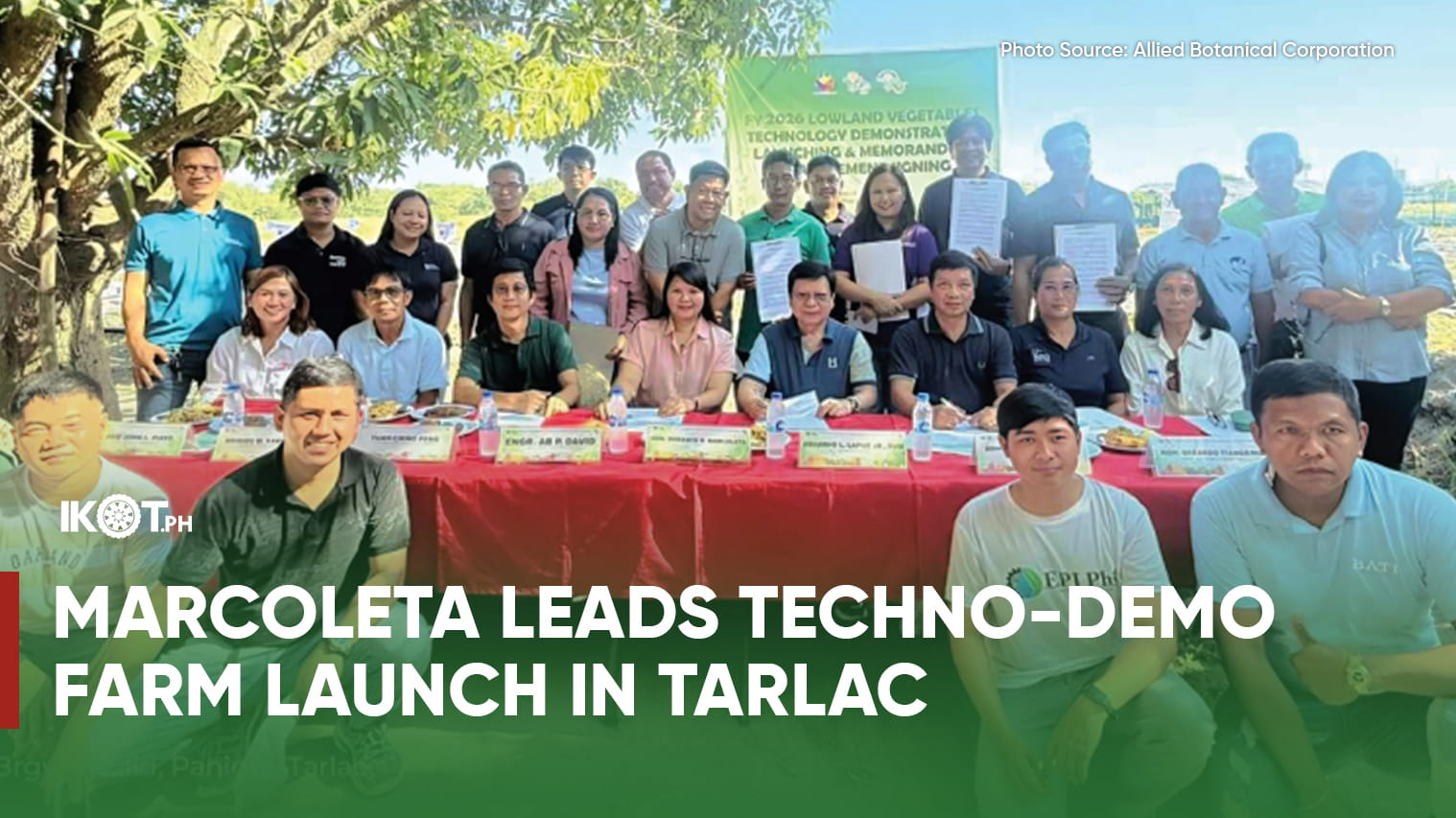
Senator Rodante Marcoleta recently led the launch of an 8,000-square-meter technology demonstration (techno-demo) farm in Paniqui town, Tarlac, with the objective of producing high yielding vegetable crops for farmers in the area.
Believing that modern farming is a key to achieving food security, Marcoleta graced the memorandum signing for the project – together with farmers’ groups, local and agriculture officials, and other stakeholders.
“As a farmer’s son, I am fully aware of the struggles of small farmers to earn a decent living, no matter how hard they work in the field every day. We are the country’s food producers, and yet are hardly able to bring enough food on the table for our own family,” the legislator said at the event held in Barangay Apulid.
“I fully support projects like these which push for modern, sustainable vegetable production to uplift farming communities.”
“That is why I fully support projects like these which push for modern, sustainable vegetable production to uplift farming communities,” added the lawmaker, who also hails from Paniqui town.
Formally called the Lowland Vegetable Technology Demonstration (Techno-Demo) Project, the initiative is part of the High Value Crops Development Program (HVCDP) of the Department of Agriculture.
The techno-demo farm will grow lowland vegetable crops, such as bitter gourd, squash, green and hot peppers, pole sitao, eggplant, pechay, okra, upland kangkong, cucumber, bell pepper, and watermelon.
According to the senator, the techno-demo farm aims to produce 8,000 kilograms of vegetable yield during the demo period, which will run until August to September next year.
“The farm targets a 113.33% return on investment.”
Moreover, he said the farm targets a 113.33% return on investment (ROI), based on average cost of production at P150,000, gross sales of P320,000, and net income of P170,000.
“We hope to achieve these targets and deliver the same results in other farming communities,” Marcoleta said of the project, which will serve as a model farm for adaptable and climate-resilient vegetable production.
The techno-demo farm enlisted the support of nine private companies, namely: Bon Affaire Trading Inc. (BATI), RAMGO International Corporation, Allied Botanical Corporation, Thaiphil Advance Agritech Corporation, MIKA Agritrading, FA Greenseeds Corporation, ATS Infinitrade Solutions OPC, APO Agriventures Corporation, and EPI Phil. Each partner manages a 1,000-square-meter plot, where it would provide seeds, planting materials, and other agricultural inputs.
Key indicators like crop performance, yield, pest and disease incidence, and overall profitability will be monitored throughout the course of the project.
The results will be presented during the Harvest Festival, where the performance of the plots managed by each partner firm will be evaluated.
The results will also help guide future HVCDP projects of the Department of Agriculture in other areas.