
The House of Representatives approved on second reading a Legislative-Executive Development Advisory Council (LEDAC) priority measure seeking to tighten the country’s child online safety laws amid rising cases of online sexual abuse and exploitation involving Filipino children.
House Bill No. 9461, or the proposed “Child Online Safety and Protection Act of 2026,” seeks to strengthen and expand Republic Act No. 11930, the Anti-Online Sexual Abuse or Exploitation of Children (OSAEC) and Anti-Child Sexual Abuse or Exploitation Materials (CSAEM) Act of 2022.
In sponsoring the bill, House Committee on Public Order and Safety chair and Manila Representative Rolando Valeriano said the measure adopts a broader and more coordinated approach against online child exploitation.
“The bill seeks to create a stronger and more coordinated national framework that protects children, improves investigations and prosecutions, strengthens victim protection, and ensures that offenders and facilitators are held accountable.”
“Ultimately, the bill seeks to create a stronger and more coordinated national framework that protects children, improves investigations and prosecutions, strengthens victim protection, and ensures that offenders and facilitators are held accountable,” Valeriano said.
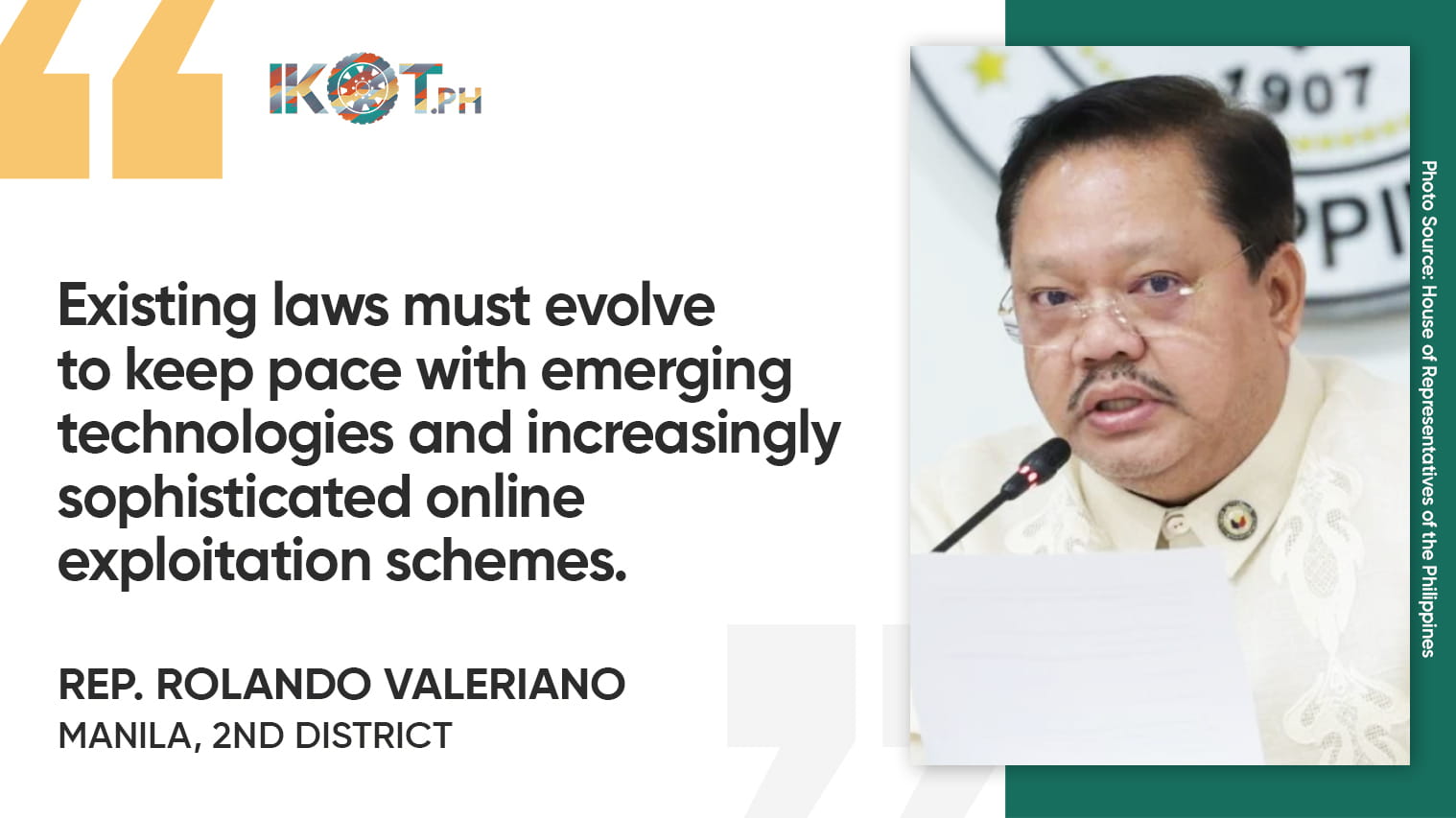
The legislator said existing laws must evolve to keep pace with emerging technologies and increasingly sophisticated online exploitation schemes.
“[RA 11930] was a landmark law that criminalized these offenses and established mechanisms for prevention and enforcement. However, experience since its enactment has revealed important legal and implementation gaps that must now be addressed,” the lawmaker explained.
He warned that the Philippines remained among the countries most heavily affected by online child sexual exploitation.
“The Philippines has long been identified as one of the global epicenters of [OSAEC] and [CSAEM], due to the alarming number of victims and facilitators operating in the country,” Valeriano said.
He cited the International Justice Mission’s “Scale of Harm” study, which found that nearly half a million Filipino children—or one in every 100 Filipino children—were trafficked in 2022 alone to produce child sexual exploitation materials.
Valeriano also pointed to a study by End Child Prostitution, Child Pornography and Trafficking of Children for Sexual Purposes (ECPAT), the United Nations Children’s Fund (UNICEF), and the International Criminal Police Organization (INTERPOL), which found that 20 percent of Filipino internet users aged 12 to 17 experienced serious forms of online sexual abuse or exploitation, including blackmail, non-consensual sharing of intimate images, and coercion through money or gifts.
He further noted data from the National Center for Missing and Exploited Children showing that the Philippines ranked second worldwide in cybertipline reports in 2024, recording more than 1.7 million reports that year.
“These figures highlight the urgent need for stronger and more responsive measures to protect Filipino children online,” Valeriano said.
Under the bill, child sexual abuse materials will now include artificial intelligence-generated, synthetic and digitally manipulated exploitative content, including deepfakes involving children.
The proposal also criminalizes sexual extortion, grooming, luring, image-based sexual abuse and livestreamed exploitation.
Those convicted of producing, distributing, livestreaming or facilitating child sexual abuse materials may face life imprisonment and fines of at least P2 million.
Persons found guilty of possessing child sexual abuse materials may face up to 20 years in prison and fines of up to P500,000.
Persons found guilty of possessing child sexual abuse materials may face up to 20 years in prison and fines of up to P500,000.
Those convicted of merely accessing such materials may face up to 12 years in prison and fines of up to P300,000.
The bill also imposes heightened duties on internet intermediaries, digital platforms, financial intermediaries, regulators and learning institutions to help prevent, detect, stop and report online child exploitation activities.
It authorizes lawful blocking, takedown and disruption orders against online accounts, platforms and digital infrastructure used in exploitation operations.
The proposal likewise strengthens financial surveillance by allowing covered financial entities to temporarily restrict or suspend suspicious transactions linked to child exploitation offenses.
The bill also creates the National Council for Child Online Safety and Protection under the Department of Justice and establishes the National Child-Safety Command and Operations Service as its operational arm.