The House of Representatives approved on second reading a bill expanding the government’s feeding program into a wider national nutrition initiative covering Filipino learners from early childhood to senior high school.
House Bill No. 9466 seeks to transform Republic Act No. 11037 or the “Masustansyang Pagkain Para sa Batang Pilipino Act” into a more comprehensive nutrition-centered program.
The measure, a Legislative-Executive Development Advisory Council (LEDAC) priority, was principally authored by Speaker Faustino “Bojie” Dy III and House Committee on Basic Education and Culture chair Roman Romulo and co-authored by 86 other lawmakers.
In his sponsorship speech, Romulo said hunger and undernutrition continue to cripple the learning and development of many Filipino children, especially those in poor and vulnerable communities.
“The classroom is difficult to navigate on an empty stomach.”
“For many of our learners, especially those in vulnerable communities, the classroom is difficult to navigate on an empty stomach. A child who is hungry cannot concentrate. A child who is undernourished struggles to grow, to learn, and to thrive,” the veteran legislator said.
The bill expands feeding coverage to all learners from Kindergarten to Grade 3 and undernourished learners from Grades 4 to 12, while extending feeding days to 200 annually. It also includes nutritionally-at-risk pregnant learners, children with disabilities, indigenous learners and other marginalized sectors.
The seasoned lawmaker explained that the proposal goes beyond simply providing meals.
“This measure recognizes that nutrition is not a one-time intervention. It is a continuing, integrated, and multi-sectoral responsibility,” he said.
“That is why this bill expands the current feeding program into a broader nutrition-centered framework that addresses not only caloric intake, but also micronutrient deficiencies, food quality, child development, maternal nutrition, sanitation, health education, and local food sustainability,” Romulo added.
The measure also strengthens the milk feeding program by prioritizing locally produced fresh milk and dairy products sourced from Filipino farmers and cooperatives.
“This does not only improve child nutrition; it also creates livelihood opportunities and stimulates the growth of the local dairy industry,” he pointed out.
The proposal further requires that at least 30% of agricultural and fishery products used in the program be sourced directly from local farmers and fisherfolk, particularly small-scale producers.
“This is not merely a feeding program. It is also an economic intervention.”
“This is not merely a feeding program. It is also an economic intervention that uplifts rural communities and strengthens food security,” Romulo said.
The bill also provides for micronutrient supplementation, iron and folic acid interventions, deworming, sanitation and hygiene programs, nutrition education, and the establishment of central kitchens to improve food safety and meal distribution.
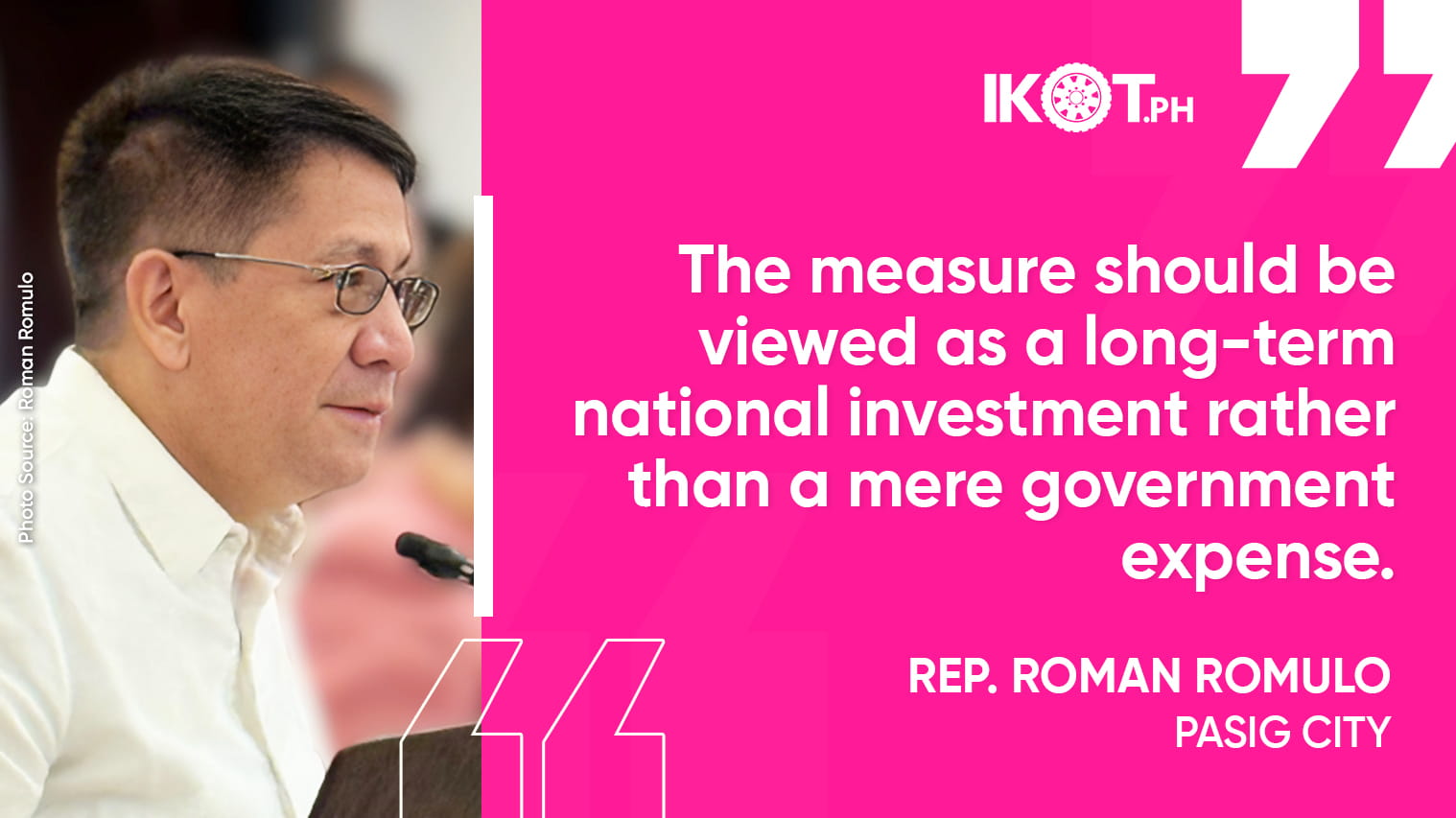
He said the measure should be viewed as a long-term national investment rather than a mere government expense.
“This bill is therefore not merely an expenditure. It is a strategic national investment,” Romulo said.
“An investment in healthier children. An investment in stronger communities. An investment in a more productive and resilient Philippines,” he concluded.