
Camarines Sur Governor LRay Villafuerte is backing the fresh push by President Marcos in his 5th State of the Nation Address (SONA) for nuclear power as part of his Administration’s “clean and green” energy agenda, noting that “the Philippines is ready for this switch as it already has in place a comprehensive plan to deal with the use of nuclear fission for generating electricity.”
Villafuerte said this plan for the safe, secure and peaceful use of nuclear or atomic power is embedded in Republic Act (RA) No. 12305, which created the Philippine Atomic Energy Commission (PhilATOM) as the sole and independent regulatory agency to oversee the use of nuclear energy to generate electricity for both our commercial and household requirements.”
A co-author of RA 12305 when he was still a congressman in the previous 19th Congress, the governor explained that the law-proposed framework for nuclear power use is aligned with the country’s international commitments such as those with the Vienna-based International Atomic Energy Agency (IAEA).
The switch to nuclear power is timely, said Villafuerte, given that the Philippines was elected back in September to the Board of Governors of the IAEA for 2025-2027, during the 69th regular session of the IAEA General Conference in Vienna, Austria.
The switch to nuclear power is timely, said Villafuerte, given that the Philippines was elected back in September to the Board of Governors of the IAEA for 2025-2027, during the 69th regular session of the IAEA General Conference in
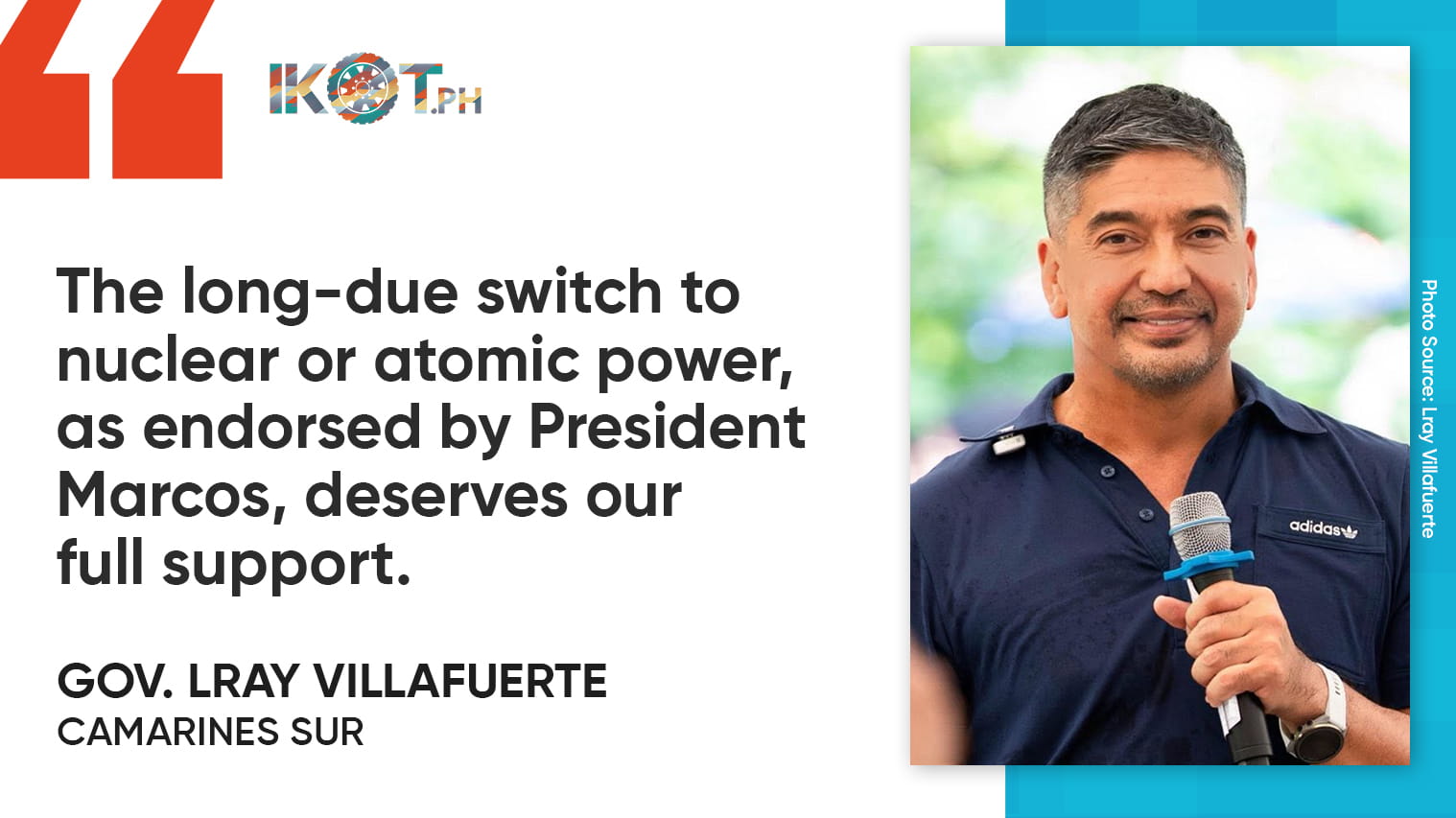
“The long-due switch to nuclear or atomic power, as endorsed by President Marcos, deserves our full support, given that the law-provided creation of the PhilATOM to oversee the implementation of a national emergency plan for potential nuclear or radiological emergencies plus the establishment of separate funds for disposing of nuclear wastes and later decommissioning power plants, are our guarantees for the safe, secure and peaceful use of atomic energy,” Villafuerte said.
“These RA 12305 provisions are consistent with the highest IAEA international standards on nuclear safety,” he added.
In his SONA last Monday, the President said that: “Pushing the envelope further, perhaps it is time for us to revisit nuclear energy production. We are already using nuclear energy in the fields of medicine, agriculture, water filtration and the upcycling of plastic.”
President Marcos said in his SONA that, “We are confident in its capacity to reinforce our energy security and bring down the cost of electricity in our country. Titiyakin nating ito ay ligtas. Titiyakin din nating maipaliwanag nang mabuti sa publiko ang magandang dulot sa atin ng enerhiyang nukleyar.”
Otherwise known as the “Philippine National Nuclear Energy Safety Act,” RA 12305 “clears the way,” said Villafuerte, “to the safe use of nuclear or atomic power for our household and commercial or industrial power requirements, in step with the government’s long-term strategy to spell energy security and at the same time steadily wean our country away from fossil fuels and reduce our carbon footprint.”
As a precondition for authorizing the establishment of nuclear facilities, Villafuerte said that operators of would-be power plants are mandated by ths new law to each establish a Radioactive Waste and Spent Fuel Management Fund, “to be used for the long-term management and final disposition of high-level radioactive wastes, which may be by geological isolation using deep boreholes.”
Villafuerte said that, “The amount to be put up by every nuclear plant operator shall: (1) be determined by the PhilATOM, in consultation with the Energy Regulatory Commission (ERC); (2) be sourced from the electricity generated from the use of nuclear energy; and (3) not be passed on the consumers of electricity sourced from nuclear power.”
Under this law, the amount “may be adjusted considering the current economic conditions at the time, the income generated by the Authorized Party, and the amount of high-level radioactive waste produced: Provided, that the said amount shall not be passed on to the consumers.”
Also, RA 12305 requires the operators of the would-be nuclear power plants to establish a Decommissioning Trust Fund for the eventual dismantling of these facilities.
RA 12305 states that the amount of this Fund may be adjusted by the PhilATOM based on the current economic conditions, along with the income generated and volume of high-level radioactive wastes produced by the operator—and that such amount shall not be passed on to the consumers.
Under this law, a National Plan for Off-site Nuclear or Radiological Emergencies shall be established to protect the public in a nuclear or radiological emergency declared as a consequence of an incident within or outside the territory and jurisdiction of the country.
It states that, “This emergency plan shall be integrated in the operational framework of the National Disaster Risk Reduction and Management Council (NDRRMC), provided that this plan shall be maintained and approved by the head of the lead agency in charge of overseeing the national response organization.”
For an effective emergency response in the event of accidents, the law requires emergency response training, drills and exercises, involving authorized parties and response organizations, to be carried out on a regular basis, and that such drills and exercises shall cover a full range of postulated emergencies. including emergencies with transboundary consequences.
As pointed out by the Department of Energy (DOE), he said, our country’s election to the IAEA Board opens access for: (1) technical cooperation on nuclear medicine, agriculture, food security, and energy; (2) promoting national priorities like safe nuclear power development; and for (3) enhancing our international standing as a responsible nuclear partner, Villafuerte said.
In the Philippines’ Nuclear Energy Roadmap, which the DOE unveiled at the IAEC General Conference in Vienna last September 2024, the government targets to have operational nuclear power plants by 2032, with an initial 1,200 megawatts (MW) of energy entering our power mix, and gradually rising to 4,800 MW by 2050.