
Senator Bong Go filed Senate Bill No. 2333, or the proposed Sanitarians Professionalization Act, seeking to establish a comprehensive system for regulating, supervising, licensing, and registering sanitarians in the Philippines.
The measure recognizes the work of sanitarians, also referred to as sanitary inspectors, in preventing disease, enforcing sanitation standards, promoting proper hygiene, and protecting communities from environmental health hazards.
“Malaki ang responsibilidad ng ating mga sanitarians sa pangangalaga ng kalusugan ng publiko.”
“Malaki ang responsibilidad ng ating mga sanitarians sa pangangalaga ng kalusugan ng publiko. Sila ang tumutulong upang masigurong malinis at ligtas ang ating pagkain, tubig, mga establisimyento, at komunidad,” Go said.
According to the bill, the absence of a comprehensive regulatory system has resulted in varying professional standards and limited mechanisms for ensuring that sanitation and hygiene functions are performed only by qualified and competent practitioners. Senate Bill No. 2333 seeks to address this by creating a formal framework for professional registration, licensure, ethical standards, and continuing development.
The proposed law defines the sanitation and hygiene profession as work primarily concerned with education and the prevention and control of diseases and other public health concerns through scientific methods and paramedical measures.
Its scope covers waste management; food and water supply sanitation; vermin and vector control; industrial hygiene; epidemiology; pollution control; environmental health planning and program implementation; and other community-level activities related to public hygiene.
“Sa pamamagitan ng tamang training, pagsusulit, at lisensya, masisiguro nating may sapat na kakayahan ang mga gumaganap ng mahalagang tungkuling ito.”
“Dapat may malinaw na pamantayan sa propesyong ito. Sa pamamagitan ng tamang training, pagsusulit, at lisensya, masisiguro nating may sapat na kakayahan ang mga gumaganap ng mahalagang tungkuling ito,” the veteran legislator said.
Under the proposal, a Board of Professional Sanitary Inspectors would be created under the general supervision of the Professional Regulation Commission. The Board would be composed of a chairperson and three members appointed from nominees selected by the accredited professional association of sanitary inspectors.
The Board would supervise and regulate the registration, licensure, and practice of professional sanitarians. It would also be authorized to formulate professional policies, adopt a code of ethics, prepare licensure examinations, issue or revoke certificates of registration, investigate violations, and develop standards intended to improve the profession.
The measure also directs the Board to prepare a curriculum for a Bachelor of Science in Sanitation and Hygiene degree and prescribe the subjects and corresponding weights to be covered by the professional licensure examination.
Applicants for registration would generally be required to pass a written examination administered at least once a year. The examination would cover the Code of Sanitation and its implementing rules, chemistry, biology, microbiology and parasitology, biostatistics and epidemiology, food and milk sanitation, household and industrial hygiene, waste management, pollution control, occupational health, environmental health planning, and other subjects determined by the Board.
To qualify for the examination, an applicant must be at least 20 years old, possess the required educational qualifications, meet standards on health and good moral character, and have no final conviction for an offense involving moral turpitude. Foreign nationals may qualify when their countries grant equivalent professional privileges to Filipinos.
Successful examinees would be required to take a professional oath before receiving their certificates of registration and professional licenses.
The bill further proposes integrating the profession into one national organization recognized by the Board as the sole accredited association of registered sanitarians.
Membership in that organization would not prevent practitioners from joining other professional groups.
Once the measure is implemented, establishments and government institutions requiring sanitation services would be expected to employ duly registered sanitarians. Except under circumstances specifically allowed by the proposed law, no person would be permitted to practice or offer sanitation and hygiene services without a valid certificate of registration and professional license.
The Board would also have the authority, after proper notice and hearing, to suspend or revoke professional registration for causes such as malpractice, violations of professional ethics, unprofessional conduct, or breaches of the proposed law and its implementing regulations.
The seasoned lawmaker said professionalizing sanitarians would promote accountability while giving qualified practitioners greater recognition and clearer opportunities for professional growth.
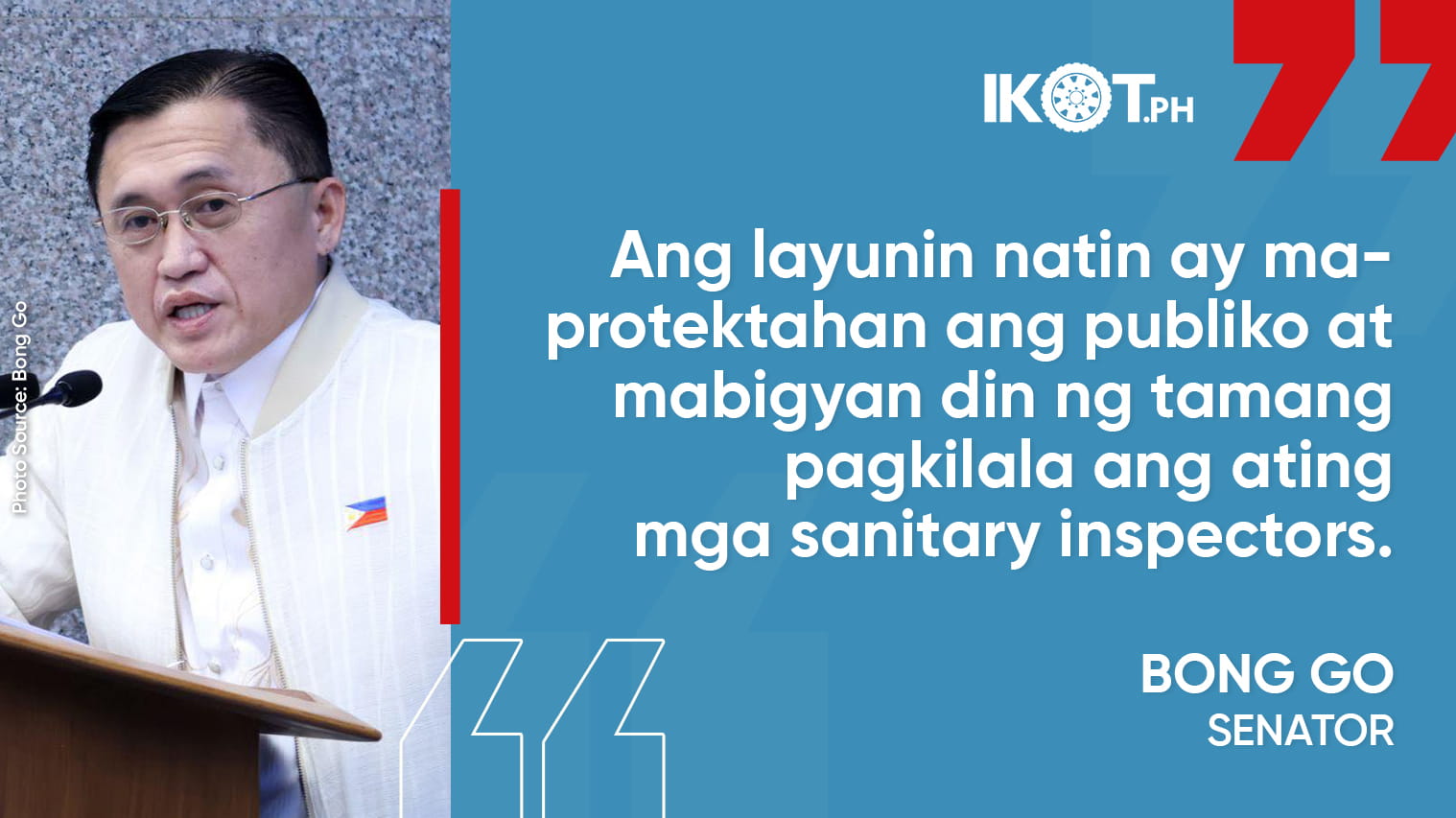
“Ang layunin natin ay maprotektahan ang publiko at mabigyan din ng tamang pagkilala ang ating mga sanitary inspectors. Mahalaga ang kanilang trabaho sa pag-iwas sa sakit at pagpapanatili ng kalinisan sa ating mga komunidad,” the senator said.
The proposed measure provides an initial appropriation of P10 million for its implementation. Funding for succeeding years would be included in the annual General Appropriations Act.
The Board would be required to formulate the necessary implementing guidelines within 90 days from the approval of the measure.
As part of his health reforms crusade, Go has consistently emphasized the importance of disease prevention, accessible healthcare services, and adequate support for professionals and workers serving the public health system.
“Mas mabuting maiwasan ang sakit bago pa ito lumala. Kaya mahalagang palakasin natin ang sanitation services at suportahan ang mga propesyonal na araw-araw na nangangalaga sa kaligtasan at kalusugan ng ating mga kababayan,” he concluded.