
Local government unit (LGU) officials are taking on a stronger voice in the construction of so-called “last mile” public schools in their respective localities, under a new law that President Marcos has signed to expand the access of Filipino learners to basic education by providing for the establishment of these institutions in geographically isolated and disadvantaged areas (GIDAs) and other underserved communities, according to Camarines Sur (CamSur) representatives Luigi Villafuerte and Migz Villafuerte.
Both former governors of CamSur, the Villafuertes are co-authors of RA 12321, or the “Last Mile and GIDA Schools Act,” which institutionalizes government support for the construction of basic education schools, plus provision of facilities and other essential learning inputs, in GIDAs along with underserved or conflict areas and indigenous people (IP) communities.
They noted that RA 12321 tasks the Department of Education (DepEd) to draw up and publish, within a year of this law’s effectivity, a National Last Mile and GIDA Schools Map that shall serve as basis for “planning, resource allocation and program implementation” for schools that are to be built in faraway places.
To ensure wide access to education in these last mile schools, the Villafuertes said the law mandates the DepEd to work closely on this initiative with LGUs, other concerned national government (NG) agencies, civil society organizations (CSOs) and other stakeholders.
Also, RA 12321 mandates the DepEd to adopt a national school accessibility standard, which includes making sure that learners have access to basic education schools that are, whenever feasible, within a walkable distance of three kilometers (km) from their homes.
The law directs the DepEd to work closely with LGUs along with concerned NGAs, CSOs and other stakeholders on several aspects of this new program.
“Our local governments are taking on a bigger say in this new initiative of the Marcos administration to guarantee access to basic education of Filipino learners in GIDA and other faraway communities by giving LGUs a broader role in the selection and construction of last mile schools in their respective localities, as well as the allocation of resources and provision of transport access to these learning institutions, and grant of extra pay to the reassigned teachers,” said Luigi, a deputy majority leader.
Migz, who chairs the House committee on information and communications technology (ICT), said that, “RA 12321 is truly a transformative law as it seeks to ensure that Filipino youths are no longer deprived of access to basic education by reason of geography or distance or because they happen to live in conflict areas or IP communities.”
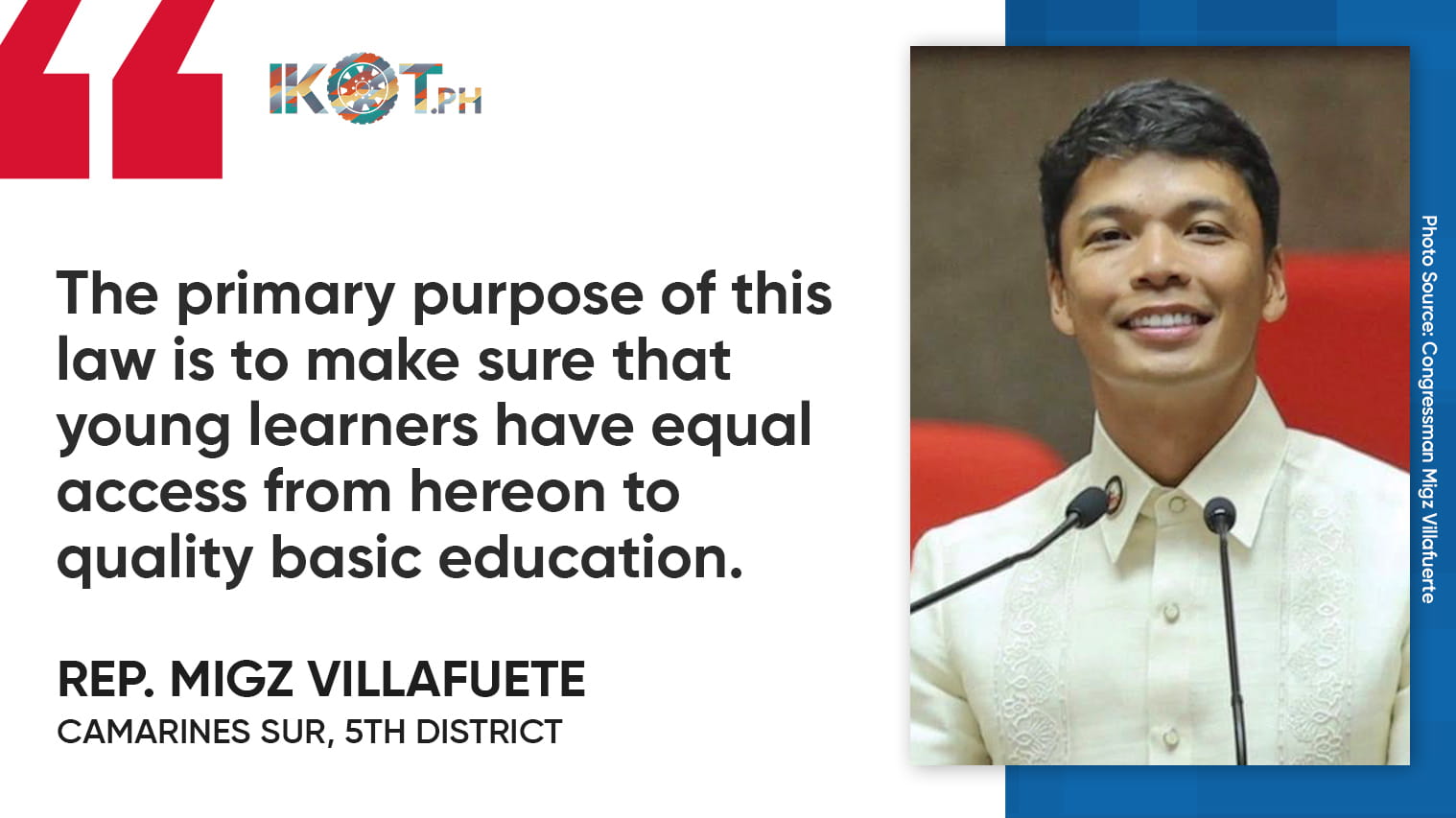
“Hence, the primary purpose of this law is to make sure that young learners have equal access from hereon to quality basic education regardless of whether they live in urban centers or in distant rural villages,” Migz said.
The House-approved version of RA 12321 was House Bill (HB) No. 4745, which was a substitute bill for 15 similar measures, including HB 2561 that Luigi and Migz had authored with fellow CamSur Rep. Tsuyoshi Anthony Horibata and Bicol Saro Rep. Terry Ridon.
Migz explained that to ensure access to education in last mile schools, the law directs the DepEd to work closely with LGUs along with concerned NGAs, CSOs and other stakeholders on several aspects of this new program.
He said the law tasks the DepEd to work with LGUs and CSOs on “the construction, upgrading and community-based support for the last mile schools, including the construction of local or provincial roads leading to these schools.”
Under the law, he said, the Department of Transportation (DOTr) shall coordinate with LGUs on “ensuring the availability of safe, reliable and accessible public transportation services to and from Last Mile and GIDA schools, including the planning, development and coordination of transport routes and services aligned with access roads and local conditions.”
The DepEd, in coordination with the Department of Budget and Management (DBM), other relevant agencies and LGUs, shall, under the law, “provide a comprehensive support package for teachers and non-teaching personnel assigned to Last Mile and GIDA schools,” said Luigi, including additional compensation and allowances.
RA 12321 further directs the DepEd to coordinate with LGUs that “may provide accommodation support, especially for relocated school personnel, which may include the construction of quarters where feasible, rental or housing subsidies, or partnerships with LGUs and communities for safe local housing,” he said.
The law requires the DepEd to assess and report on learner participation, retention and learning outcomes for students enrolled in Last Mile and GIDA schools, to ensure the progress and gaps are systematically monitored and addressed through adequate funding from both NGAs and LGUs, or other measures, or both,” Luigi said.
RA 12321 is truly a transformative law as it seeks to ensure that Filipino youths are no longer deprived of access to basic education by reason of geography or distance.
It requires the DepEd, moreover, to publish annually a list of Last Mile and GIDA schools, “which shall serve as the basis for the allocation of national funds and guide the participation and support of LGUs,” he added.
Under this law, a school may be classified as a Last Mile or GIDA school if it is located in, or serves, communities affected by “conflict, insecurity, disaster vulnerability, or other conditions that significantly impede safe access to education,” or where over 75% of learners belong to IP communities.
School buildings and related facilities classified as Last Mile or GIDA schools shall comply with the DepEd prescribed minimum standards and specifications for public school infrastructure.
The law states that, ““Such standards shall ensure that all school facilities remain safe, durable, accessible, climate- and disaster-resilient, and suitable to the geographic, cultural, and environmental conditions of the communities they serve.”
It states, too, that, “When practicable, the DepEd shall integrate the use of bamboo, engineered bamboo, and other sustainable, locally sourced materials in the design, construction, repair and rehabilitation of public schools and facilities.”
The Villafuertes are also co-authors of a Congress-approved bill that seeks to address rising elementary and high school dropouts rates by overhauling laws on voucher assistance or state subsidies for underprivileged but deserving Filipinos enrolled in private schools.
Approved by the bicameral conference committee (bicam) of both legislative chambers is the consolidated bill amending the two laws on the Government Assistance to Students and Teachers in Private Education (GASTPE) program—Republic Act (RA) No. 6728 and RA 8458.
RA 6728 established the original GASTPE, while RA 8458 expanded it by introducing initiatives such as Education Service Contracting (ESC), the Senior High School (SHS) Voucher Program, In-Service Training (INSET), and Teachers’ Salary Subsidy (TSS).
The proposed measure co-authored by the Villafuertes and already approved by the bicam aims to further expand voucher assistance for qualified students, particularly the most vulnerable and disadvantaged, while also extending support for teachers through in-service training, scholarships, and salary subsidies.
This bill’s purpose is to decongest public schools and strengthen the viability of private institutions.
The bicam-approved bill will be ratified by both chambers and then submitted to Malacañan Palace for the President’s approval and enactment into law.