
Camarines Sur Representatives Migz Villafuerte and Luigi Villafuerte are appealing to the Senate to act swiftly on the Senate counterpart measure to the House-approved cybersecurity bill, which seeks to establish a separate agency tasked with protecting Filipinos and businesses from online fraud and increasingly advanced threats in cyberspace.
The Villafuertes called on senators to advance the measure creating the National Cybersecurity Agency (NCSA), which is the crux of House Bill (HB) No. 9605, or the “National Cybersecurity and Critical Information Infrastructure Protection Act of 2026.”
The House of Representatives passed the measure on third and final reading on August 12 by a vote of 198-3, with one abstention.
HB 9605 seeks to establish the NCSA under the Department of Information and Communications Technology (DICT) to serve as the country’s primary policy, planning, coordinating, implementing and administrative body for national cybersecurity.
The bill is among the priority measures in the 20th Congress identified by President Ferdinand R. Marcos Jr. through the Legislative-Executive Development Advisory Council (LEDAC).
Migz Villafuerte chairs the House Committee on Information and Communications Technology (ICT), which endorsed the bill under Committee Report No. 423.
The measure consolidated 28 cybersecurity- and critical information infrastructure protection-related bills considered by the committee during the First Regular Session, including HB 2826, which Migz Villafuerte authored with Deputy Majority Leader Luigi Villafuerte, Camarines Sur Representative Tsuyoshi Anthony Horibata and Bicol Saro party-list Representative Terry Ridon.
“Cybersecurity is no longer an ICT concern alone.”
In his sponsorship speech, Migz Villafuerte said cybersecurity is no longer an ICT concern alone, in light of the country’s mounting reliance on digital systems in all sectors—from government, the economy and finance to transportation, health and energy—which has transformed it into a national security concern.
Hence, the legislator said, the NCSA, as proposed in HB 9605, aims to facilitate a whole-of-government approach to handling cybersecurity; beef up response to cyberattacks; establish minimum standards for critical information infrastructure protection; and provide for congressional oversight, judicial review and legal accountability.
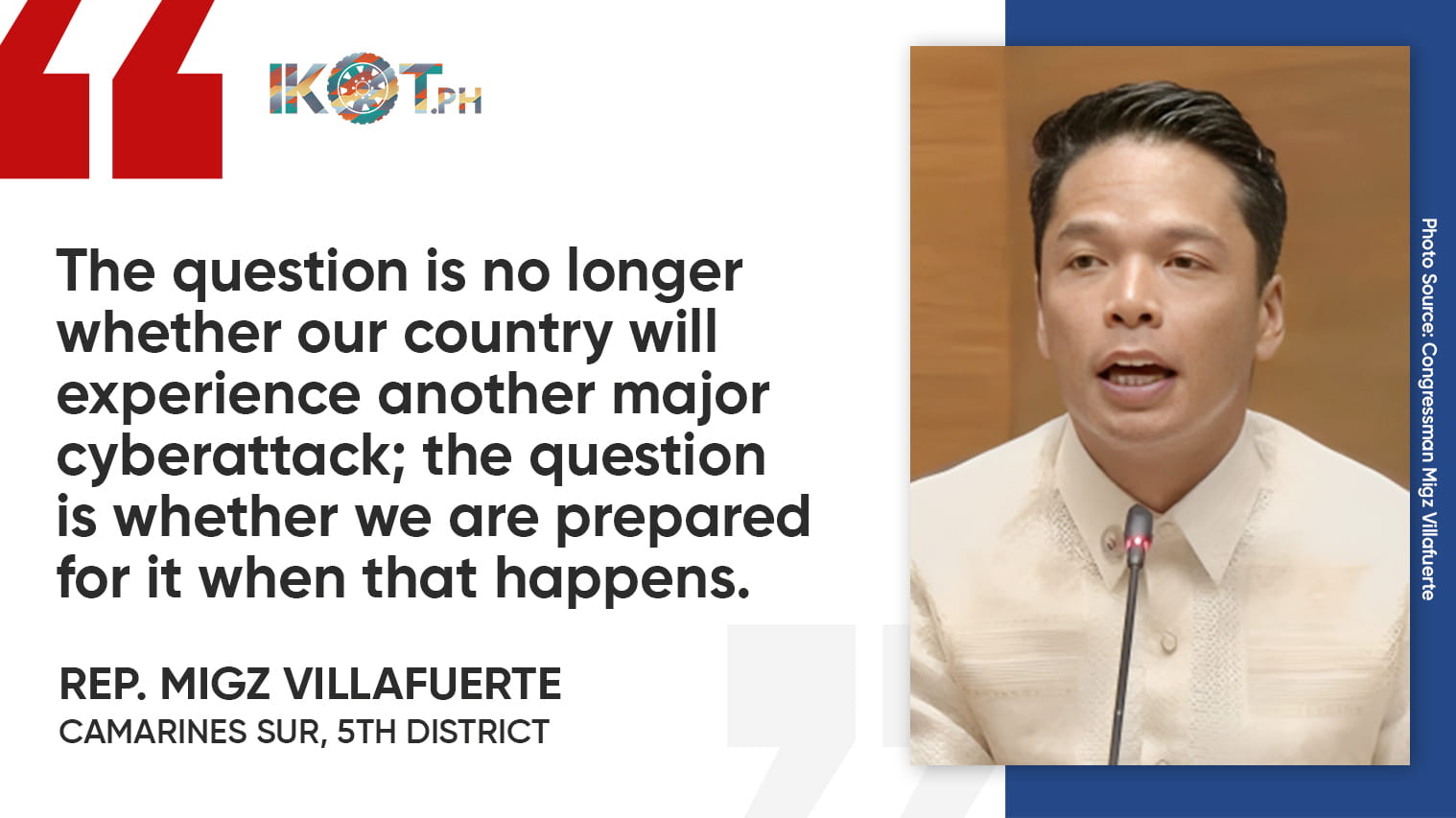
“The question is no longer whether our country will experience another major cyberattack; the question is whether we are prepared for it when that happens,” the lawmaker explained. “And because such a threat has become permanent, our institutional response must also be a permanent one.”
The proposed NCSA, he added, would strengthen national coordination, improve incident response and establish minimum cybersecurity standards for critical information infrastructure.
Posting on social media, Migz Villafuerte said the bill’s four aims are to: “(1) Protektahan ang mga Pilipino laban sa online fraud, identity theft, data breaches, ransomware at iba pang cyber threats; (2) Patibayin ang seguridad ng mga digital infrastructures na mahalaga sa kuryente, telecommunications, banking at iba pang essential services; (3) Paglikha ng NCSA na tutugon sa mga cyberattacks; (4) Atasan ang mga ahensya ng gobyerno at private institutions na palakasin ang cybersecurity, imonitor, at ireport ang mga cyber incidents.”
Luigi Villafuerte explained that the approval of the cybersecurity bill has become urgent following President Ferdinand Marcos Jr.’s recent issuance of Executive Order (EO) No. 119, which updated the government data-classification framework established in 1964 to accelerate the country’s digital transformation while safeguarding Filipinos against cybersecurity risks.
“This new data security framework provides for standardized cybersecurity practices to protect government information and strengthens the country’s resilience against cyber threats.”
While EO 119 enables government agencies to adopt cloud technologies, the lawmaker said this new data security framework provides for standardized cybersecurity practices to protect government information and strengthens the country’s resilience against cyber threats.
In a House press release, Speaker Faustino “Bojie” Dy III highlighted the bill’s importance, noting that the proposed NCSA would set minimum cybersecurity standards, audit critical information infrastructure, coordinate responses to cyber incidents and strengthen threat-intelligence sharing.
“Kapag mas ligtas ang ating digital infrastructure, mas ligtas din ang ating mamamayan,” the Speaker stressed.