
The House Committee on Energy, chaired by Palawan Representative Jose Alvarez, approved substitute bills and their corresponding committee reports seeking to free consumers from paying for system loss and liberalize power generation down to the consumer level.
A total of 43 House bills (HBs) and two House resolutions were filed seeking to end the practice of passing on to Filipino consumers the costs of inefficiencies arising from non-technical energy losses.
President Ferdinand Marcos Jr. identified the issue as a matter for legislative scrutiny in his last State of the Nation Address (SONA).
“The measure, when enacted into law, would provide meaningful relief to Filipino consumers by eliminating a charge that should properly be borne by the entities responsible for managing and operating the (electricity) distribution network.”
Speaker Faustino “Bojie” Dy III and Majority Leader and Ilocos Norte 1st District Representative Sandro Marcos—authors of HB 10430, one of the bills filed on the subject—said the measure, when enacted into law, would “provide meaningful relief to Filipino consumers by eliminating a charge that should properly be borne by the entities responsible for managing and operating the (electricity) distribution network”.
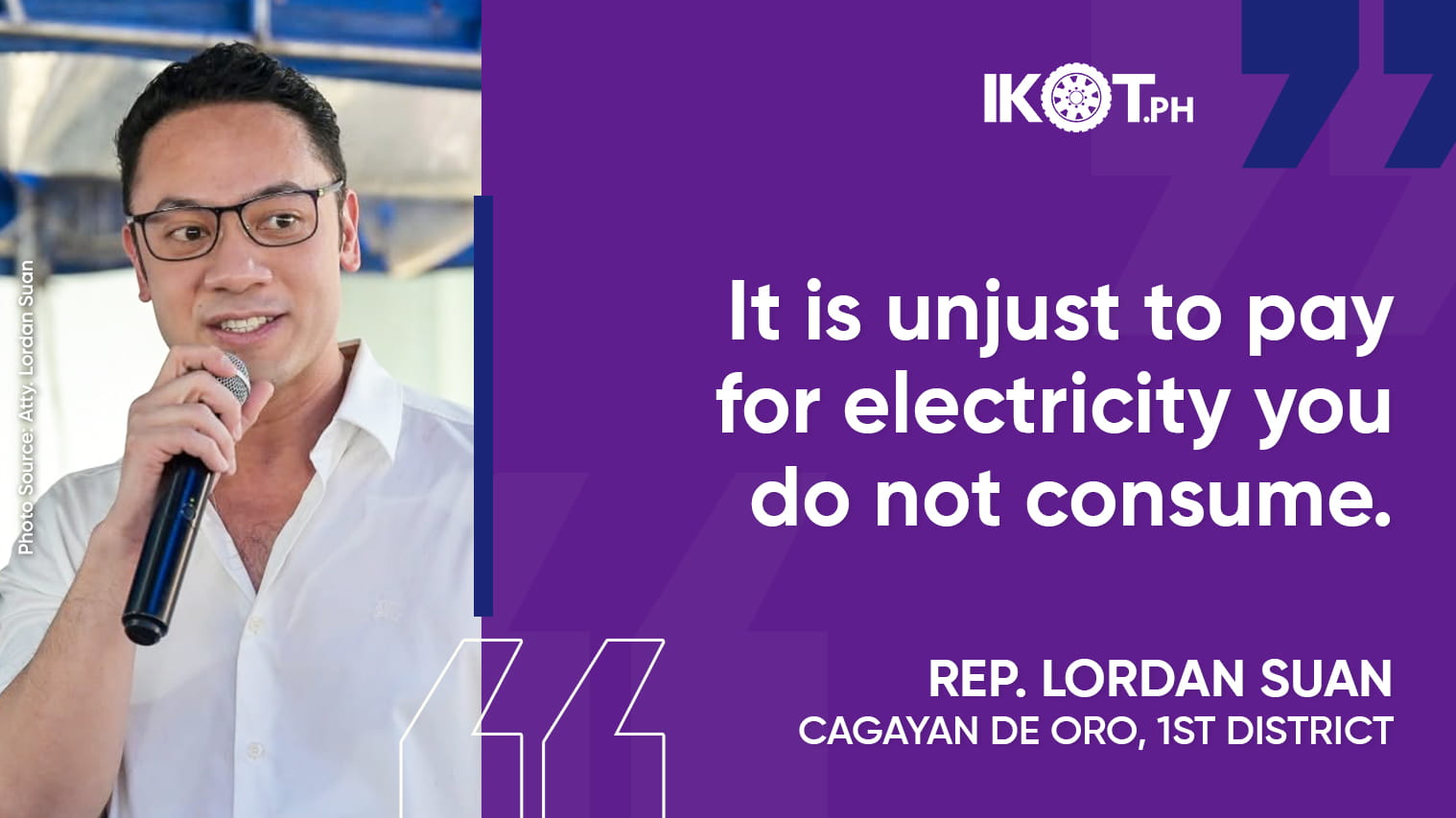
Cagayan de Oro 1st District Representative Lordan Suan, who filed HB 10299, described the practice of passing on the system loss burden to a captive market as unfair.
“The practice runs contrary to the principles of business efficiency and accountability.”
“It is unjust to pay for electricity you do not consume,” Suan said, adding that the practice runs contrary to the principles of business efficiency and accountability.
The committee also approved a substitute bill promoting the use of power generation and storage systems in households, taking advantage of advances in solar and energy storage technologies.
The proposed “Sariling Kuryente Act” seeks to reduce household electricity expenses, lessen dependence on the electric grid, and improve the country’s overall power supply.
Under the measure, regulatory requirements for the safe installation and operation of power generation and storage systems for non-commercial purposes would be simplified to promote wider public access to and use of existing and emerging energy technologies.
Proponents of the measure said “unnecessary procedures and restrictions” hinder nationwide adoption, discouraging “investments that could otherwise benefit households, enterprises and the country as a whole”.
Both bills, when enacted, would amend Republic Act No. 9136, otherwise known as the Electric Power Industry Reform Act (EPIRA) of 2001.