
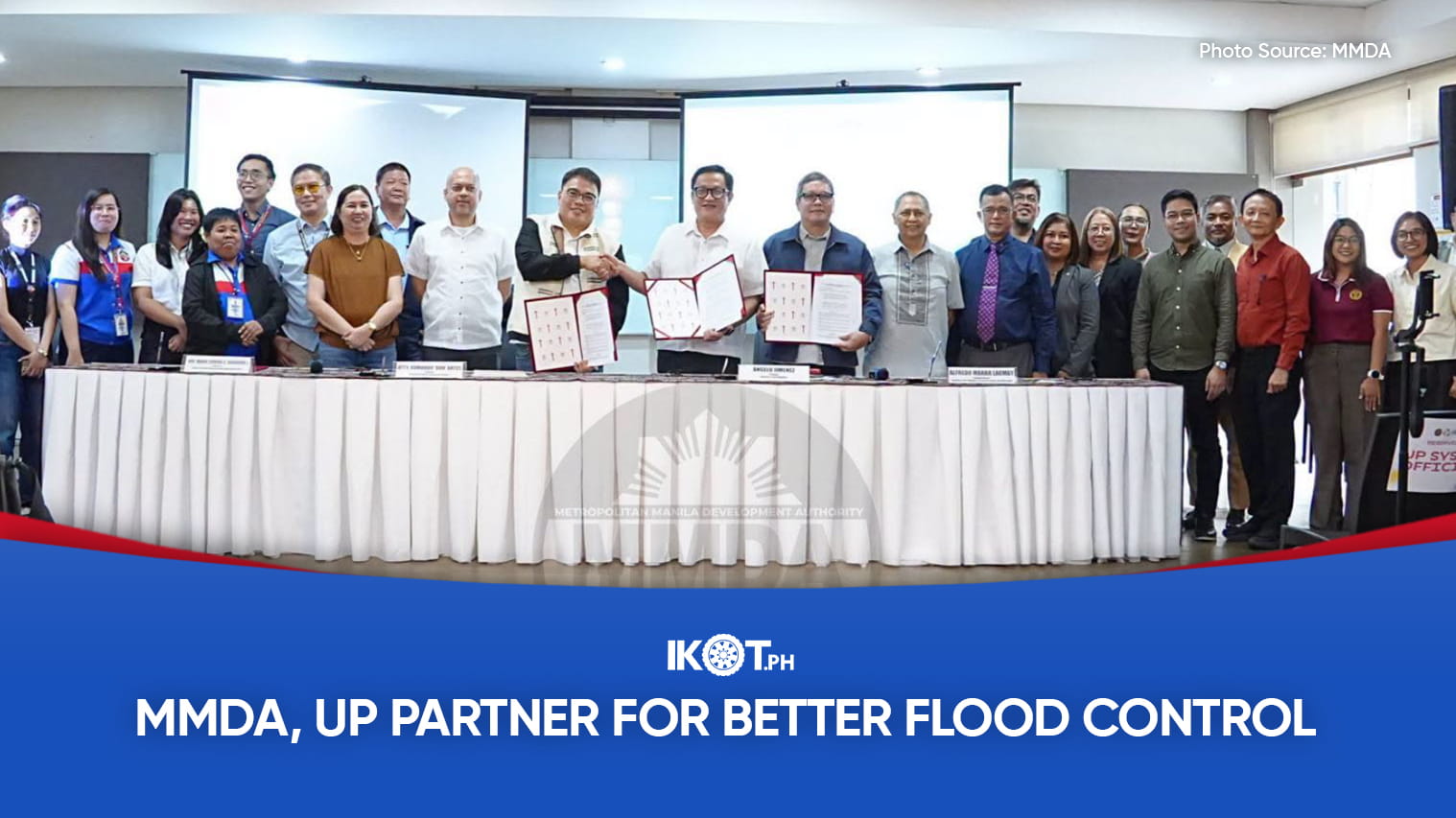
The Metropolitan Manila Development Authority (MMDA) together with the University of the Philippines (UP) signed a memorandum of understanding (MOU) to strengthen Metro Manila’s flood resilience through building rainwater impounding sites inside the campus.
The collaboration is in support of President Ferdinand Marcos, Jr.’s Oplan Kontra Baha Initiative, where 39 detention basins are planned to be built initially under the Metro Manila Sponge City Project to mitigate flooding in the region.
In his message, MMDA Chairman Atty. Don Artes explained that the concept of the project is as simple as storing the water when it rains before it is safely discharged to the proper drainage system network.
“What we want is for our cities to withstand, absorb, and temporarily store the water and safely discharge it.”
“What we want is for our cities to withstand, absorb, and temporarily store the water and safely discharge it,” Artes stated.
He emphasized that the rain impounding facility projects of the MMDA are vital in making the metropolis a sponge city, noting that the RIFs or detention basins have the capacity to temporarily catch the rainwaters and decelerate flooding.
“With the collaboration of infrastructures and nature-based solutions, we can help reduce the flooding while creating something useful for the community,” Artes stated.
Furthermore, he announced that aside from the originally identified site in the study conducted by Dutch engineering firm Haskoning, the UP Resilience Institute-NOAH is also studying additional five sites which can either serve as nature-based solution site or an RIF.
“This improvement will help us determine the volume and locations of the rain ahead of time which we will tie up with Project NOAH so they can simulate it.”
Artes said the MMDA is currently in talks with UPRI-NOAH Executive Director Dr. Alfredo Mahar Lagmay for the possible expansion of the Efficient Flood Control Operating System (EFCOS), which currently determines the volume of the rain from upper Marikina, to widen its scope and cover the whole Metro Manila.
“This improvement will help us determine the volume and locations of the rain ahead of time which we will tie up with Project NOAH so they can simulate it. Through the EFCOS expansion, we will know the possible level of flooding in an area which can help us to easily address it,” he explained.
Artes also called for a continuous collaboration of infrastructure, nature, and science to build a Metro Manila that is more prepared and safe for every Filipino.
For his part, UP President Atty. Angelo Jimenez said that UP is looking forward to working with the MMDA in identifying areas that can contribute to stronger flood mitigation efforts and building a more resilient Metropolitan Manila.
“Through this memorandum of understanding, we establish a framework for cooperation and research, technical assistance, knowledge sharing, capacity building, and the development of practical tools and knowledge products,” Jimenez stated.
The university official likewise sees the collaboration with MMDA as a basis to identify shared priorities and develop specific collaborative activities with their respective mandates and capacities towards better flood management in the NCR.