
The Senate and House of Representatives have finalized the provisions of the proposed National Children’s Nutrition Act during the bicameral conference committee meeting on Senate Bill No. 2272 and House Bill No. 9466, which seek to repeal and replace Republic Act No. 11037, or the Masustansyang Pagkain para sa Batang Pilipino Act.
The reconciled measure establishes a National Children’s Nutrition Program that adopts a life-stage approach to addressing malnutrition, recognizing that nutrition interventions must begin early and continue throughout a child’s development to support physical growth, cognitive development, and capacity to learn.
The need for sustained nutrition interventions is underscored by EDCOM 2 findings that one in four Filipino children is stunted, while only a quarter of children under five meet the recommended energy intake. Stunting, which commonly results from chronic undernutrition during the First 1,000 Days, is associated with poorer educational outcomes and can cause irreversible damage to cognitive development.
Under the measure, the Department of Social Welfare and Development (DSWD), in coordination with local government units (LGUs), will implement a Supplemental Feeding Program for all children aged two to below five years old under the Early Childhood Care and Development (ECCD) system, across all modalities (whether learners are in daycare centers, supervised neighborhood play, or community and home-based programs) and regardless of nutritional status.
For school-age children, the Department of Education (DepEd) will provide universal school-based feeding to public school learners from Kindergarten to Grade 3, regardless of nutritional status, and targeted feeding to undernourished learners in Grades 4 to 6.
The measure also includes pregnant adolescent learners enrolled in schools where the feeding program is implemented. DepEd may likewise extend the program to undernourished, vulnerable, or Indigenous Peoples learners in schools covered by the government’s voucher program, including those in self-contained classes or the Alternative Learning System.
“We wanted to be specific about who is responsible at every stage of a child’s life.”
“We wanted to be specific about who is responsible at every stage of a child’s life. By identifying the different feeding programs, we make clear that at every stage, there should be a program supporting the child and an agency responsible for delivering that support,” EDCOM 2 Co-Chairperson Senator Bam Aquino said.
The expanded coverage also addresses the nutrition needs of pregnant adolescent learners, who were not expressly identified as beneficiaries under the previous school feeding law. Under the proposed measure, pregnant adolescent learners will receive fortified meals and additional micronutrient supplementation, including iron, folic acid, calcium, and multiple micronutrients as needed.
Complementary interventions under the measure include regular growth and nutrition monitoring, micronutrient supplementation, a supplementary milk program, and nutrition education.
The measure also requires annual adjustments to meal funding based on the nutritional recommendations of the National Nutrition Council (NNC) and the Department of Science and Technology–Food and Nutrition Research Institute (DOST-FNRI), as well as inflation. Funds for the Supplemental Feeding Program and School-Based Feeding Program must be spent on direct food costs.
EDCOM 2 Co-Chairperson Representative Roman Romulo emphasized the need to ensure that funds allocated for feeding reach children in the form of adequate meals.
“Once maintenance and operating expenses are deducted, the amount left for food may not be enough to provide an adequate meal.”
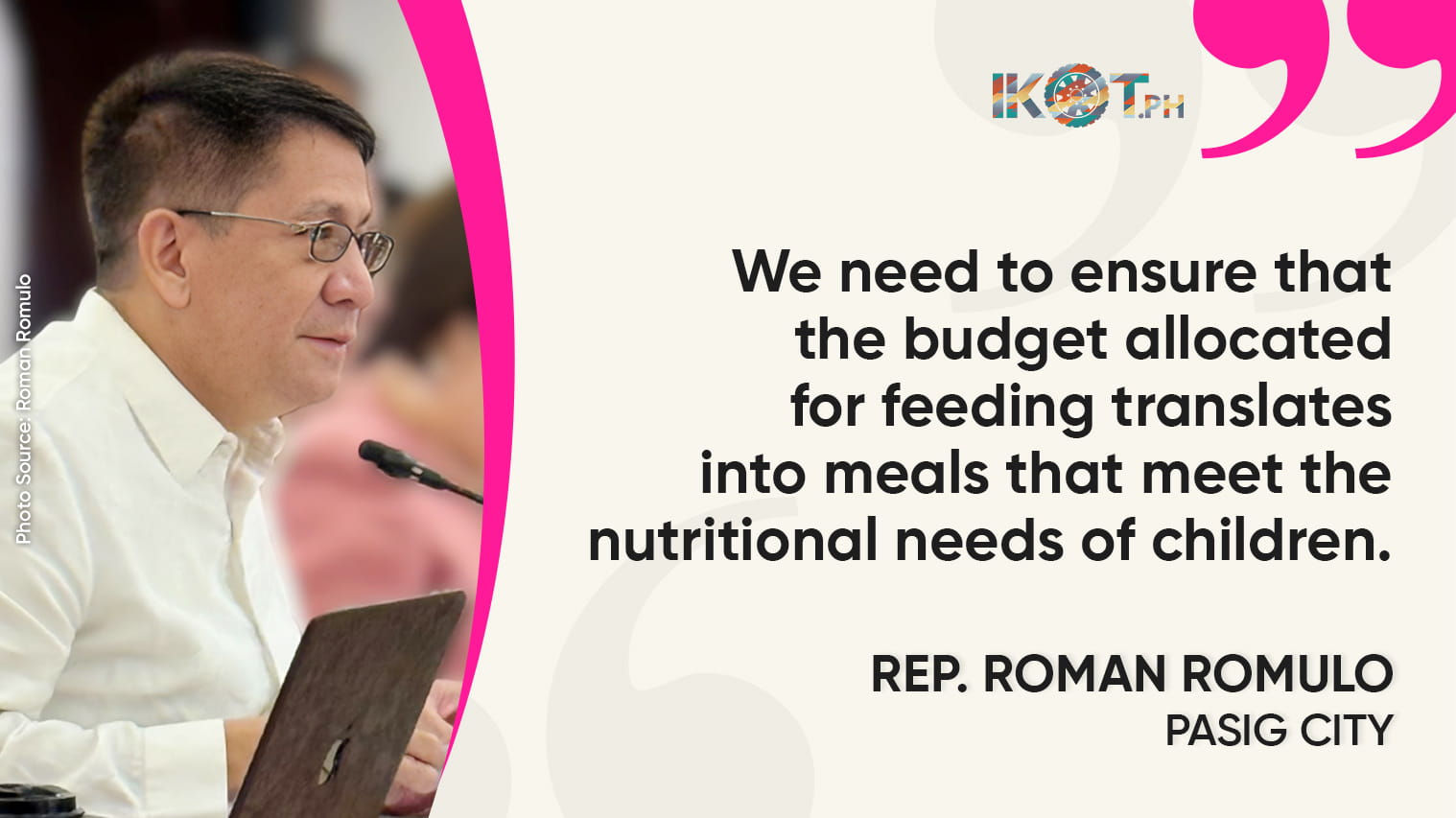
“We need to ensure that the budget allocated for feeding translates into meals that meet the nutritional needs of children. Once maintenance and operating expenses are deducted, the amount left for food may not be enough to provide an adequate meal,” Romulo said.
The measure designates the Department of Health (DOH) as the lead agency for the National Children’s Nutrition Program, responsible for overall policy direction, coordination, and monitoring of health and nutrition interventions, including the issuance of standards, protocols, and guidelines. The NNC will serve as the central interagency coordinating and monitoring body, overseeing nutrition surveillance, accountability mechanisms, and the integration of nutrition-related data systems across implementing agencies and LGUs.
The measure also clarifies the financing responsibilities for health and nutrition interventions. PhilHealth will cover eligible individual-based health and nutrition services through its benefit packages, while the DOH and other concerned national government agencies, with support from LGUs, will remain responsible for population-based services. These include nutrition surveillance, community-wide screening, health promotion, and the procurement, warehousing, and distribution of health and nutrition commodities.
The measure further strengthens local food systems by prioritizing the direct procurement of agricultural and fishery products for feeding programs from qualified and accredited local farmers, fisherfolk, and their cooperatives and enterprises, consistent with Republic Act No. 11321, or the Sagip Saka Act, and Republic Act No. 12009, or the New Government Procurement Act. Subject to local availability and practicability, priority will be given to small-scale local farmers and fisherfolk.
The National Children’s Nutrition Act is among the Legislative-Executive Development Advisory Council (LEDAC) priority measures. It is authored by EDCOM 2 Co-Chairpersons Aquino, Senator Joel Villanueva, Romulo, and Representative Jude Acidre, with EDCOM 2 Commissioners Senate President Win Gatchalian, Senator JV Ejercito, and Representative Anna Veloso-Tuazon as co-authors.