The government is allocating ₱38.2 billion in 2027 to subsidize the tuition of disadvantaged students who need to enroll in private high schools because public schools in their communities are either inaccessible or lack sufficient classroom capacity, House Minority Leader and 4Ps party-list Representative Nonoy Libanan said.
Libanan noted the funding is expected to benefit a combined 2.3 million students from low-income families, including those who cannot be accommodated in overcrowded public schools.
“The subsidies will give underprivileged students a greater opportunity to continue their education despite their families’ financial difficulties and the limited capacity of public schools,” the veteran legislator said.
“The subsidies will give underprivileged students a greater opportunity to continue their education despite their families’ financial difficulties.”
“Without this assistance, many students risk abandoning their studies, particularly those whose families are struggling to make ends meet and who may be forced to seek work instead of completing high school,” the seasoned lawmaker added.
Under the 2027 National Expenditure Program (NEP), the ₱38.2-billion allocation for secondary education subsidies is broken down into three programs:
· ₱12 billion for the Junior High School Educational Service Contracting Program (JHSESC);
· ₱24 billion for the Senior High School Voucher Program (SHSVP); and
· ₱2.2 billion for the Joint Delivery Voucher Program (JDVP).
He cited data from the Second Congressional Commission on Education showing that financial constraints remain a major reason for students dropping out of senior high school.
During school year 2024-2025, for instance, 2,041,601 students enrolled in Grade 11. Of this number, 169,836, or 8.3 percent, failed to continue to Grade 12.
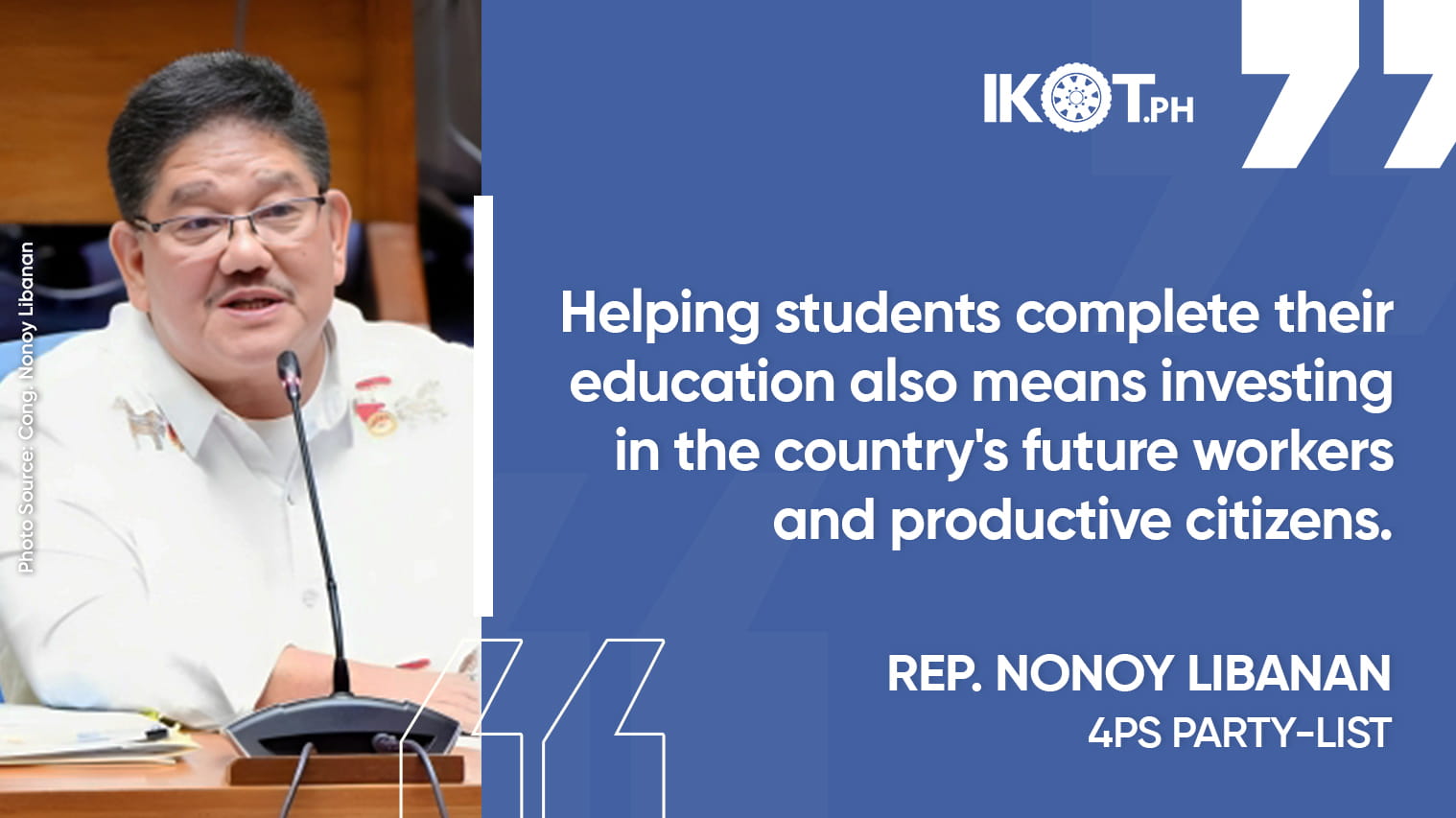
“The ability of families to keep their children in school should not be dictated by their financial circumstances. Helping students complete their education also means investing in the country’s future workers and productive citizens,” Libanan said.
“Every student who gets to finish high school has a better chance of escaping poverty and building a more secure future.”
“Every student who gets to finish high school has a better chance of escaping poverty and building a more secure future. These subsidies can make that difference for families who otherwise could not afford private education,” he added.
The JHSESC provides qualified beneficiaries, mainly graduates of public elementary schools, with the opportunity to attend Grades 7 to 10 in private high schools under contract with the Department of Education (DepEd).
The SHSVP, meanwhile, offers tuition assistance to qualified graduates of Grade 10, as determined by the DepEd, who wish to pursue Grades 11 and 12 in participating private high schools.
Under the JDVP, senior high school students enrolled in the technical-vocational-livelihood track may receive tuition aid to take specialized courses at private institutions and non-DepEd schools.
The DepEd and the Private Education Assistance Committee jointly administer the JHSESC and SHSVP, while the DepEd directly oversees the implementation of the JDVP.