
The House of Representatives approved on second reading a measure seeking to ensure that disadvantaged graduating students who have completed all academic requirements are not denied participation in graduation ceremonies because of outstanding financial or property obligations.
House Bill No. 11579, or the proposed Kapakanan ng Magsisipagtapos Act, seeks to protect the opportunity of financially disadvantaged students to celebrate their academic achievements with their families and classmates, while preserving the right of educational institutions to collect unpaid fees and other school obligations.
Sponsoring the measure on the House floor, House Committee on Higher and Technical Education Chairperson and TINGOG Party-list Representative Jude Acidre emphasized that graduation represents not only years of hard work and perseverance by students but also the sacrifices made by families to support their education.
Acidre noted that many parents work additional hours and carefully manage their limited income to cover tuition, transportation, and other school expenses, sustained by the hope of giving their children opportunities for a better future.
Yet even after students have completed their academic requirements, job losses, unexpected medical expenses, calamities, and other financial difficulties may leave their families unable to settle outstanding school obligations in time for graduation.
“A graduation should recognize how far a student has come, not how much that student still owes.”
“Because a graduation should recognize how far a student has come, not how much that student still owes,” the veteran legislator said.
Under HB 11579, public and private higher education institutions, including state universities and colleges (SUCs) and local universities and colleges (LUCs), would be prohibited from denying disadvantaged graduating students participation in graduation ceremonies because of unpaid tuition and other school fees, miscellaneous fees, or liabilities arising from the loss of or damage to school property.
The prohibition would also apply to public and private technical-vocational institutions offering long-term courses exceeding one year.
To qualify, students must have completed all academic requirements and obtained certification of their disadvantaged status from the appropriate municipal, city, or provincial social welfare and development officer or regional office of the Department of Social Welfare and Development (DSWD), based on calamities, emergencies, force majeure, or other justifiable reasons.
While protecting students’ participation in graduation ceremonies, Acidre clarified that the measure would not cancel their outstanding obligations or prevent educational institutions from collecting fees lawfully due to them.
“Compassion and accountability can coexist.”
“It affirms that compassion and accountability can coexist, and that fairness to our educational institutions need not come at the expense of fairness to our learners,” the seasoned lawmaker said.
Under the measure, schools would retain the right to require promissory notes, withhold academic records and credentials, including actual diplomas, until all fees are paid, and pursue available legal remedies for collection.
Schools may also voluntarily allow disadvantaged students to participate in graduation ceremonies and release their academic records and credentials without requiring certification or promissory notes, in accordance with their respective policies.
The measure further provides for administrative sanctions against institutions found violating the prohibition, which may be imposed by the Commission on Higher Education (CHED) or the Technical Education and Skills Development Authority (TESDA), as applicable.
Calling for the bill’s passage, he underscored that students who have completed their academic requirements deserve the opportunity to celebrate their achievements alongside the families and loved ones who helped them reach that milestone.
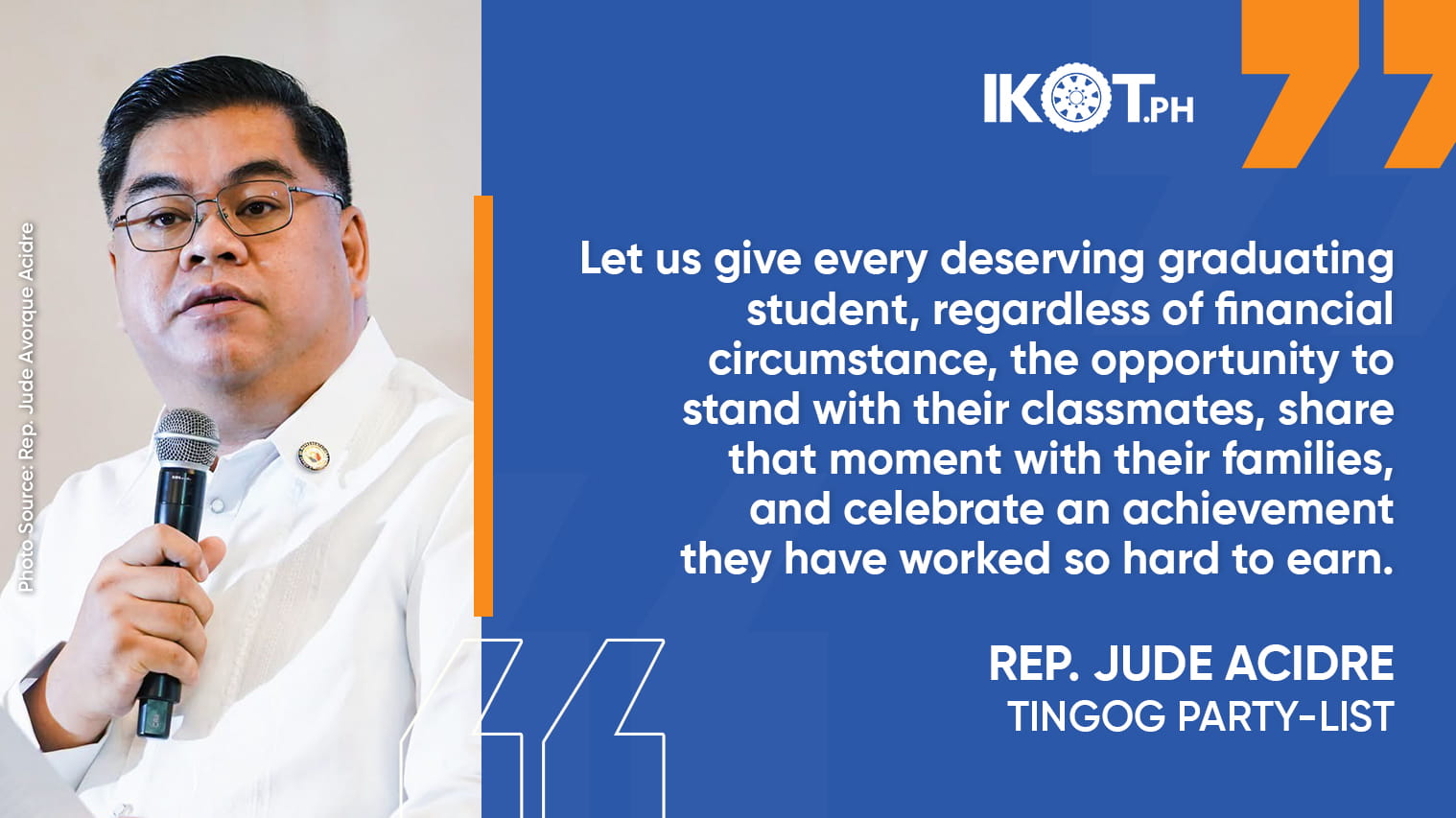
“Let us give every deserving graduating student, regardless of financial circumstance, the opportunity to stand with their classmates, share that moment with their families, and celebrate an achievement they have worked so hard to earn,” Acidre concluded.