The Department of Education (DepEd) started on Thursday its nationwide orientation to align local government units (LGUs), school heads, and partner agencies on the implementation of the new Executive Order (EO) No. 130, s. 2026, and DepEd Order No. 014, s. 2026, establishing standardized rules for class suspensions and learning continuity during emergencies.
President Ferdinand R. Marcos Jr.’s new EO shifts away from blanket class cancellations, instead establishing an evidence-based system featuring automatic, localized, and granular suspension and resumption mechanisms that allow national and local authorities as well as school heads to respond dynamically to ground-level risks while keeping learning intact.
During the online orientation attended by more than 17,000 participants, DepEd officials emphasized that the primary goal of the new framework is to ensure learning continues safely when natural hazards like extreme heat, typhoons, or floods force the suspension of in-person classes.
To accommodate private schools and other stakeholders who were not able to join the initial session, DepEd will run another orientation to ensure all educational institutions are properly aligned with the new guidelines.
During the online orientation attended by more than 17,000 participants, DepEd officials emphasized that the primary goal of the new framework is to ensure learning continues safely when natural hazards like extreme heat, typhoons, or floods force the suspension of in-person classes.
To prevent confusion and give schools maximum flexibility, DepEd asked that LGUs do not specify the exact alternative learning mode to be used by schools covered by in-person class suspensions.
DepEd highlighted that school capacities vary widely, and some institutions lack the infrastructure or connectivity required for online instruction. Leaving the decision-making about Alternative Delivery Modes (ADM) to individual school leaders ensures learning modalities are practical, context-appropriate, and focused directly on learning without tying the hands of educators.

Complementing the learner-centered guidelines, the framework also introduced a provision for alternative work arrangements for teaching and non-teaching personnel, to be implemented whenever practicable during class suspensions.
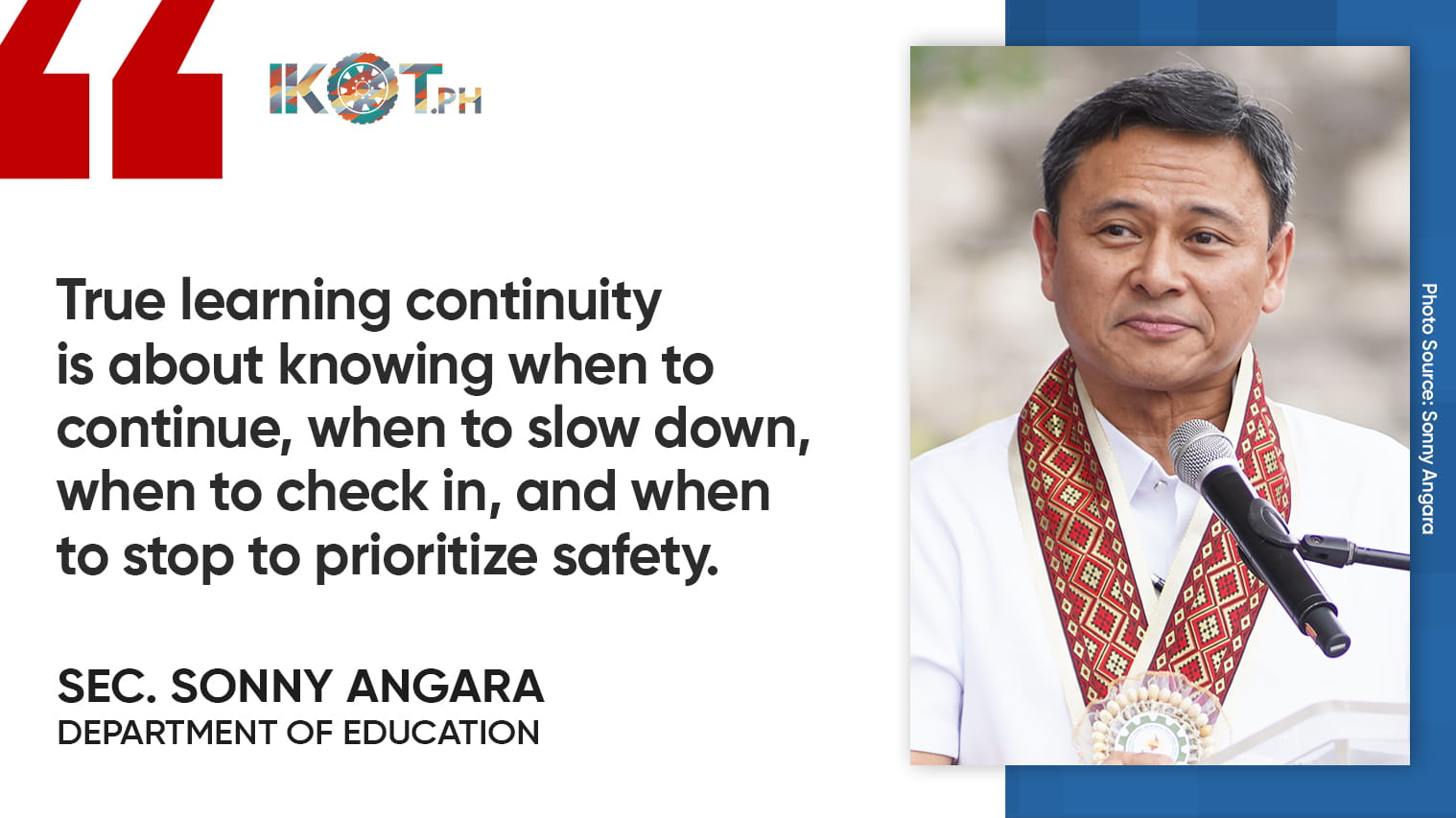
“True learning continuity is about knowing when to continue, when to slow down, when to check in, and when to stop to prioritize safety,” Education Secretary Sonny Angara said, stressing that learner and teacher well-being remains the department’s top priority during crises.
“When emergencies happen, our immediate instinct must always be to protect our learners and teachers. However, suspending physical classes should no longer mean hitting complete pause on a child’s education,” Angara added.
“By giving our local executives and school heads the flexibility and guidelines to switch to distance learning, light check-ins, or modular work, we are ensuring that learning adapts rather than stops.”
Under the operational guidelines for learning continuity during emergencies, DepEd introduced the 4H Response System consisting of Hayo (Continue), Hinay (Ease-in), Hinga (Check-in), and Hinto (Stop). The framework gives school leaders clear parameters to adapt teaching modalities depending on the severity of the situation.
Under Hayo, regular in-person classes continue under safe, manageable conditions. When minor disruptions occur, schools shift to Hinay through structured distance learning, print modules, or modified schedules. In situations of heightened stress, schools transition to Hinga by lightened academic expectations, learner well-being check-ins, broadcast materials, and learning packets. Finally, under Hinto, all learning activities and work are temporarily suspended only when physical safety and basic needs are directly compromised.
The policy is being finalized through a Joint Memorandum Circular (JMC) to be co-issued with the Commission on Higher Education (CHED), Technical Education and Skills Development Authority (TESDA), Department of Science and Technology (DOST), Department of Environment and Natural Resources (DENR), and Department of the Interior and Local Government (DILG).