
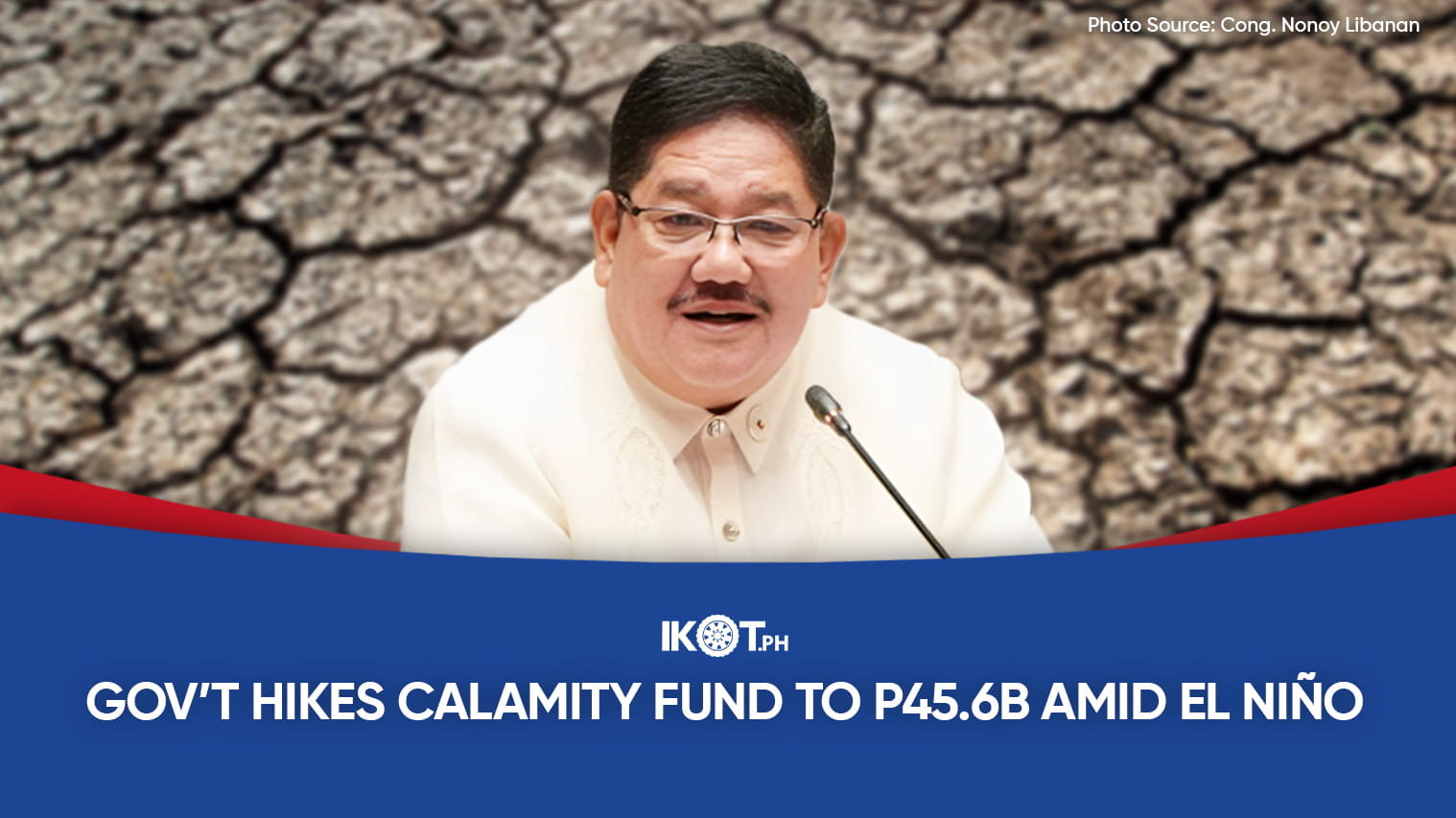
The national government is increasing its disaster readiness and recovery funding to P45.6 billion in 2027 amid the onset of a potentially severe and prolonged El Niño phenomenon that could bring drought conditions to Metro Manila and all 82 provinces, House Minority Leader and 4Ps Party-list Representative Nonoy Libanan said.
Under the 2027 National Expenditure Program (NEP), the allocation for the Calamity Fund has been raised by P5.8 billion, or 14 percent, from the P39.8 billion provided under this year’s national budget, according to Libanan.
“This is a substantial increase, but the threat we are facing calls for more than just a bigger calamity fund.”
“This is a substantial increase, but the threat we are facing calls for more than just a bigger calamity fund. Government agencies must ensure that resources are readily available and that disaster preparedness measures are in place well ahead of the worst effects of El Niño,” the veteran legislator said.
Metro Manila and 47 provinces could be hit hard by drought by the end of January 2027 because of the strong-to-very strong El Niño, according to the latest outlook from the Philippine Atmospheric, Geophysical and Astronomical Services Administration (PAGASA).
By the end of March, all of the country’s 82 provinces as well as the National Capital Region could be battered by prolonged drought.
The state weather agency’s outlook was based on observed rainfall conditions as of November 1, 2026.
PAGASA defines drought as three consecutive months of way-below-normal rainfall, or a reduction of more than 60 percent from the average rainfall.
PAGASA’s outlook is consistent with the latest assessment of the United States’ National Oceanic and Atmospheric Administration (NOAA), which, in a November 12, 2026 issuance, placed at more than 79 percent the probability of a strong-to-very strong El Niño persisting through January to March 2027.
“National departments, particularly those handling agriculture, water resources, health, social welfare and disaster management, as well as local government units, should not underestimate the potential impact of a severe drought,” the seasoned lawmaker said.
“We should not wait for communities to experience these hardships before taking decisive action.”
“Water shortages, crop losses, rising food prices and disruptions to the livelihoods of millions of Filipinos are real possibilities. We should not wait for communities to experience these hardships before taking decisive action,” he added.
Libanan said agencies and local governments must work together to identify vulnerable communities, secure adequate water supplies, protect agricultural production and prepare assistance for families whose incomes and livelihoods could be affected.
“The government should use the weeks ahead to prepare contingency measures, coordinate resources and make sure that vulnerable households, farmers and other affected sectors will not be left to fend for themselves,” he pointed out.
The Calamity Fund, formally known as the National Disaster Risk Reduction and Management Fund, bankrolls relief, rehabilitation and recovery programs for communities affected by natural and human-induced disasters. It also supports eligible pre-disaster activities.
A severe and prolonged drought could trigger a chain of adverse consequences, including water shortages, farm losses, food supply disruptions, higher commodity prices, health problems, loss of income, increased poverty, interruptions in education and environmental degradation.