
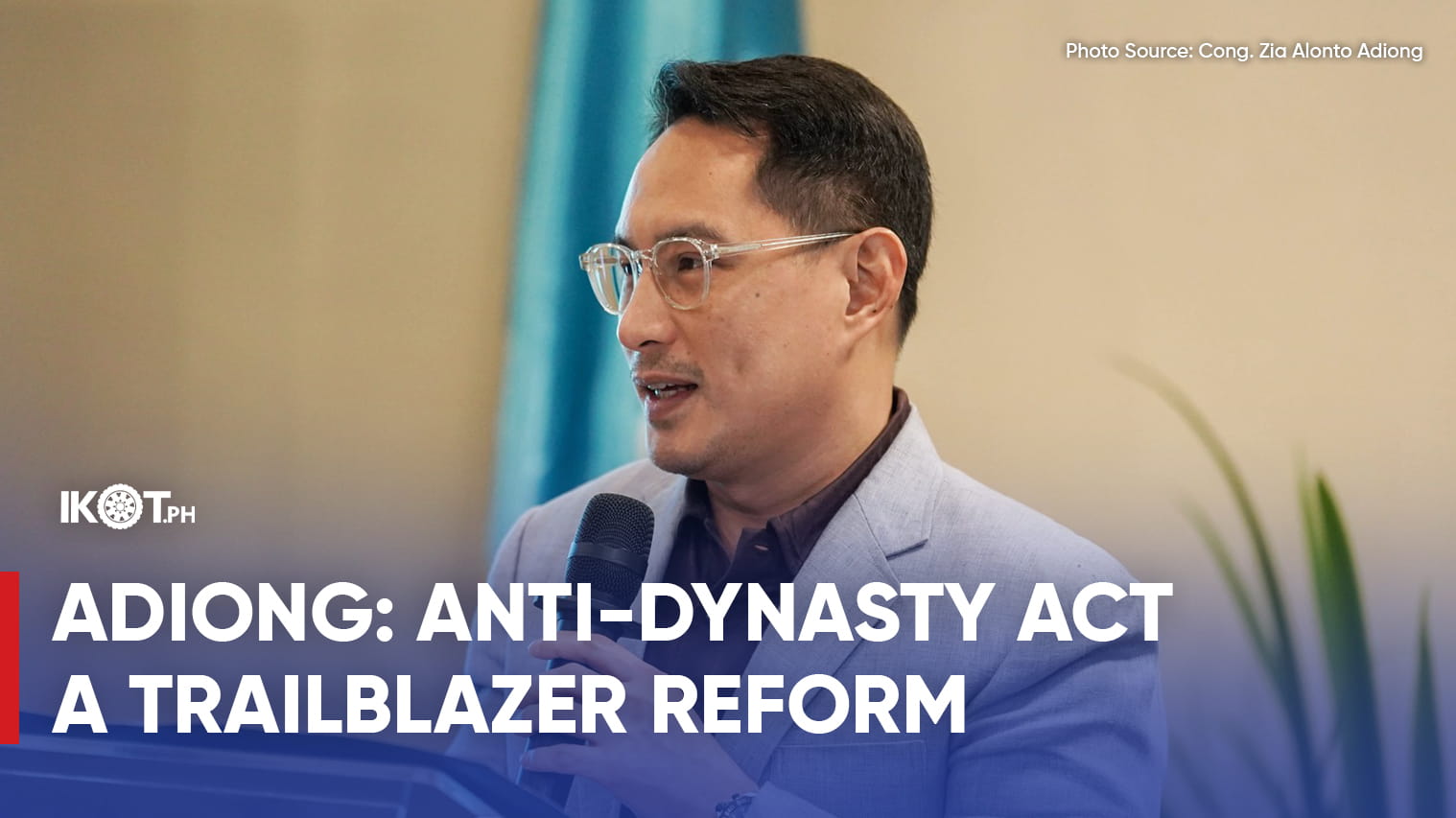
Lanao del Sur Representative Zia Alonto Adiong described the Anti-Political Dynasty measure approved by the House Committee on Suffrage and Electoral Reforms as a “trailblazer” reform that would finally define political dynasties nearly four decades after the Constitution mandated their prohibition.
Adiong, who chairs the committee, said the consolidated bill marks the first serious legislative effort to operationalize Section 26, Article II of the 1987 Constitution, which directs the State to prohibit political dynasties as may be defined by law.
“So if you ask me, this is a step forward. In fact, this is a trailblazer policy because we don’t have exactly an existing anti-political dynasty. This is the first time after 40 years. So it’s a positive step,” the veteran legislator said in an ambush media interview.
The seasoned lawmaker made the remarks as the committee faced criticism from some sectors over its decision to anchor the consolidated measure on a second-degree prohibition, instead of extending the ban to the fourth degree of consanguinity or affinity.
“You know, all of us, when you talk about anti-political dynasty, it goes directly to the very foundation of our democracy, which is the right of every citizen to vote, elect their voters. So all of us are stakeholders. All of us are invested,” he explained.
“There will be critics, and there will be supporters as well.”
“So naturally, there will be people, there will be sections from our society that would come out against whatever is the result from the committee deliberation that we had. Expected ko na ‘yan. There will be critics, and there will be supporters as well,” Adiong added.
His committee earlier approved the consolidated Anti-Political Dynasty bill, adopting a second-degree prohibition on relatives holding certain elective positions simultaneously. The measure will soon be endorsed for plenary consideration.
The panel used as its working draft a version filed by Speaker Faustino “Bojie” Dy III and House Majority Leader Sandro Marcos, which initially proposed a broader fourth-degree prohibition on political dynasties.
Adiong said the committee’s primary goal is to craft a clear legal definition of political dynasty to prevent the concentration of political power and government resources in the hands of a single clan within a locality.
“Kailangan mong tanggalin ‘yung concentration of power. That is to us the definition of a political dynasty.”
“Kailangan mong tanggalin ‘yung concentration of power. That is to us the definition of a political dynasty,” he said.
Adiong noted that the Philippines currently lacks a legal framework directly addressing such concentration of political power.
“So as to whether or not this would directly address the concerns of the people, we have not seen, as of yet, any current policy or legal framework that addresses that issue—the concentration of power,” he noted.
Adiong urged lawmakers and stakeholders to remain open to refining the proposal as it moves to plenary debates.
He noted that several committee members are willing to work toward a more agreeable version and that some lawmakers who are not fully supportive of the measure remain open to discussions.
“That’s why I ask everyone, the authors, and those who have also withdrawn their authorship to keep an open mind because we still have more to go before the actual approval of the Anti-Political Dynasty [Act]. I’m talking about the actual plenary debates,” Adiong said.
Before approving the consolidated proposal, the committee held consultations with constitutional experts, election lawyers, legal scholars and electoral reform advocates.
It also conducted public consultations in Luzon, Visayas and Mindanao to gather views from various sectors as Congress works to finally operationalize the constitutional provision against political dynasties.
Responding to comments from some consultations pushing for a fourth-degree prohibition, Adiong said the committee weighed different views before settling on the second-degree restriction.
“Well, una, there are also participants who are also pushing for the second degree of consanguinity and affinity. There are also participants, especially in Carmona, Cavite, who do not want the anti-political dynasty,” he said.
Adiong noted that most bills filed in the House support a second-degree prohibition, with more than half—nearly 60 percent—of the proposals adopting the same civil relationship restriction.
He also pointed out that existing laws already impose similar limits, citing the Sangguniang Kabataan law and the Electoral Code of the Bangsamoro Autonomous Region in Muslim Mindanao, which prohibit second-degree relatives from holding certain positions simultaneously.
Adiong said the restriction applies to the actual occupancy of office rather than merely running for a post.
He added the committee also considered implementation concerns raised by the Commission on Elections (Comelec).
Adiong noted that extending the prohibition to the fourth degree of consanguinity or affinity could make it difficult for Comelec to verify family relationships among candidates, since it would involve not only first cousins but also the spouses of those relatives.
“Mahirap ‘yun para sa Comelec. Magkakaroon tayo ng oras kung paano i-verify, i-validate kung talaga magkakamag-anak ito before Comelec can actually accept the [Certificate of Candidacy],” he said.
Adiong stressed that the committee’s objective is to finally implement the Constitution’s directive.
“So what we’re actually doing now is not to win over arguments because definitely there will be people who are not into accepting the versions that we have already approved in the committee,” he said.
“What we’re trying to do here is to provide with finality after 40 years a legal definition of political dynasty,” Adiong stressed.
“We do not want this, this is not a race between winning an argument over the other. This is a race against time, what the Constitution says, and what we ought to do and provide after 40 years in existence,” he concluded.