
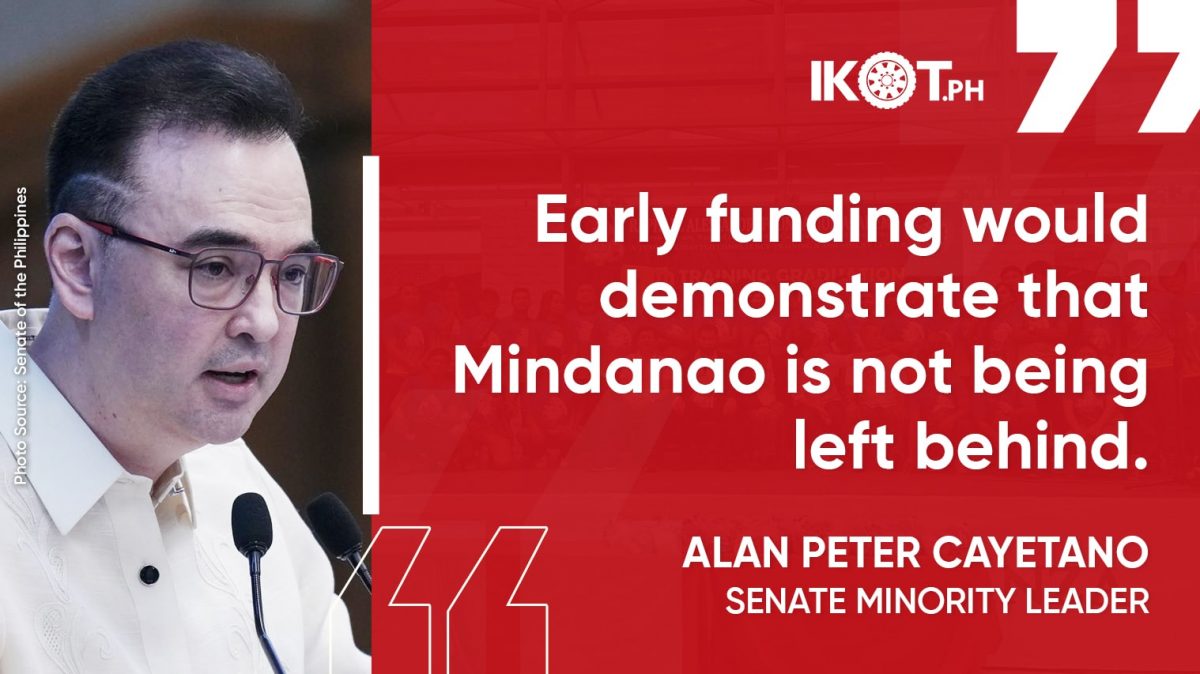
Senate Minority Leader Alan Peter Cayetano urged the Department of Transportation (DOTr) to take a more proactive approach in moving the Mindanao Railway forward, saying even limited groundwork would show that long-term development is not confined to Metro Manila.
During the senate plenary debates for the proposed 2026 budget of the department, Cayetano asked the DOTr to revisit how it can start even a single segment of the railway project after the agency said the overall plan is on hold due to collapsed negotiations with its original proponent — but right-of-way work and studies are still ongoing.
“May I ask if we can do better than that? Maybe there was a leg of the Mindanao Railway that you can do through our appropriations. How can we put some money in 2026 for the study, for the groundwork to start in 2027?” the veteran legislator inquired.
The seasoned lawmaker said early funding would demonstrate that Mindanao is not being left behind even as most large-scale transport investments continue to pour into Metro Manila.
“It’s a good signal sa Mindanao na hindi naman tayo panay Metro Manila lang.”
“It’s a good signal sa Mindanao na hindi naman tayo panay Metro Manila lang,” the senator stressed.
He linked the Mindanao Railway to the broader issue of how feasibility studies shape national development, saying planners tend to prioritize areas with high population density because they appear more viable on paper.
This, Cayetano warned, pushes more people toward already congested urban centers such as the National Capital Region (NCR) and Regions III and IV, instead of strengthening more regional economies.
“If we keep building in these red areas (densely-populated), people will still keep moving there. That’s the weakness of feasibility study [because] they’re looking at the financial and the engineering side. But the unintentional consequences, everyone will move to that area,” he said.
In the deliberations of the Department of Public Works and Highways (DPWH)’s proposed 2026 budget, Cayetano already warned about rapid urbanization, saying poorly planned growth is straining many emerging cities and agencies must anticipate population shifts instead of reacting when congestion appears.
“Countries with strong rural development systems show how regions can thrive without depending on capital cities.”
The Minority Leader said countries with strong rural development systems show how regions can thrive without depending on capital cities.
“We [already] forgot the lesson our elders taught us about rural development,” he said.
“In Europe, their rural areas have internet, roads, water, hospitals… For us, if you say ‘rural,’ basically it means agricultural or poor,” Cayetano concluded.