
“This is progressive. This is one step forward.”
House Committee on Suffrage and Electoral Reforms Chair and Lanao Del Sur 1st District Representative Zia Alonto Adiong stressed this as the Anti-Political Dynasty substitute bill approved by the Committee marks the first concrete implementation of the Constitution’s mandate nearly four decades after it was written.
Adiong pointed out that the country currently has no enabling law defining and prohibiting political dynasties.
“In the first place, we do not have an anti-political dynasty as of yet being implemented in this country,” the veteran legislator said.
“Hindi dapat magkaroon ng concentration of power in one LGU.”
“What we can assure you is that this version, we tried to decongest ‘yong political unit from a culture of one political family. Hindi dapat magkaroon ng concentration of power in one LGU,” the seasoned lawmaker said.
The substitute measure, adopted after a series of public consultations and committee hearings nationwide, bars political dynasties within the second degree of consanguinity or affinity from simultaneously holding elective positions within the same political unit.
According to the lawmaker, the bill directly addresses the core problem: the concentration of power that weakens democratic checks and balances.
“Ibig sabihin, Vice Mayor, asawa; kapatid, anak, Mayor — ‘yon talaga ‘yong may concentration ng power because it weakens the very foundation of democracy, which is checks and balances. So, we try to address that,” he explained.
At the same time, Adiong clarified that the proposal does not impose a blanket prohibition on relatives participating in elections in separate localities.
“We cannot prevent altogether those who want the chance to participate in other localities,” he added, emphasizing that running for office does not automatically translate to victory.
“Running does not necessarily mean winning. What we are trying to address is the concentration of powers. Kailangan mabuwag ‘yon,” Adiong pointed out.
Committee member and Bukidnon 2nd District Representative Jonathan Keith Flores echoed Adiong’s position, pointing out that the current legal framework has no formal definition of political dynasty.
“Ang basis natin ngayon is zero definition of what political dynasty is,” Flores said.
“In one political unit, pwedeng mayor, vice mayor, and councilors are all occupied by persons coming from the same family as of now. But with the bill passed only one position can occupy that particular political unit,” the legislator explained.
The lawmaker described the measure as a major shift from the status quo.
“It’s a big leap forward kasi dati in one political unit, pwede unli members of the same family. Ngayon, isa na lang talaga in the versions we’re working with.”
“Ngayon, it’s a big leap forward kasi dati in one political unit, pwede unli members of the same family. Ngayon, isa na lang talaga in the versions we’re working with,” he said.
Responding to calls from some sectors for a broader fourth-degree ban, Adiong maintained that the approved version remains a meaningful and realistic reform.
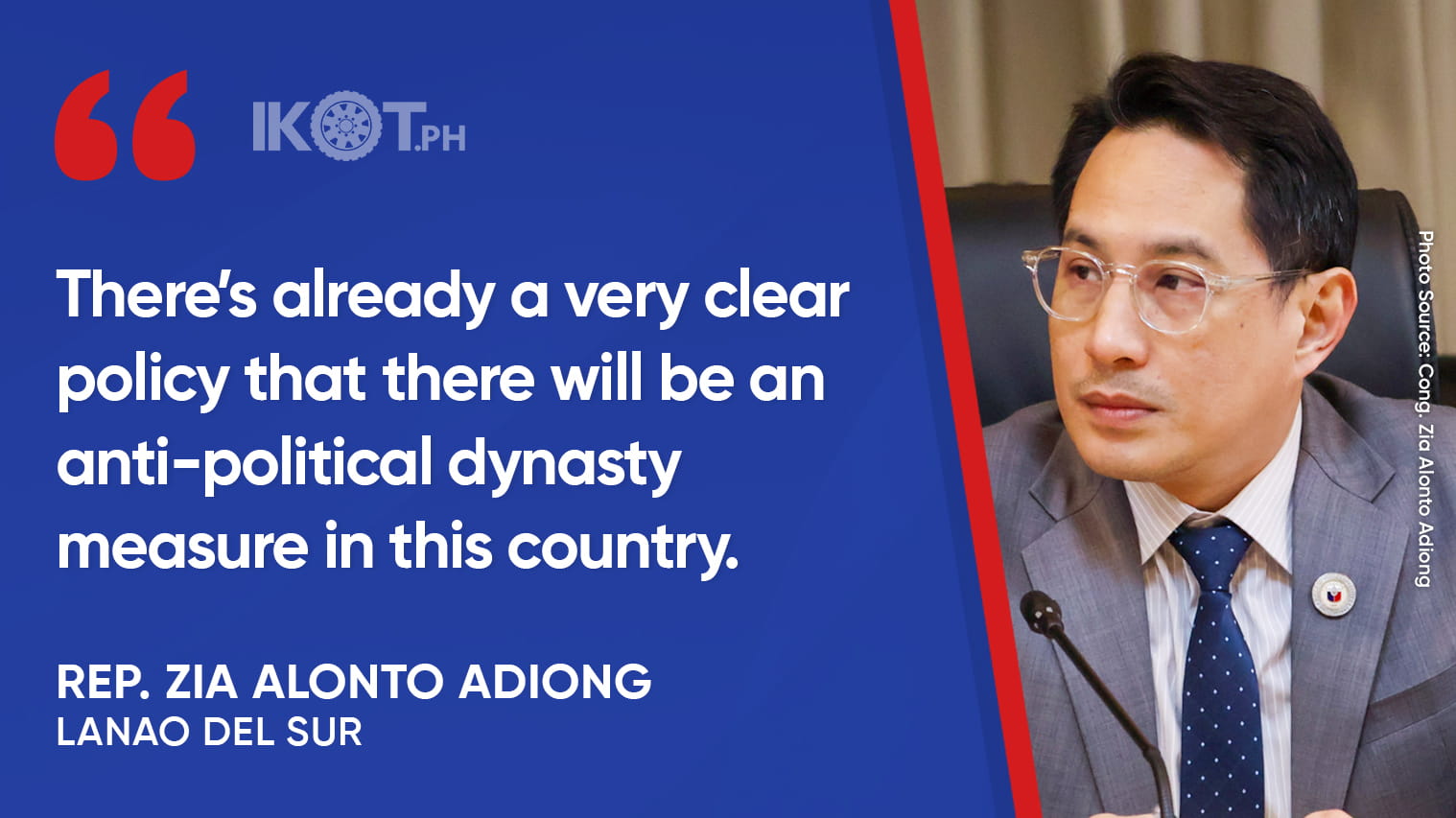
“There’s already a very clear policy that there will be an anti-political dynasty measure in this country,” he said. “There’s no actual policy right now covering power concentration within a locality. Wala pa. So this is a step forward.”
The substitute bill is expected to be sponsored on the plenary floor before the Lenten break, where it will undergo debate and possible amendments.