
Deputy Majority Leader Luigi Villafuerte and Camarines Sur (CamSur) Rep. Migz Villafuerte want the government to build Accessory Dwelling Units (ADUs), which are more commonly known as “granny flats” or “backyard homes,” to help close the national housing backlog that already ballooned to 6.5 million units as of 2025.
Popular in countries like the United States (US), Australia, Canada and New Zealand, ADUs—also known as “secondary dwellings”—are small, self-contained residential units built within the same lots that have existing primary dwellings.
In House Bill (HB) No. 8813, Luigi Villafuerte and Migz Villafuerte, who chairs the House committee on information and communications technology (ICT), noted that the successful implementation of ADU systems in the above mentioned countries “have proven to be an effective tool in increasing housing supply quickly and efficiently without requiring large tracts of new land or massive government expenditure.”
The other authors of HB 8813 are CamSur Rep. Tsuyoshi Anthony Horibata and Bicol Saro Rep. Terry Ridon.
“By unlocking the potential of residential lots across the country, the proposed ADU system could generate hundreds of thousands of new housing units within a few years.”
An ADU is a self-contained residential unit located in the same residential lot as a primary dwelling, with its own sleeping area, kitchen, bathroom and independent entrance.
In the US alone, ADUs now make up 20% of all housing permits in California from 2016 to 2023.
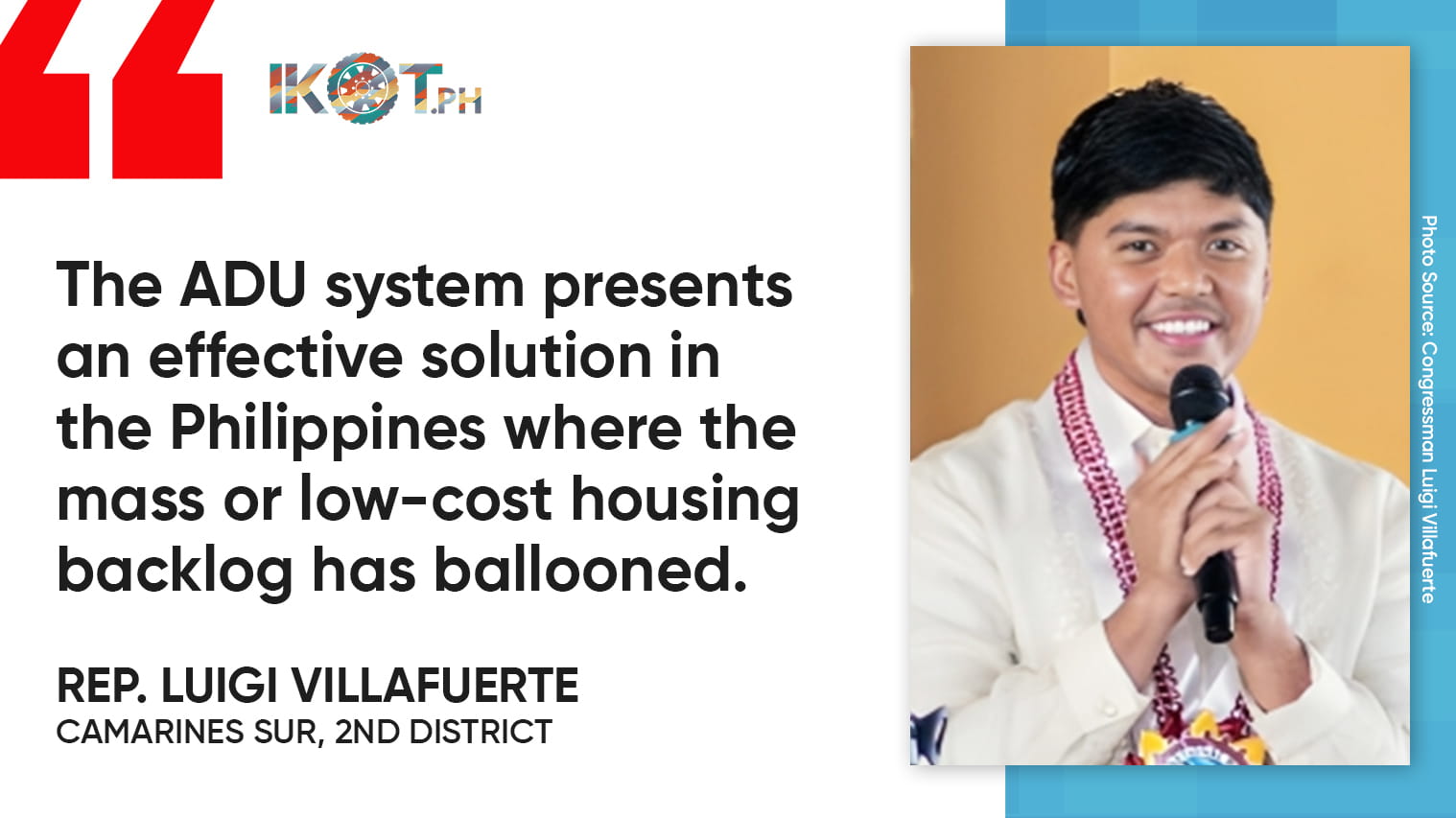
“The ADU system presents an effective solution in the Philippines where the mass or low-cost housing backlog has ballooned because of how expensive lands have become in urban areas,” Luigi said.
“Because of this cost factor, priority developers tend to focus on building middle to high-income housing units instead of the low-cost or more affordable ones,” he said.
“With the high cost of housing materials exacerbating other housing woes like the slow process of approval of housing permits and land titles, among others, new and innovative housing solutions must be explored to complement existing government programs,” Luigi said.
“With this bill, we hope to address the continuing severe housing shortage in the Philippines by allowing the implementation and establishment of ADUs in residential lots nationwide, and at the same time simplifying permitting procedures, and providing incentives to homeowners and builders to encourage ADU development,” Migz said.
Citing Department of Human Settlements and Urban Development (DHSUD) data, Migz said that, as of 2025, the national housing backlog exceeded 6.5 million housing units last year—and is still growing.
This housing challenge is a result, said Migz, of “rapid urbanization, population growth and rising land prices in urban centers, which means that more and more Filipino families lack access to adequate, safe and affordable housing.”
“Without a proper and long-term solution, the housing backlog may grow significantly up to 22 million by 2040,” Migz said.
By allowing homeowners to construct small secondary housing units or ADUs within their residential properties, he said that ADUs provide multiple benefits.
Migz said that such affordable ADUs within existing communities provide supplemental income for homeowners through rental opportunities; housing options for students, workers and young families; multi-generational housing arrangements for Filipino families; and more efficient use of existing urban land and infrastructure.
“By unlocking the potential of residential lots across the country, the proposed ADU system could generate hundreds of thousands of new housing units within a few years, significantly helping address the country’s widening housing backlog,” Luigi said.
More importantly, he added, “this measure empowers Filipino homeowners to become active partners in solving the housing crisis while generating additional economic opportunities for families and communities.”
Regardless of type, all ADUs shall have the minimum size of 18 square meters (sqm) and the maximum size of 75 sqm with a maximum height of up to two (2) floors.
The main goals of HB 8813 are to:
- Allow the construction of up to two (2) ADUs per residential lot;
- Establish a streamlined and time-bound permit system to reduce bureaucratic delays;
- Provide tax incentives and financing support to homeowners and builders;
- Promote modular and prefabricated housing technologies to accelerate construction; and
- Encourage LGUs to integrate ADUs into their respective local housing strategies.
The following are the types of ADUs that shall be implemented under this Act:
- Detached ADU – small house built within the lot;
- Attached ADU– extension of the main dwelling unit;
- Garage Conversion ADU – garage of the main dwelling unit that shall be converted into a small, independent living space;
- Roof Deck ADU – small, independent living space that is built on top of an existing building or main dwelling unit that shall be converted into a livable unit; and
- Modular or Prefabricated ADU – small, independent home that is built off-site in a factory and then transported to a property for installation.
Regardless of type, all ADUs shall have the minimum size of 18 square meters (sqm) and the maximum size of 75 sqm with a maximum height of up to two (2) floors.
Furthermore, ADUs may be built only on lots with a minimum size of 120 sqm.
Under Republic Act (RA) No. 9485, as amended by RA 11032 or otherwise known as the Anti-Red Tape Law, LGUs are tasked to approve ADU permits within sixty (60) days from submission; otherwise, the permits shall be deemed automatically approved.
All ADU permits shall be processed through a national digital permit platform integrated with DHSUD, LGUs and the Housing and Land Regulatory Board (HLURB) zoning data.
The DHSUD shall create a national catalogue for the following ADU models, which shall receive immediate permit approval nationwide: (1) Pre-approved ADU Designs; (2) Modular ADU Systems; and (3) Contained ADU Systems.
Homeowners who build ADUs are entitled under the bill to the following incentives:
- Real property tax Incentive of 50% for every five (5) years; provided, that the ADU is exclusively built for purposes of affordable housing, student housing, rental housing for workers, and/or additional dwelling for a family member; and
- Income Tax Exemption for annual rental income of those who earn up to P300,000.
As for ADU builders and manufacturers, they are entitled under the bill to the following incentives:
- 5-year income tax holiday;
- Value-Added Tax (VAT) exemption for ADU units priced below P3 million;
- Duty-free importation of machinery for modular housing plants; and
- Strategic investment priority classification by the Board of Investments (BOI).
Government financial institutions (GFIs), such as the Home Development Mutual Fund(Pag-IBIG Fund), Land ank o the Philippines (LandBank) and the Development Bank of the Philippines (DBP), shall create special ADU loan programs with low-interest loanable amounts of up to P3 million each and repayment terms of up to 25 years.
The DHSUD may enter into agreements with the private sector for purposes of financing the ADU program.
Homeowners renting ADUs to teachers, nurses, police officers, government employees and students shall receive additional incentives of property tax rebates and government-backed rental insurance.
LGUs shall have the following responsibilities in the implementation of this Act, provided that local governments shall not impose excessive fees on ADU constructions:
- Integrate ADUs into zoning ordinances;
- Establish ADU information desks; and
- Streamline permit processes.