
Camarines Sur (Camsur) Governor LRay Villafuerte sees a good year for Camsureños this 2026 as the provincial government, with the full support of other elective and appointive officials plus sectoral leaders, makes initial headway in his inaugural commitment last year to lead the province to “greater heights” on his watch.
Upon assuming office last year following his formidable win in summer’s midterm elections, Villafuerte pledged to work on bringing about better lives for Camsur folk on the back of a 12-point governance agenda for a “greener, smarter, healthier, better-connected and digitally savvier” province over his three-year term.
Villafuerte said that, “CamSur folk can take comfort in my resolve to work double-time this year on programs geared to harness the boundless potentials of our province that has become one of the country’s richest and fastest-growing local economies.”
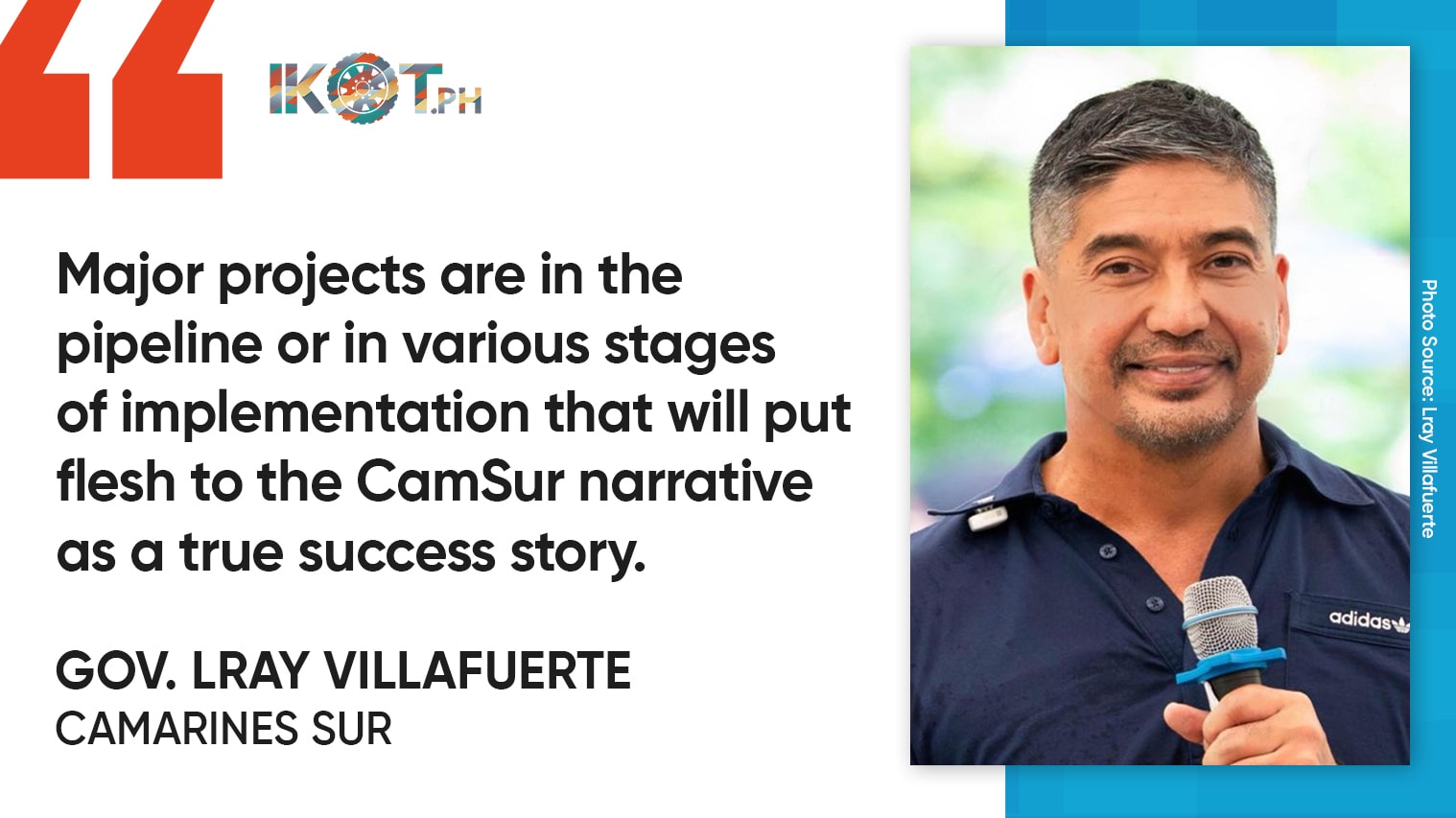
“Major projects are in the pipeline or in various stages of implementation that will put flesh to the CamSur narrative as a true success story that has evolved from being one of the country’s poorest provinces to the third richest and with the second highest revenue growth,” Villafuerte said.
Villafuerte said that initiatives have also been taken to transform CamSur into a center for agricultural processing and exports; a haven for clean energy in step with the country’s support for a low-carbon global economy; and a hub for tourism, sports and wellness.
The president of the National Unity Party (NUP) and senior vice chairman (for South Luzon) of the League of Provinces of the Philippines (LPP), Villafuerte said the provincial government’s flagship project is the Smart Global City, which will be anchored by CamSur Uptown that will have logistics centers, offices, schools, hospitals, malls and residential villages.
At the heart of CamSur Uptown will be the iconic and ultra-modern provincial government center that is designed like CamSur’s internationally famous pili nut, and that will have a fully equipped mega evacuation center for Camsureños who will be forced to flee their homes during calamities.
This government center, which has been designed by architect and urban design consultant Carlos Arnaiz of the design firm CAZA, is already 70% complete.
CAZA, a Brooklyn-based design studio and think tank, has offices in the Philippines and Colombia.
Among its projects in the Philippines are the BCDA Iconic Building and Bonifacio Theater Park in Taguig City, Caticlan Airport in Aklan, the Baguio Apartments in Baguio City and the Baler Hospital in Aurora province.
Indicative of CamSur’s continued rise as an investment magnet in the Philippines, he said that Allied Manufacturing Corporation Asia Pacific Pty Ltd and Google are putting up a local Chromebook manufacturing facility in CamSur Uptown Global City, and which is due for initial operation this year.
This facility will focus on the local assembly of Chromebook laptops and related education technology devices for deployment in public schools nationwide.
To be housed in a 5,000-square meter (sq m) area, this facility will have an initial production capacity of 100,000 units monthly, scalable to 200,000 units.
Villafuerte said that initiatives have also been taken to transform CamSur into a center for agricultural processing and exports; a haven for clean energy in step with the country’s support for a low-carbon global economy; and a hub for tourism, sports and wellness.
He made it clear that the successive stints of his late father Luis Villafuerte, his sons now-Representatives Migz Villafuerte and Luigi Villafuerte, and of him as governor point to “a living legacy of sustainable and bold leadership—a Ka Fuerte brand of governance anchored on building the impossible and breaking new ground—that has turned our once struggling province into one of the richest and fastest-growing in the Philippines.”
“But as I have promised my fellow Camsureños when I returned to the Provincial Capitol last year as governor, I have been moving forward with our programs and projects—and will continue to do so this year—faster, bolder and more determined,” he said.
To achieve a Connected CamSur that promises to be a Global gateway, we will have an international standard airport by 2028 that will house a Smart Pili Aerotropolis, as well as an international standard seaport in Pasacao.
There is also the upgrade of Tandoc port in Siruma, he said.
“In keeping with our program to convert our province into the RE (Renewable Energy) Capital of the Philippines, we have been promoting and developing approved RE projects on renewables like wind and solar power that are projected to generate a combined 8,000 megawatts (MW) of electricity,” he said.
Work has started, for one, he said, on the 1000-MW offshore wind (OSW) project in San Miguel Bay of the Danish firm Copenhagen Infrastructure Partners (CIP), which is investing $3 billion or P165 billion in this project, which, once operational by 2028, will be the largest OSW project in the Philippines that will create thousands of jobs, generate billions of pesos in revenues, and spell a cleaner future for the province.
The other RE projects being supported by the provincial government include the 58.5 MW onshore wind project of Aboitiz Power in Libmanan, which has an investment of P5 billion; the 74 MW solar power project in Calabanga of NexifRatch Energy, which is investing P2.8 billion; and the 50 MW onshore wind project by Citicore valued at P5.7 billion in Bombon.
A CamSur food complex is also being built that will house processing facilities for rice, coconut, fruits and vegetables, and will revolutionize the value-added processing and trading of farm goods.
Also, the provincial government has been at the forefront of the country’s digital transformation, by providing free wifi in at least 700 barangays, or roughly two-thirds of the 1,036 villages in the province, he said.
Right now, free wifi is already available in 227 barangays combined in Iriga City and 18 municipalities.
“We are going nonstop in installing Starlink devices, including in upland, coastal and other GIDA (geographically isolated and disadvantaged areas) barangays, as a way to provide free internet connectivity all over CamSur, in sync with the goal of President Marcos to close the country’s digital divide,” Villafuerte said.
“By virtue of Republic Act (RA) No. 12294, which Migz an I had authored, the Baao Community College (BCC) was put up as a provincially managed college by the late Government Reorganization Minister Luis Villafuerte over two decades ago when he was still CamSur governor,” he said.
On environmental protection, he said that the provincial government of flood-prone CamSur is pioneering an ambitious decade-long green climate-adaptive flood mitigation program patterned after the coastal embankments or eco-dikes in Japan that protect seaside communities against tsunamis and storm surges.
“CamSur is launching the Green Embankment Program under El Verde, which is our innovative, nature-based solution to flooding and storm surges,” he said. “Inspired by Japan’s successful green embankment models, we’re turning our shorelines and riverbanks into living great walls of forests designed to better shield our high-risk communities, create jobs and build a greener tomorrow for Camsureños.”
On agriculture development, he said that the Marcos administration is building a P500-million mega cold storage facility in CamSur with a capacity of 1,300 tons, which will be a food security hub once up and running this 2026.
It will become a center for agricultural produce bound for Metro Manila that are to come not only from the province and the rest of Bicol but from the Visayas and Mindanao as well, he said.
A CamSur food complex is also being built that will house processing facilities for rice, coconut, fruits and vegetables, and will revolutionize the value-added processing and trading of farm goods, he said.
There is also the CamSur logistics hub, which, once operational, will be the first of its kind and the largest in the country.
In terms of sports, he said that CamSur is not resting on its laurels as host to the CamSur Watersports Complex (CWC), which is dubbed as the world’s best wakeboard and cable ski facility.
Also, the provincial government is building an international standard golf course, and a world-class fitness center for pickleball, CrossFit, hyrox and other types of fitness training, he said.
For wellness, the provincial government is working with leading pharmaceutical company Iba Botanicals in developing a 7,500-hectare (ha) production facility for Vetiver oil, which is a key ingredient in making perfumes, aromatic oils, creams and soaps along with other personal care (PC) products that are widely in demand across the globe.
“The CamSur provincial government is showing the way to transforming and developing ordinary rural agricultural land into big employment generators, source of low-cost yet high-value farm goods, and a mega dollar earner that has the potential to place the Philippines at front and center of the $30-billion global F&F industry,” Villafuerte said.
In his speech during the recent meeting in CamSur’s capital of Pili of the Regional Peace and Order Council (RPOC)-Region V following his assumption as its chairman, Villafuerte said that maintaining peace and order across the region is contingent on a much better effort to attack penury and destitution among Bicolanos, given the direct link between poverty and crime.
“Our mission goes far beyond preventing crime. Our mission is to defeat poverty because poverty is where fear grows, crime is born, and dreams are lost,” he said. “Together with our uniformed services, government agencies, LGUs (local government units) and every Bicolano who believes in a better tomorrow, we will build a stronger, safer, and more prosperous Bicol Region.”