
Camarines Sur Reps. Migz Villafuerte and Luigi Villafuerte have shot down a proposal by the Organisation for Economic Cooperation and Development (OECD) for the government to discontinue exempting senior citizens from the 12% Value Added Tax (VAT) as part of fiscal consolidation reforms to reduce our debt and narrow the budget deficit.
At this time when the government should be expanding the safety nets for the elderly and other vulnerable sectors, the Villafuertes said that “taking out the VAT-free privilege from the bundle of economic benefits they now enjoy would make living even more arduous for seniors, most of whom are already struggling to cope with the ever increasing cost of living.”
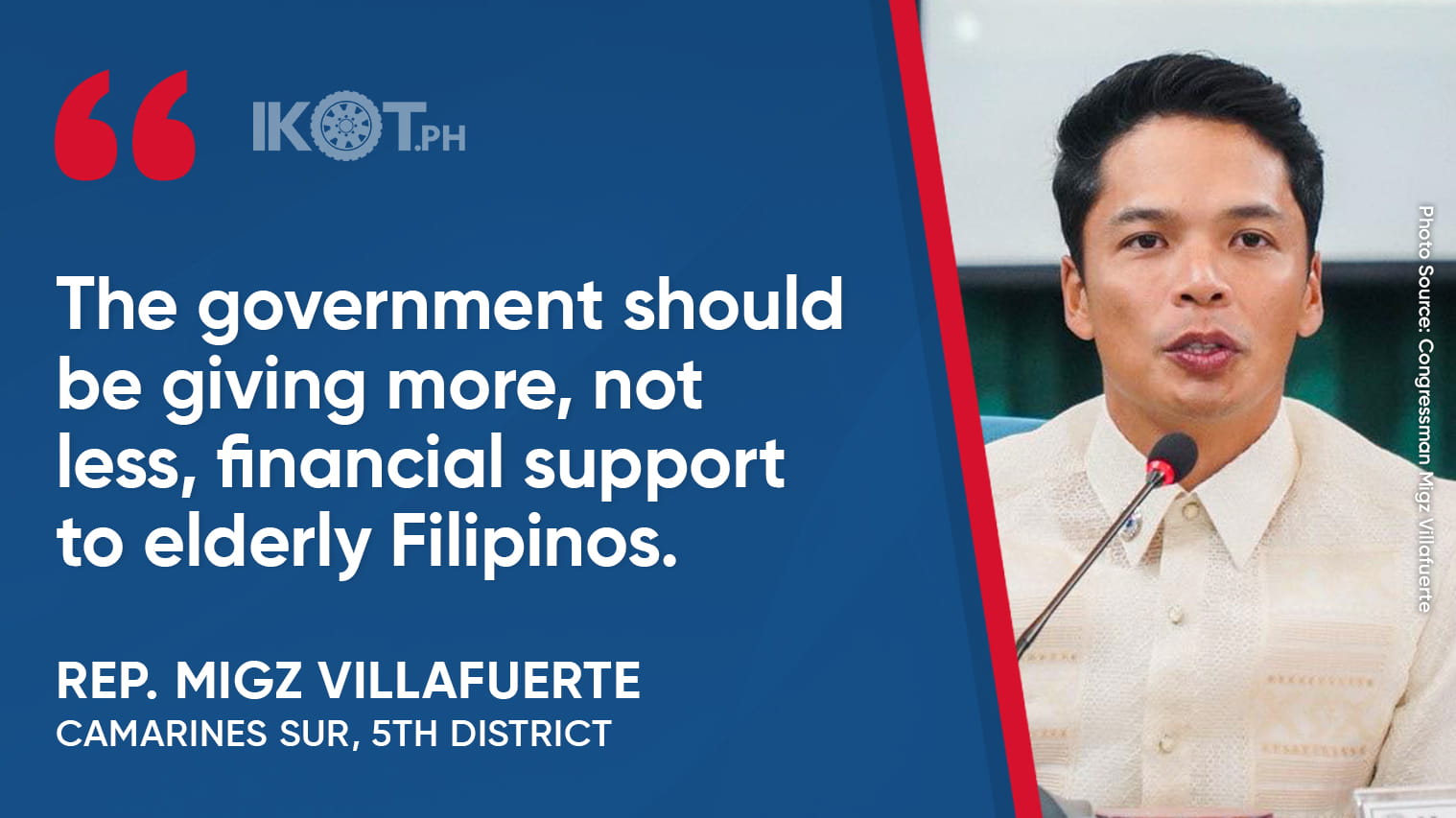
“The government should be giving more, not less, financial support to elderly Filipinos, many of whom have neither sources of adequate income nor families who can sufficiently provide for their daily needs,” Migz, who chairs the House committee on information and communications technology (ICT), said.
Luigi, a deputy majority floor leader, said that to discontinue the grant of VAT-exemption privileges to the elderly on their expenses —as proposed by the Paris-based OECD—would “further marginalize seniors—and run counter to President Marcos’ Bagong Pilipinas vision of a prosperous country where no Filipino is left behind.”
According to the Department of Finance (DOF), it is reviewing the OECD’s suggestion on the removal of the VAT exemptions for senior citizens, healthcare providers and private education.
Fully aware that many of our senior citizens are in dire financial straits in the face of spiraling commodity prices and healthcare costs, the Villafuertes said that they have introduced House Bill (HB) No. 2048 establishing a universal social pension (socpen) for the elderly that will mean a monthly allowance of at least P500 for all senior citizens, including those who are not considered indigent ones or without incomes.
The Villafuertes said they are proposing in HB 2048, which they co-authored with fellow CamSur Rep. Tsuyoshi Anthony Horibata and Bicol Saro Rep. Terry Ridon, that this universal socpen or cash grant for all seniors, of an initial P500 monthly be doubled to P1,000 in five years’ time.
However, an estimated 4 million indigent seniors who are already getting a monthly socpen of P1,000 under the Social Pension for Indigent Senior Citizens (SPISC) Program—as provided for in Republic Act (RA) No. 9994, or the “Expanded Senior Citizens Act” of 2010, and RA 11916, or “An Act Increasing the SocPen of Indigent Senior Citizens”—will continue to receive this higher pension of P1,000 even if HB 2048 becomes a law.
According to the Department of Finance (DOF), it is reviewing the OECD’s suggestion on the removal of the VAT exemptions for senior citizens, healthcare providers and private education.
DOF Secretary Frederick Go was quoted in reports as telling the media that: “OECD has a lot of good suggestions, but we have to study them. We’ll see which ones we can do, which ones we cannot do.”
In the inaugural launch of OECD’s Economic Survey of the Philippines, OECD Secretary-General Mathias Cormann was quoted in media reports as saying that the Marcos administration should accelerate its pace of fiscal consolidation by way of reforms to generate higher revenues for optimum growth, put “public debt on a more prudent path,” let the increased revenue “go to the bottom line,” and adopt “relevant tax arrangements including those related to VAT.”
As part of its proposals to limit debt servicing costs and create fiscal space to deal with future economic shocks, the OECD said the Marcos government should phase out VAT exemptions and corporate tax incentives such as tax holidays.
“Phasing out VAT exemptions for private healthcare, education and senior citizens, combined with targeted social transfers, would raise revenues while improving the efficiency and equity of the tax and benefit system,” it said.
The Philippines has a 12% VAT on sales, imports of goods and services and other transactions—the highest in Southeast Asia.
Fortunately for seniors, RA 9994 granted Filipinos 60 years of age and above a 20% discount along with exemption from the 12% VAT on essential goods and services, notably their expenses on medicines, transportation and restaurants.
Rather than discontinue VAT exemptions to raise more revenues, Migz Villafuerte said the government could broaden its revenue base to cut debt servicing and deficit spending by improving tax administration, especially in the collection of new taxes.
The OECD said the Marcos government should phase out VAT exemptions and corporate tax incentives such as tax holidays.
Luigi said that the Bureau of Internal Revenue (BIR), for instance, could exert better effort to hit its 2026 target of collecting P20 billion or more from the 12% consumption levy on digital services .
As for the Bureau of Customs (BOC), he said this bureau could improve its collections to hit its target of surpassing the P1-trillion mark this 2026, from last year’s P934.4 billion.
The Villafuertes said that despite the numerous legislative measures meant to keep senior citizens in the mainstream of society, the current monthly socpen pension for them remains exclusionary, such that the inflation rate leading to the rise in the cost of goods and services affects even those who are not officially classified as indigents.
HB 2048 is actually a refiled bill from the 19th Congress, and which was approved on third and final reading by the House of Representatives. But this measure did not clear the Senate.
While RA 9994 established the SPISC with a cash grant of P500 each month, RA 11916 doubled this monthly stipend to P1,000 starting in 2022.
Another law beneficial to the aged is RA 11982, or the “Act granting Benefits to Filipino Octogenarians and Nonagenarians,” which Migz and former congressman and now-CamSur Gov. LRay Villafuerte co-authored in the past Congress, which grants a P10,000 cash gift to every senior citizen when they reach 80, 85, 90 and 95 years of age.
RA 10868 provided for a P100,000 gift each for seniors when they become centennials or turn 100.
According to the Philippine Statistics Authority (PSA), there were 9,242,121 senior citizens as of 2020. Other estimates have currently placed the number of Filipino seniors at a higher 11 million.