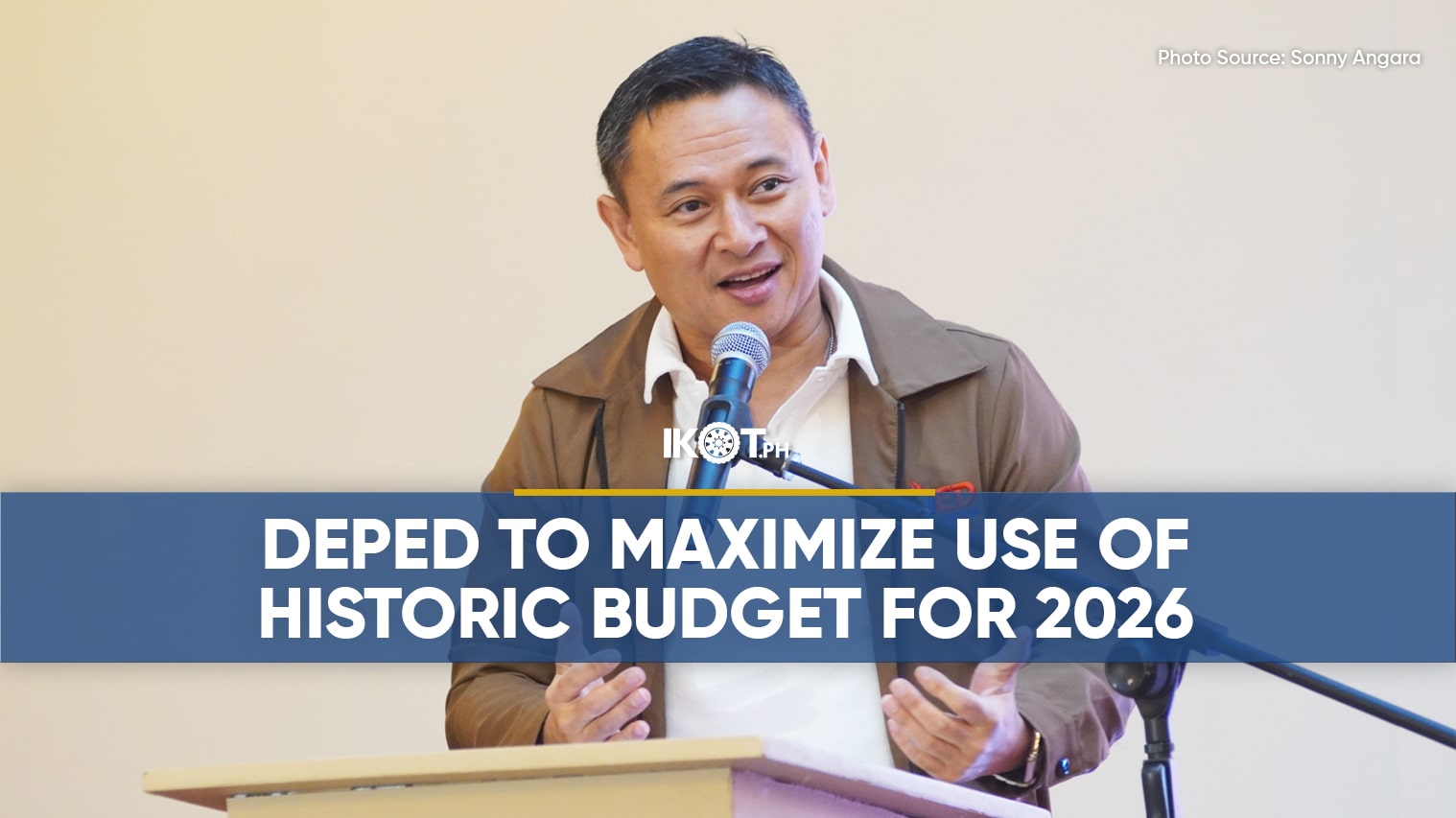
To ensure the continuity of reforms in education, the Department of Education (DepEd) vowed to maximize the historic budget in its sector after President Ferdinand Marcos Jr. signed into law the P6.79 trillion 2026 General Apppropriations Act (GAA).
This marks the first time the Philippines reached the United Nations Educational, Scientific and Cultural Organization (UNESCO) benchmark for education spending.
“The 2026 national budget shall sustain our momentum in education reforms, in health protection, in food security, in social security, and in job creation.”
“The 2026 national budget shall sustain our momentum in education reforms, in health protection, in food security, in social security, and in job creation,” Marcos said.
With DepEd securing P1.015 trillion in funds, Angara said the agency was able to secure the biggest budget para programs directly supporting students and teachers, including classrooms and facilities in schools, school-based feeding, textbooks, learner subsidies, laptops for teachers and learners, additional positions for teaching and non-teaching personnel, and the continuing education for teachers and heads of schools.
“Ngayong 2026, nakatuon ang DepEd sa pagsisiguro na mas lalo pa nating mapapaunlad ang kalidad ng edukasyon sa ating bansa sa pamamagitan ng sapat at maayos na mga pasilidad, mas malawak na access sa digital tools, at tuloy-tuloy na suporta para sa ating mga guro,” the education chief stressed.
Based on the Five-Point Reform Agenda of Angara, the DepEd will focus on programs to address the 165,000-classroom backlog through the P85.3 billion fund in the approved Fiscal Year 2026 budget.
Through this amount, P65 billion will be allotted to the construction of 24,964 new classrooms, while P7.7 billion will be used for the repair and rehabilitation of existing school buildings.
“Bilang bahagi ng pangako sa isang mas malinaw at mas mabilis na pagpapatupad ng mga programa sa pagtatayo ng paaralan, ang DepEd ay aktibong magsusumikap sa pakikipagtulungan sa mga local government units at private sector partners sa pamamagitan ng Public-Private Partnerships,” the education chief said.
Meanwhile, DepEd will receive P19.5 billion for the production of textbooks and other learning materials.
In 2025, the agency was able to receive 105 textbook titles in one year marking a 289% increase.
More than the physical infrastructure, DepEd wants to ensure that all public schools in the country will have access to digital tools and reliable internet connectivity. For 2026,
P10.6 billion has been allotted for the DepEd Computerization Program (DCP).
The Department has also been granted P4.6 billion for the training of teachers to ensure they are equipped with modern and effective ways to teach inside the classrooms.
Moreover, DepEd has allotted P42.4 billion to secure 32,916 teaching items, 6,000 Principal I positions, at 10,000 School Counselor Associate positions in fulfillment of the commitment to unload teachers of administrative workload. ng mga guro at pagbibigay-daan sa kanila na mas tumutok sa aktwal na pagtuturo sa silid-aralan. P29 billion has been granted by Congress to fill up teaching items.
DepEd was also able to secure P2.2 billion for 11,268 Administrative Officer II positions, as well as 5,000 Project Development Officer I post with P1 billion fund.
“Mas magiging epektibo at mas mararamdaman ang mga reporma natin ngayong taon.”
“We are looking at a very promising 2026 for the education sector. Nagpapasalamat tayo sa ating mahal na Pangulo, President Bongbong Marcos, sa kanyang patuloy na suporta sa ating mga mag-aaral at mga guro—dahil dito, mas magiging epektibo at mas mararamdaman ang mga reporma natin ngayong taon,” Angara noted.
He stressed that delivering quality education should go hand in hand with ensuring the health and welfare of students. Because of this, Congress allotted P25.6 billion to continue the implementation of the Expanded School-Based Feeding Program which will benefit 4.6 million learners nationwide.
Under the new feeding program, DepEd is eyeing to feed all Kindergarten learners and severely wasted Grade 2 to 6 learners in 200 days, while nutritionally at risk pregnant adolescents enrolled in public schools will have 45 feeding days.