
With the government now poised to implement the E-Governance law, Camarines Sur (CamSur) Representative Migz Villafuerte wants the Department of Information and Communications Technology (DICT) to work right away with local government units (LGUs) on establishing their respective electronic government or e-Gov platforms and then interlinking these channels to the national digital network “to speed up the nationwide switch to more efficient and transparent—and even graft-free—transactions with the public.”
Villafuerte said the recent release of the implementing rules and regulations (IRR) for Republic Act (RA) No. 12254, or the “E-Governance Act,” should “clear the path for the DICT to engage local executives right away on developing or improving their e-Government platforms to accelerate our country’s digital transformation and ensure our people’s easy online access to government services.”
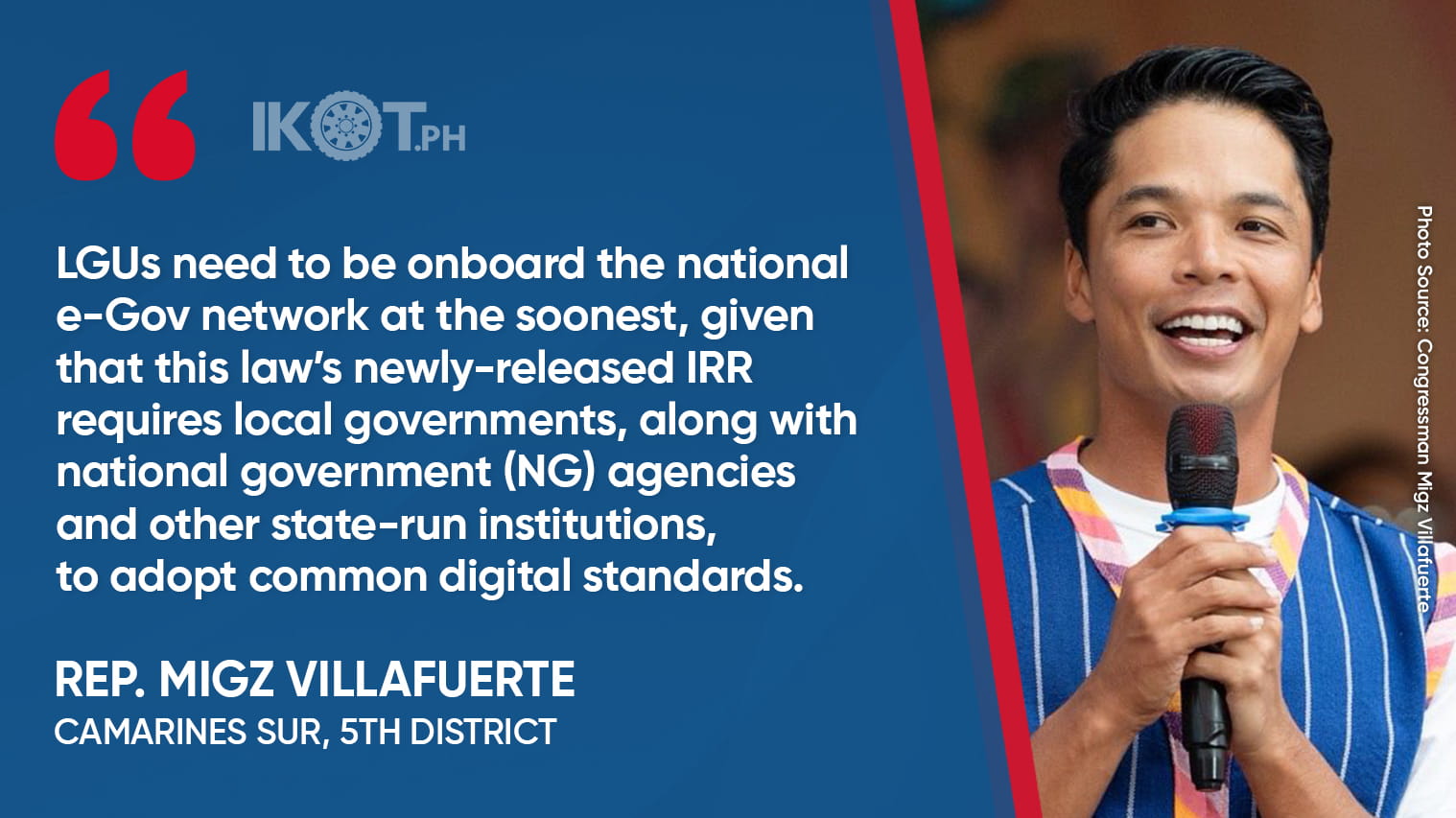
“LGUs need to be onboard the national e-Gov network at the soonest, given that this law’s newly-released IRR requires local governments, along with national government (NG) agencies and other state-run institutions, to adopt common digital standards, strengthen cybersecurity measures and re-engineer their processes for government services to be delivered online in a seamless, integrated, graft-free and citizen-centered manner,” said Villafuerte.
Under the law, Villafuerte said, LGUs that have existing digital portals or local governments that are able to put up their own platforms within a year of RA 12254’s effectivity are mandated to be immediately connected by the DICT to the national e-Gov network.
A former CamSur governor, Villafuerte is a co-author of RA 12254 and chairman of the House committee on ICT.
He noted that following the release of the law’s IRR, DICT Secretary Henry Aguda said the nationwide implementation of an e-Gov system is “about removing friction, cutting red tape, and making sure every Filipino, wherever they are, can access government services efficiently.”
Villafuerte pointed out that RA 12254 requires all LGUs to put up their respective Electronic Local Government Unit (eLGU) portals or, in case they are not able to do so, to utilize the eLGU system developed by the DICT and its equivalent programs and systems.
Under the law, he said, LGUs that have existing digital portals or local governments that are able to put up their own platforms within a year of RA 12254’s effectivity are mandated to be immediately connected by the DICT to the national e-Gov network.
The same law states that the eLGU software or equivalent, including its necessary infrastructure, shall likewise be provided by the DICT to the concerned local governments for the effective use of the eLGU system in unserved and underserved municipalities.
Villafuerte said the eLGU system provides for an Online Public Service Portal accessible through the internet, and this shall serve as a help desk where citizens can: (1) request for information and assistance on government frontline services and service procedures; and/or (2) report commendations, appreciation, complaints and feedback.
For purposes of interoperability, interconnection and harmonization, all existing systems or mechanisms, such as the 8888 Citizens’ Complaint Center and government social media channels, that are maintained by government agencies and LGUs shall be integrated into the Online Public Service Portal, he said.
And to make sure that the public is served efficiently and expeditiously, he said the law requires all LGUs, along with NG agencies and offices, government-owned or -controlled corporations (GOCCs,) and government financial institutions (GFIs) to cooperate and coordinate with each other and with the Presidential Management Staff (PMS) to guarantee prompt action on the concerns or complaints sent to the Online Public Service Portal.
RA 12254 requires all NGAs and LGUs to continuously and consistently enhance their respective websites and establish e-Bulletin Boards for efficient information dissemination, he said, and such online sites must be interactive, well-designed, functional, mobile-friendly and with regular information or content updates.
Villafuerte said this law establishes an e-Government Interoperability Fund (EIF), as a special account in the general fund managed by the DICT for implementing government websites, including the eLGU system.
This special Fund shall be sourced from donations and fees as well as Spectrum Users Fees, which now accrue to the Free Public Internet Access Fund (FPIAF) that was put up under RA 10929, or the “Free Internet Access in Public Places Act.”
The EIF may be funded, too, via grants and loans from development and foreign partners, or through Public-Private Partnership (PPP) mechanisms.
Aguda formally signed RA 12254’s IRR last March 24 at the Asian Development Bank (ADB) Headquarters in Mandaluyong City.
He said the IRR provides for a whole-of-government approach aimed at promoting seamless coordination between and among NG and LGU institutions through shared digital systems.