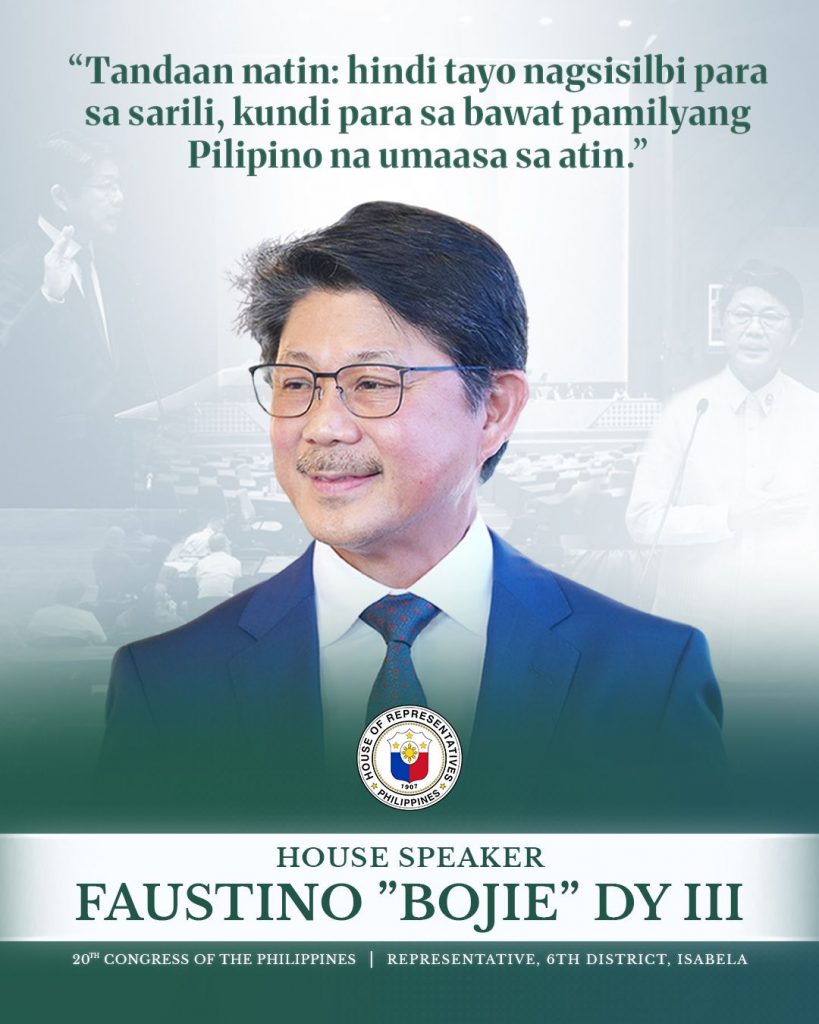

True to his promise, Speaker Faustino “Bojie” G. Dy III has taken a major step by filing a landmark Anti-Political Dynasty Bill, a reform he committed to pursue to promote fairness, competition and integrity in public service.
Speaker Dy filed House Bill (HB) 6771 together with Majority Leader Ferdinand Alexander “Sandro” Marcos, marking the first major push by top leaders of the House of Representatives to operationalize constitutional provisions intended to prohibit political dynasties.
The move follows the Speaker’s declaration during the resumption of session on Nov. 11, when he identified the Anti-Dynasty Bill as a central pillar of his reform agenda.
The measure was buoyed this week when President Ferdinand “Bongbong” Marcos Jr. on Monday directed both the House and Senate leadership to prioritize the Anti-Political Dynasty Bill as part of his priority legislative agenda announced at the LEDAC Full Council meeting—signaling unified executive and legislative focus on finally addressing the decades-old constitutional mandate.
Dy and Marcos appealed to their colleagues to approve the measure without delay, underscoring the urgency of the reform.
Dy stressed then that the measure seeks to fulfill a constitutional obligation that has remained untouched for nearly four decades by finally defining “political dynasty” in a way that opens public service to more Filipinos.
In the bill’s explanatory note, Dy and Marcos, who both come from families with a long history of public service, said urgent action is needed to uphold political equality and ensure all citizens can participate fairly in governance.
They anchored the measure on Article II, Section 26 of the Constitution, which mandates that “[t]he State shall guarantee equal access to opportunities for public service and prohibit political dynasties as may be defined by law.”

The House leaders warned that this mandate has been disregarded for decades, allowing dynasties to flourish unchecked.
“However, despite this constitutional mandate, political dynasties have remained a pervasive feature of Philippine politics due to the absence of an enabling law that defines and prohibits them,” they said.
Among the proposed restrictions, spouses, siblings and relatives within the fourth civil degree of an incumbent elected official would be barred from simultaneously holding specified elective posts.
The bill, according to Dy and Marcos, “aims to uphold the integrity, competitiveness, and inclusivity of democratic institutions by ensuring that public office is earned through meritocracy and public confidence.”
HB 6771 also marks a significant first step by asserting that power in the Senate must not be concentrated within one family.
Under the proposed measure, siblings or close relatives would no longer be allowed to serve simultaneously in the upper chamber, an initial but consequential barrier against dynastic consolidation at the national level.
The explanatory note describes the bill as “a faithful execution of the above constitutional provision – a strategic reform for good governance, and an assertion of the principle that public office is a public trust.”
Dy and Marcos emphasized that merit, not lineage, should be the basis of who serves.
The bill, they said, “aims to uphold the integrity, competitiveness, and inclusivity of democratic institutions by ensuring that public office is earned through meritocracy and public confidence.”
They further argued that the reform “reinforces the country’s alignment with international democratic standards, bolsters compliance with human rights and anti-corruption commitments, and advances equitable political participation across all sectors of society.”
For Dy and Marcos, the measure addresses unfinished business from 1987, an overdue correction that Congress must finally make.
“With this measure, Congress will finally fulfill its constitutional mandate to prohibit political dynasties and take a crucial step toward building a more inclusive and accountable political system for all Filipinos,” they said.
Dy and Marcos appealed to their colleagues to approve the measure without delay, underscoring the urgency of the reform.