
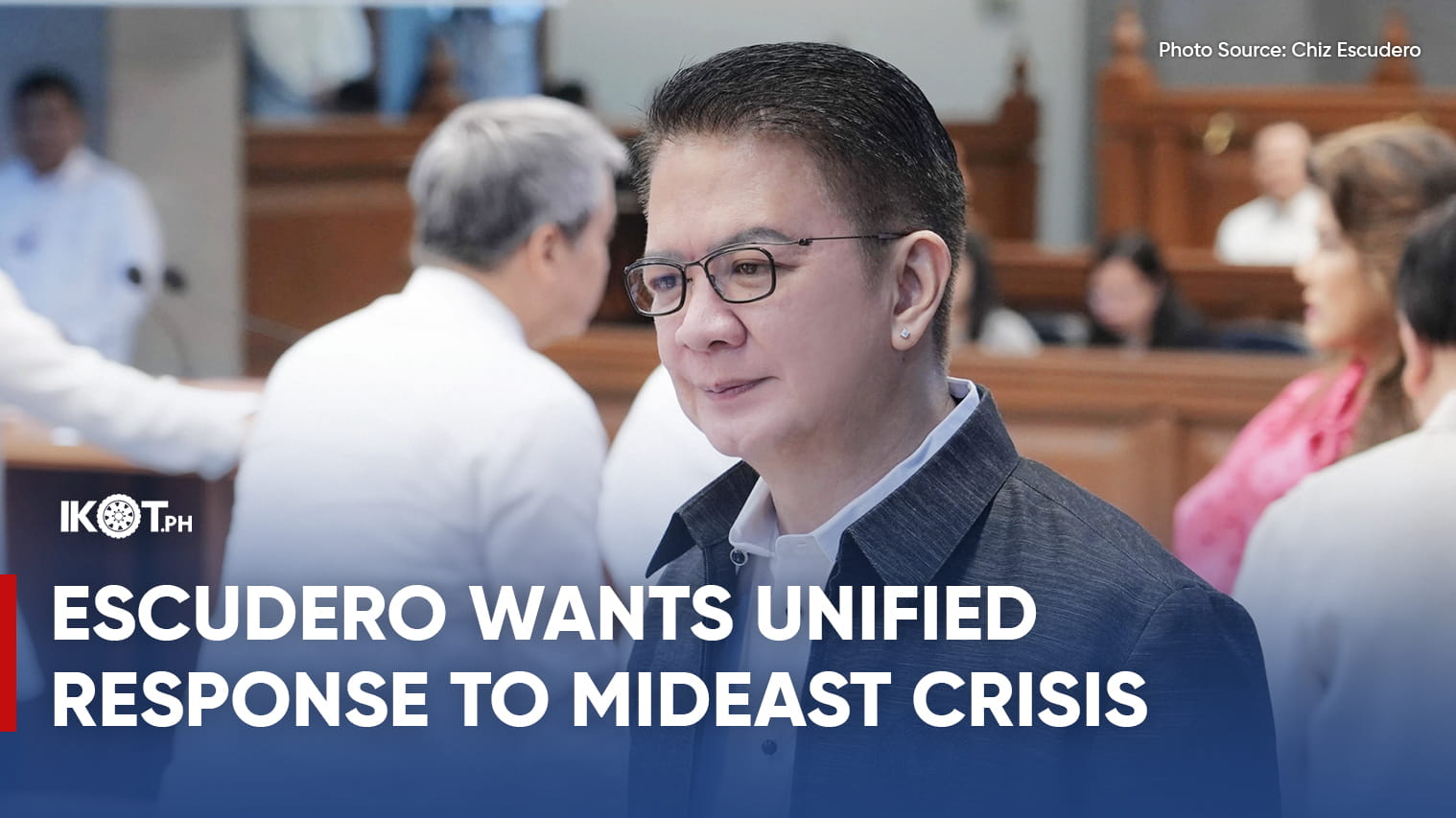
Senator Chiz Escudero has called for a unified approach in addressing the global fuel and energy disruptions amid the continuing Middle East standoff, citing the need for agencies, schools, local government units (LGUs), and businesses to act together under a unified government framework.
“The global energy landscape is shifting and we cannot afford fragmented responses. To protect the Filipino family and keep our economy moving, all sectors must contribute to a coordinated plan,” Escudero said.
The veteran legislator welcomed President Ferdinand Marcos’ signing of Executive Order No. 110, which declared a State of National Energy Emergency and adopted the Unified Package for Livelihoods, Industry, Food, and Transport (UPLIFT) for affected sectors.
“We may be the first nation to declare a State of National Energy Emergency amid this standoff, not because we are the most vulnerable, but because we are prepared to buckle down to work.”
“We may be the first nation to declare a State of National Energy Emergency amid this standoff, not because we are the most vulnerable, but because we are prepared to buckle down to work,” the seasoned lawmaker stressed.
The senator, likewise, welcomed the issuance of the Energy Regulatory Commission’s (ERC) order suspending operations of the Wholesale Electricity Spot Market (WESM) in Luzon, Visayas, and Mindanao, saying the move provides timely regulatory intervention to help stabilize electricity supply and shield consumers from potential price volatility amid the global energy disruption.
“This decisive action from the ERC ensures that power sector stakeholders operate under clear, steady guidance at a time when international tensions threaten our fuel and energy security,” he said.
Escudero further suggested that the Department of Education and the Commission on Higher Education ensure schools and universities adopt energy‑saving practices through energy efficiency dashboards, not just save energy; it will track, measure and share the best performing models across units.
“Academic institutions are large consumers of energy. Education is among the best lead in our national discipline,” he noted.
Escudero also emphasized the role of the Department of the Interior and Local Government in working closely with LGUs.
“Local governments are the guardians of our communities, closest to the people,” he said.
“Priority must be given to critical services-emergency, health security services even while trimming the non-essential consumptions in the community.”
Escudero said priority must be given to critical services-emergency, health security services even while trimming the non-essential consumptions in the community.
He also said the Department of Trade and Industry and other agencies should enjoin businesses, including cafés, restaurants, bars, and the hospitality sector, to promote responsible energy use, stressing that the private sector plays a vital part of the solution.
Escudero reiterated that an inter‑agency body must harmonize efforts across government and private institutions to ensure continuity of services and public mobility. This is especially important during the summer months, when energy usage spikes due to higher temperatures and demand, driving costs even further.
While expressing hope that rationing or severe disruptions never materialize, he said preparation is the most responsible course of action.
“Preparation is not an admission of defeat. We are acting today so that these disruptions do not take us by surprise,” Escudero concluded.