The House Committee on Health, chaired by Batanes Representative Ciriaco Gato Jr., approved the creation of a technical working group (TWG) to consolidate several measures seeking to promote and strengthen organ donation in the country to save more lives.
Misamis Oriental Representative Karen Lagbas moved for the creation of the TWG, saying it was time for lawmakers to pursue a noble undertaking that would strengthen organ donation through amendments to Republic Act (RA) 7170, or the Organ Donation Act of 1991.
Set for consolidation are House Bill (HB) 503 authored by Cavite Representative Crispin Diego Remulla, which promotes organ donation after death for specified purposes by amending RA 7170; HBs 2226 and 2517 authored by Laguna Representative Charisse Anne Hernandez and Manila Representative Giselle Mary Maceda, respectively, which seek to strengthen the human organ and tissue donation and transplantation program and provide penalties for violations; HB 4287 by Biñan City Representative Walfredo “Arman” Dimaguila Jr., further amending RA 7170 to encourage kidney donation, designate preferred beneficiaries, and provide financial support to the declared or legal beneficiaries of deceased donors; HB 6777 by Malasakit at Bayanihan Party-list Representative Girlie Veloso, which seeks to establish a national system for organ and tissue donation and transplantation and repeal RA 7170; and HB 7293 by Quezon Representative Keith Micah “Atty. Mike” Tan and 4K Party-list Representative Iris Marie Demesa Montes, providing a comprehensive framework for the human organ and tissue donation and transplantation program.
In the explanatory note of his bill, Remulla pointed out that while organ transplantation can save lives, the shortage of available donors has made access to this life-saving treatment extremely difficult for most Filipinos.
“HB 503 seeks to strengthen the promotion of organ donation after death.”
“HB 503 seeks to strengthen the promotion of organ donation after death. Through this measure, we aim to give hope to Filipino patients and families and build a healthcare system that makes life-saving treatments more accessible to those in need,” the legislator said.
The committee designated Veloso as head of the TWG.
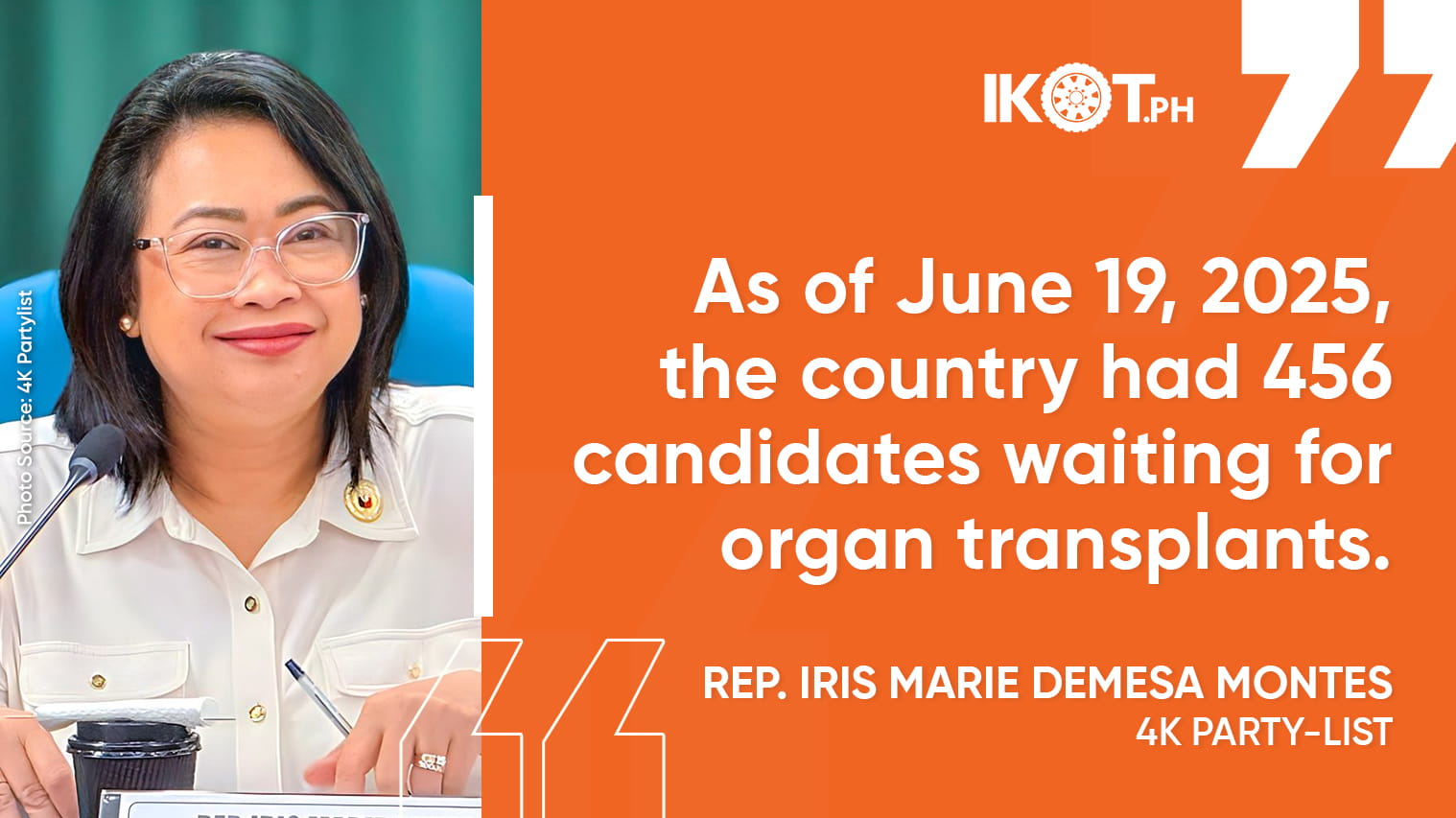
During the hearing, Montes cited reports showing that as of June 19, 2025, the country had 456 candidates waiting for organ transplants — 437 for kidney transplants, 15 for liver, and four for lungs.
“However, many of them might not survive the wait — not because the medicine does not exist or the procedure is unavailable, but because the organs they need never arrive. In fact, the gap between the number of patients in need of transplants and the number of organ donors is alarmingly wide. This is not just a matter of numbers; this is about the lives of our parents, children, siblings, and loved ones,” the lady legislator said.
The lawmaker explained that HB 7293 offers a promising solution by providing a comprehensive framework for an organ and tissue donation and transplantation program, would
1) encourage voluntary organ donation. It includes a national registry for individuals who wish to donate their organs,
2) ensure ethical standards as strict safeguards would be put in place to ensure organ donation would be carried out ethically and legally, protecting both donors and recipients,
3) ensure all organs are allocated according to established criteria with full traceability and audit trails,
4) require issuance of policies and guidelines to prevent organ trafficking,
5) provide support for donors, recognizing the financial and emotional toll on donors, and
6) offer protection in the form of support for donors.
Dr. Ma. Dominga “Minguita” Cecilia Padilla, representing both the Philippine Medical Association and the Eye Bank Foundation of the Philippines, welcomed the thrust of the proposed measures, particularly in addressing the lack of public education on organ donation.
“There is a great need for a sustained and effective information campaign on organ and tissue donation that must begin in schools.”
“There is a great need for a sustained and effective information campaign on organ and tissue donation that must begin in schools,” Padilla said.
She noted that while the anti-organ donation ads have been very effective, not much attention has been given to the nobility of organ donation.
“There must be a balance,” Padilla said, adding that the best way to curb organ trafficking, as shown by the experience of many countries, is to establish an effective non-living or deceased organ and tissue donation program.
“This will increase the donor pool and lessen the desperation that leads many to engage in illegal and unethical practices,” she concluded.