
To facilitate its deliberations, the House Committee on National Defense and Security formed a technical working group (TWG) to consolidate House Bills Nos. 1068, 3219, 4214, 4887, 4890, and 7200, all of which seek to regulate and penalize foreign interference in the country.
The proposed measures call for the establishment of institutional mechanisms to enhance national resilience and protect democratic processes and sovereignty from covert foreign influence.
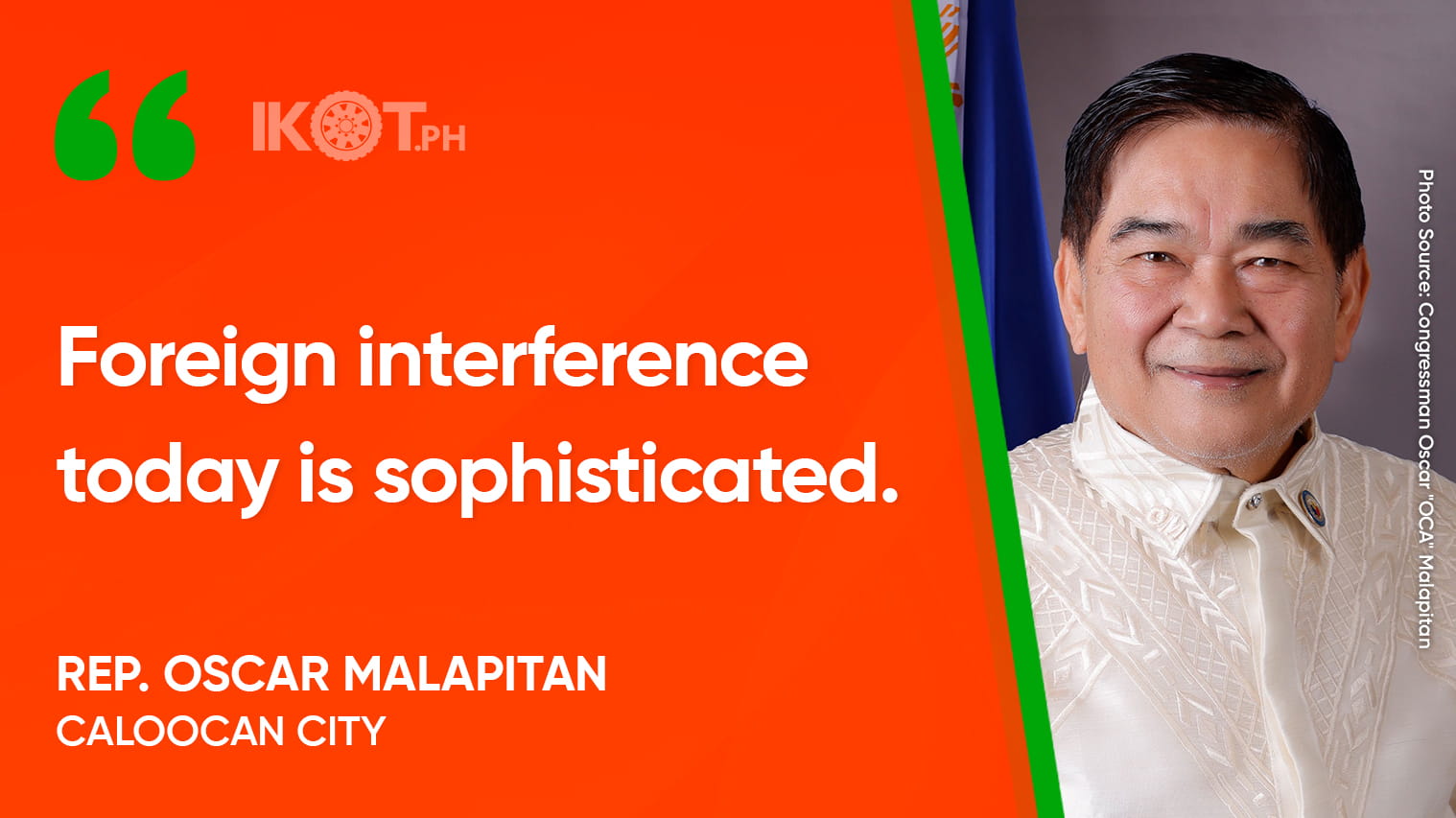
Committee Chairperson and Caloocan City Representative Oscar Malapitan said the panel has begun examining the issue of foreign interference amid concerns that existing laws are inadequate to address organized and technologically driven threats to democracy.
“It operates quietly through disinformation, digital platforms, financial channels, and influence networks.”
“Foreign interference today is sophisticated. It operates quietly through disinformation, digital platforms, financial channels, and influence networks,” Malapitan said.
Pangasinan Representative Maria Rachel Arenas said she filed House Bill No. 1068 to serve as a framework for protecting and building democratic resilience against modern forms of foreign interference that undermine public trust and institutional integrity.
“These can take the form of deception, manipulation, disinformation, economic leverage, and covert political influence that quietly erode public trust and institutional integrity,” Arenas said.
Foreign interference and malign influence (FIMI) pose a real and accelerating national security threat that operates below the threshold of armed attack, according to Armed Forces of the Philippines Chief Legal Affairs Division Colonel Lex Dapanas.
Dapanas noted that such threats target national decision-making, public perception, policy outcomes, and the country’s sovereignty, and are carried out through disinformation, covert influence networks, cyber-enabled operations, illicit finance, and proxy actors that often operate through everyday channels and digital spaces.
The proposed measures, he said, are crucial in setting clear definitions and thresholds, establishing a whole-of-government coordination mechanism, and creating an evidence pathway for case buildup.
“The battlespace is not only physical—it is also informational, cognitive, and financial.”
“I wish to underscore that this challenge cannot be met by the government alone. It requires a whole-of-society effort involving government, civil society, academia, the private sector, and international partners, because the battlespace is not only physical—it is also informational, cognitive, and financial,” Dapanas added.
Committee Vice Chairperson and 1TAHANAN Party-list Representative Nathaniel Oducado was tasked to head the TWG, which will also work on crafting a definition of FIMI tailored to the country’s specific context and circumstances.
University of the Philippines–Institute of Government and Law Reform Professor Neil Silva said there is no single definition of foreign interference, noting that international law addresses the concept broadly without providing a precise standard.
He cited the United Nations General Assembly’s Declaration on Friendly Relations, which refers to political, economic, and other forms of interference but leaves the concept open-ended.
Silva added that foreign interference extends beyond speech to covert political activities and evolving digital methods, including the use of bots to spread malinformation, disinformation, and misinformation, making it difficult to adopt a single, uniform definition.